Highlighter is on. Drag to highlight text. Click a highlight to remove it.
ALL / Neurology
Wernicke's encephalopathy
Wernicke's encephalopathy
Wernicke's encephalopathy is a neuropsychiatric disorder caused by thiamine deficiency which is most commonly seen in alcoholics. Rarer causes include persistent vomiting, aոοrеxiа nervosa, stomach cancer, and dietary deficiency. A classic triad of ophthalmoplegia/nystagmus, ataxia and encephalopathy may occur.In Wernicke's encephalopathy, petechial haemorrhages occur in a variety of structures in the brain including the mamillary bodies and ventricle walls.
Features
- oculomotor dysfunction
- nystagmus (the most common ocular sign)
- ophthalmoplegia: lateral rectus palsy, conjugate gaze palsy
- gait ataxia
- encephalopathy: confusion, disorientation, indifference, and inattentiveness
- peripheral sensory neuropathy
Investigations
- decreased red cell transketolase
- MRI
Treatment is with urgent replacement of thiamine
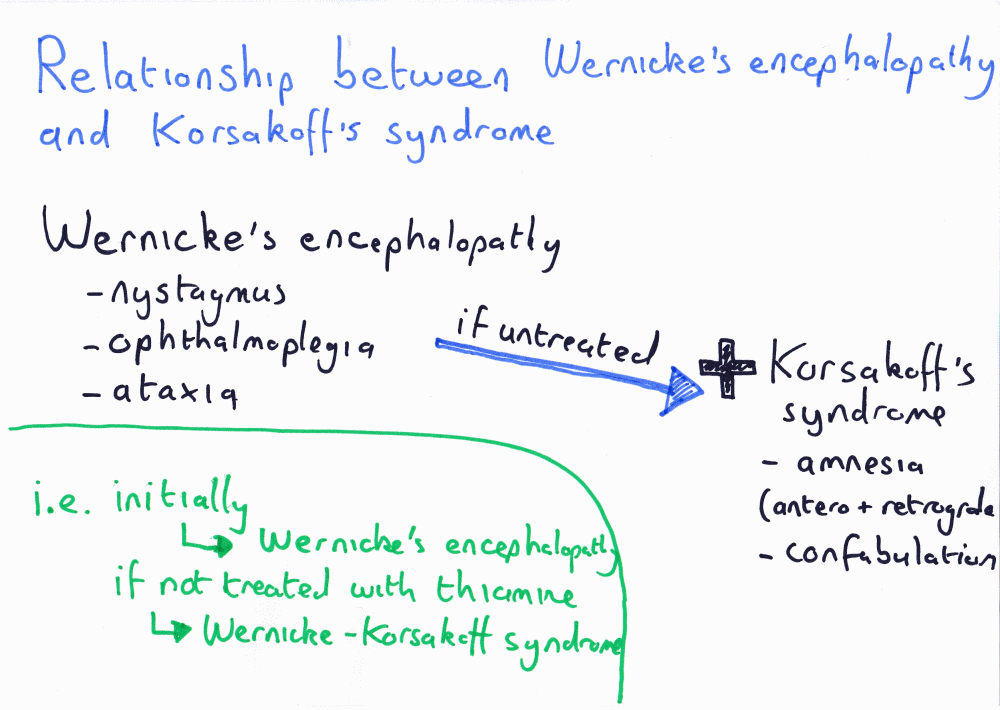
Relationship with Korsakoff syndrome
If not treated Korsakoff's syndrome may develop as well. This is termed Wernicke-Korsakoff syndrome and is characterised by the addition of antero- and retrograde amnesia and confabulation in addition to the above symptoms.
+PassMedicine Notes
Wernicke's encephalopathy is a neuropsychiatric disorder caused by thiamine deficiency which is most commonly seen in alcoholics. Rarer causes include persistent vomiting, aոοrеxiа nervosa, stomach cancer, and dietary deficiency. A classic triad of ophthalmoplegia/nystagmus, ataxia and encephalopathy may occur.
In Wernicke's encephalopathy, petechial haemorrhages occur in a variety of structures in the brain including the mamillary bodies and ventricle walls.
Features- oculomotor dysfunction
- nystagmus (the most common ocular sign)
- ophthalmoplegia: lateral rectus palsy, conjugate gaze palsy
- gait ataxia
- encephalopathy: confusion, disorientation, indifference, and inattentiveness
- peripheral sensory neuropathy
- decreased red cell transketolase
- MRI
Treatment is with urgent replacement of thiamine
Relationship with Korsakoff syndrome
If not treated Korsakoff's syndrome may develop as well. This is termed Wernicke-Korsakoff syndrome and is characterised by the addition of antero- and retrograde amnesia and confabulation in addition to the above symptoms.
pdd512.png