Highlighter is on. Drag to highlight text. Click a highlight to remove it.
ALL / Nephrology
Haemolytic uraemic syndrome
Haemolytic uraemic syndrome
Haemolytic uraemic syndrome is generally seen in young children and produces a triad of:- acute kidney injury
- microangiopathic haemolytic anaemia (MAHA)
- thrombocytopenia
Most cases are secondary (termed 'typical HUS'):
- classically Shiga toxin-producing Escherichia coli (STEC) 0157:H7
- 'verotoxigenic', 'enterohaemorrhagic'
- this is the most common cause in children, accounting for over 90% of cases
- pneumococcal infection
- HIV
- rare: systemic lupus erythematosus, drugs, cancer
Primary HUS ('atypical') is due to complement dysregulation.
Investigations
- a blood film is the most useful initial diagnostic test
- remember that in HUS there is a ΜΑНΑ (i.e. Coombs-negative haemolysis) resulting from intravascular red blood cell fragmentation → formation of ѕϲhiѕtοϲytеs
- anaemia: a haemoglobin level < than 8 g/dL
- thrombocytopenia
- U&E: acute kidney injury
- stool culture
- looking for evidence of STEC infection
- PCR for Shiga toxins
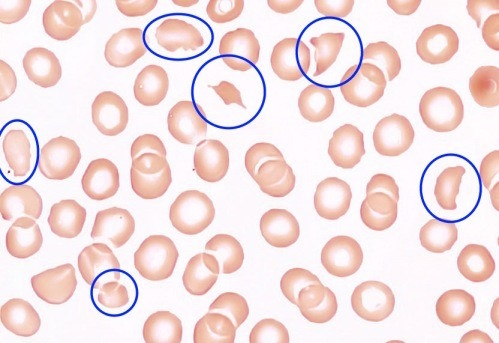
Blood film with schistocytes highlighted
Management
- treatment is supportive e.g. Fluids, blood transfusion and dialysis if required
- there is no role for antibiotics, despite the preceding diarrhoeal illness in many patients
- the indications for plasma exchange in HUS are complicated
- as a general rule plasma exchange is reserved for severe cases of HUS not associated with diarrhoea
- eculizumab (a C5 inhibitor monoclonal antibody) has evidence of greater efficiency than plasma exchange alone in the treatment of adult atypical HUS
+PassMedicine Notes
Haemolytic uraemic syndrome is generally seen in young children and produces a triad of:
- acute kidney injury
- microangiopathic haemolytic anaemia (MAHA)
- thrombocytopenia
- classically Shiga toxin-producing Escherichia coli (STEC) 0157:H7
- 'verotoxigenic', 'enterohaemorrhagic'
- this is the most common cause in children, accounting for over 90% of cases
- pneumococcal infection
- HIV
- rare: systemic lupus erythematosus, drugs, cancer
Primary HUS ('atypical') is due to complement dysregulation.
Investigations- a blood film is the most useful initial diagnostic test
- remember that in HUS there is a ΜΑНΑ (i.e. Coombs-negative haemolysis) resulting from intravascular red blood cell fragmentation --> formation of ѕϲhiѕtοϲytеs
- anaemia: a haemoglobin level < than 8 g/dL
- thrombocytopenia
- U&E: acute kidney injury
- stool culture
- looking for evidence of STEC infection
- PCR for Shiga toxins
- treatment is supportive e.g. Fluids, blood transfusion and dialysis if required
- there is no role for antibiotics, despite the preceding diarrhoeal illness in many patients
- the indications for plasma exchange in HUS are complicated
- as a general rule plasma exchange is reserved for severe cases of HUS not associated with diarrhoea
- eculizumab (a C5 inhibitor monoclonal antibody) has evidence of greater efficiency than plasma exchange alone in the treatment of adult atypical HUS