Highlighter is on. Drag to highlight text. Click a highlight to remove it.
ALL / Respiratory Medicine
Cystic fibrosis
Cystic fibrosis
Cystic fibrosis (CF) is a common autosomal recessive multisystem disorder in Caucasian populations, characterised by dehydrated secretions causing chronic lung disease, pancreatic insufficiency and raised sweat chloride.Pathophysiology
- caused by mutations in the CFTR gene on chromosome 7
- CFTR encodes an ATP-gated, cAMP-regulated epithelial Cl- channel
- the commonest mutation is Phe508del (delta F508)
- this causes misfolding of CFTR, retention in the rough endoplasmic reticulum and failure of trafficking to the cell surface
- in the airways and gastrointestinal tract there is reduced Cl- and water secretion
- increased epithelial Na+ absorption via ENaC further draws water from the lumen, producing thick, tenacious mucus
- in sweat glands, defective CFTR reduces Cl- reabsorption
- this leads to increased sweat chloride, the basis of diagnostic sweat testing
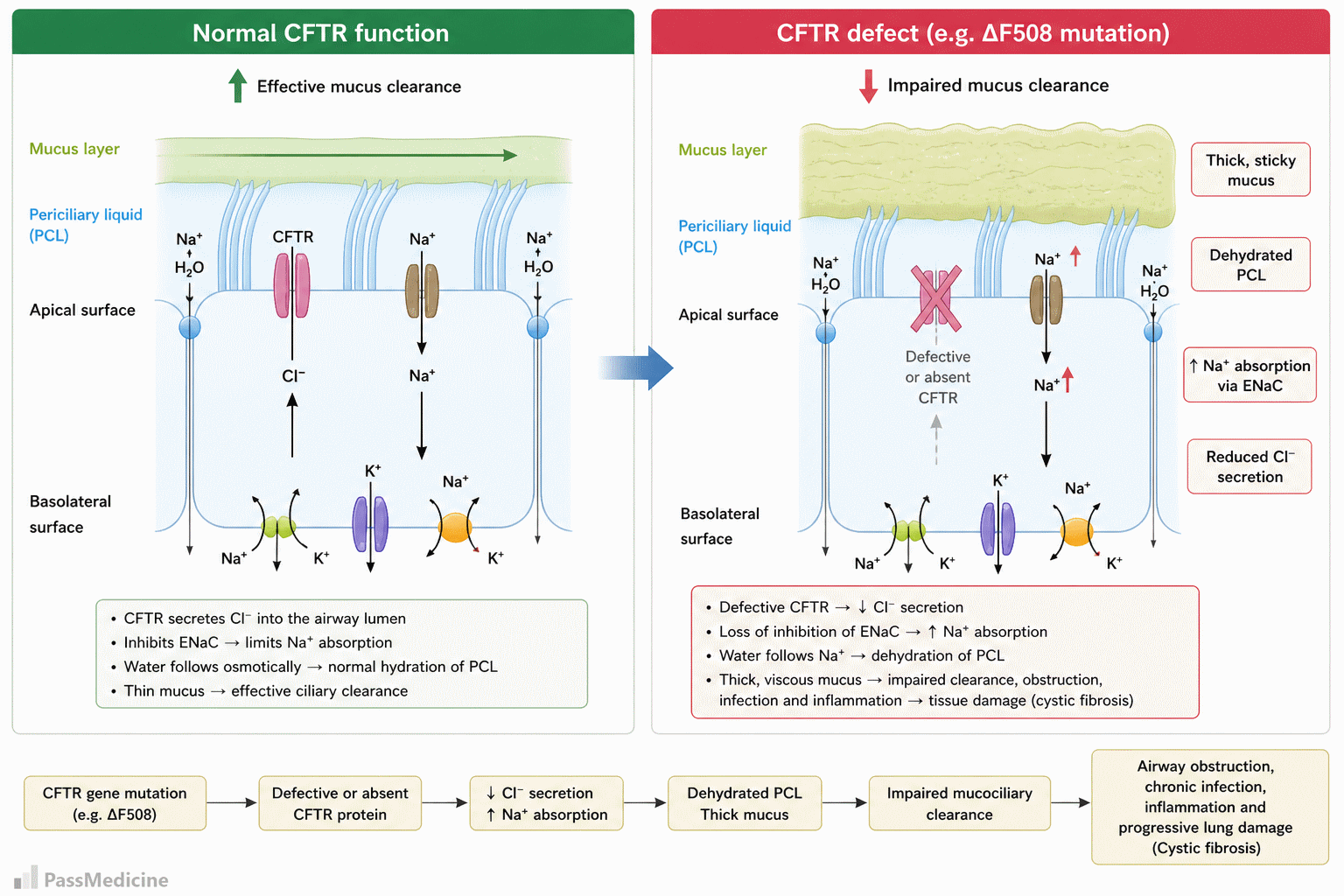
Pathophysiology of cystic fibrosis
In the UK 80% of CF cases are due to delta F508 on the long arm of chromosome 7. Cystic fibrosis affects 1 per 2500 births, and the carrier rate is c. 1 in 25
Organisms which may colonise CF patients
- Staphylococcus aureus
- Pseudomonas aeruginosa
- Burkholderia cepacia*
- Aspergillus
*previously known as Pseudomonas cepacia
+PassMedicine Notes
Cystic fibrosis (CF) is a common autosomal recessive multisystem disorder in Caucasian populations, characterised by dehydrated secretions causing chronic lung disease, pancreatic insufficiency and raised sweat chloride.
Pathophysiology- caused by mutations in the CFTR gene on chromosome 7
- CFTR encodes an ATP-gated, cAMP-regulated epithelial Cl- channel
- the commonest mutation is Phe508del (delta F508)
- this causes misfolding of CFTR, retention in the rough endoplasmic reticulum and failure of trafficking to the cell surface
- in the airways and gastrointestinal tract there is reduced Cl- and water secretion
- increased epithelial Na+ absorption via ENaC further draws water from the lumen, producing thick, tenacious mucus
- in sweat glands, defective CFTR reduces Cl- reabsorption
- this leads to increased sweat chloride, the basis of diagnostic sweat testing
In the UK 80% of CF cases are due to delta F508 on the long arm of chromosome 7. Cystic fibrosis affects 1 per 2500 births, and the carrier rate is c. 1 in 25
Organisms which may colonise CF patients- Staphylococcus aureus
- Pseudomonas aeruginosa
- Burkholderia cepacia*
- Aspergillus
*previously known as Pseudomonas cepacia