Highlighter is on. Drag to highlight text. Click a highlight to remove it.
ALL / Neurology
Myasthenia gravis
Myasthenia gravis
Myasthenia gravis is an autoimmune disorder characterised by impaired neuromuscular transmission due to antibodies targeting acetylcholine receptors at the neuromuscular junction. Anti-acetylcholine receptor antibodies are present in approximately 85–90% of cases*. It is more common in women (2:1).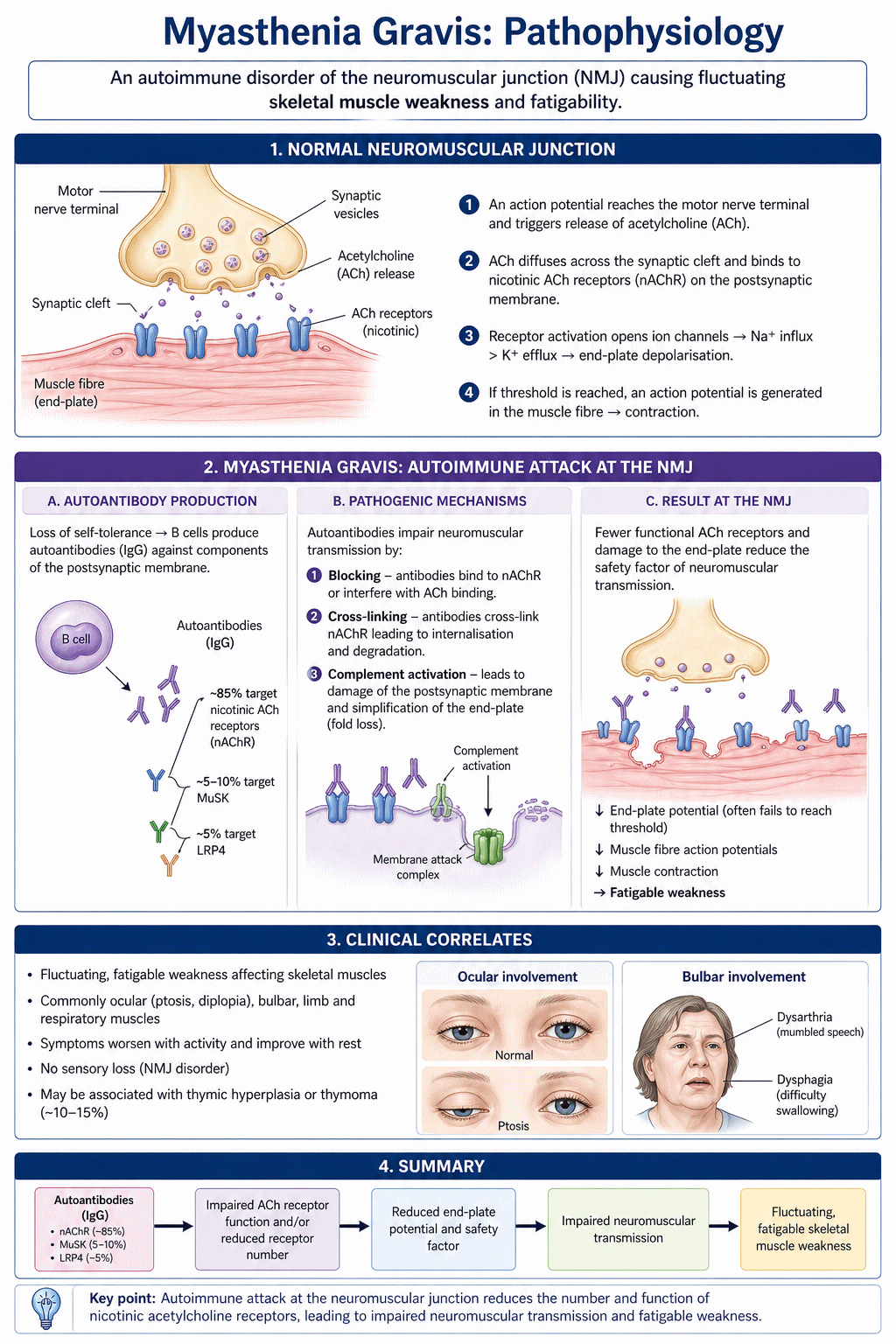
Pathophysiology of myasthenia gravis
The key feature is muscle fatigability - muscles become progressively weaker during periods of activity and slowly improve after periods of rest:
- extraocular muscle weakness: diplopia
- proximal muscle weakness: face, neck, limb girdle
- ptosis
- dysphagia
Associations
- thymomas in 15%
- autoimmune disorders: pernicious anaemia, autoimmune thyroid disorders, rheumatoid, SLE
- thymic hyperplasia in 50-70%
Investigations
- single fibre electromyography: high sensitivity (92-100%)
- CT thorax to exclude thymoma
- CK normal
- antibodies to acetylcholine receptors
- positive in around 85-90% of patients
- n the remaining patients, about about 40% are positive for anti-muscle-specific tyrosine kinase antibodies
- Tensilon test: IV edrophonium reduces muscle weakness temporarily - not commonly used any more due to the risk of cardiac arrhythmia
Management
- long-acting acetylcholinesterase inhibitors
- pyridostigmine is first-line
- immunosuppression is usually not started at diagnosis, but the majority of patients eventually require it in addition to long-acting acetylcholinesterase inhibitors:
- prednisolone initially
- azathioprine, cyclosporine, mycophenolate mofetil may also be used
- thymectomy
Management of myasthenic crisis
- plasmapheresis
- intravenous immunoglobulins
*antibodies are less commonly seen in disease limited to the ocular muscles
+PassMedicine Notes
Myasthenia gravis is an autoimmune disorder characterised by impaired neuromuscular transmission due to antibodies targeting acetylcholine receptors at the neuromuscular junction. Anti-acetylcholine receptor antibodies are present in approximately 85–90% of cases*. It is more common in women (2:1).
The key feature is muscle fatigability - muscles become progressively weaker during periods of activity and slowly improve after periods of rest:- extraocular muscle weakness: diplopia
- proximal muscle weakness: face, neck, limb girdle
- ptosis
- dysphagia
- thymomas in 15%
- autoimmune disorders: pernicious anaemia, autoimmune thyroid disorders, rheumatoid, SLE
- thymic hyperplasia in 50-70%
- single fibre electromyography: high sensitivity (92-100%)
- CT thorax to exclude thymoma
- CK normal
- antibodies to acetylcholine receptors
- positive in around 85-90% of patients
- n the remaining patients, about about 40% are positive for anti-muscle-specific tyrosine kinase antibodies
- Tensilon test: IV edrophonium reduces muscle weakness temporarily - not commonly used any more due to the risk of cardiac arrhythmia
- long-acting acetylcholinesterase inhibitors
- pyridostigmine is first-line
- immunosuppression is usually not started at diagnosis, but the majority of patients eventually require it in addition to long-acting acetylcholinesterase inhibitors:
- prednisolone initially
- azathioprine, cyclosporine, mycophenolate mofetil may also be used
- thymectomy
- plasmapheresis
- intravenous immunoglobulins
*antibodies are less commonly seen in disease limited to the ocular muscles