Barrett's oesophagus
Barrett's oesophagus
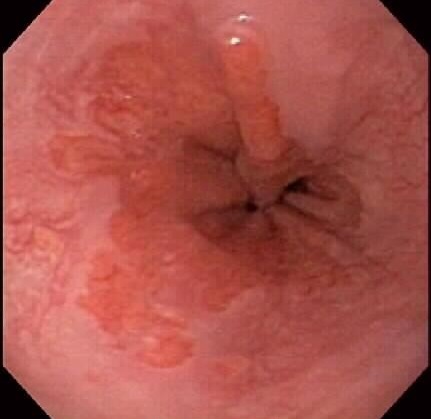
Barrett's refers to the metaplasia of the lower oesophageal mucosa, with the usual squamous epithelium being replaced by columnar epithelium. There is an increased risk of oesophageal adenocarcinoma, estimated at 50-100 fold. There are no screening programs for Barrett's - it's typically identified when patients have an endoscopy for evaluation of upper gastrointestinal symptoms such as dyspepsia.Barrett's can be subdivided into short (<3cm) and long (>3cm). The length of the affected segment correlates strongly with the chances of identifying metaplasia. The overall prevalence of Barrett's oesophagus is difficult to determine but may be in the region of 1 in 20 and is identified in up to 12% of those undergoing endoscopy for reflux.
Histological features
- the columnar epithelium may resemble that of either the cardiac region of the stomach or that of the small intestine (e.g. with goblet cells, brush border)
Risk factors
- gastro-oesophageal reflux disease (GORD) is the single strongest risk factor
- male gender (7:1 ratio)
- smoking
- central obesity
Interestingly alcohol does not seem to be an independent risk factor for Barrett's although it is associated with both GORD and oesophageal cancer.
Whilst Barrett's oesophagus itself is asymptomatic clearly patients will often have coexistent GORD symptoms.
Management
- high-dose proton pump inhibitor
- whilst this is commonly used in patients with Barrett's the evidence base that this reduces the change of progression to dysplasia or induces regression of the lesion is limited
- endoscopic surveillance with biopsies
- for patients with metaplasia (but not dysplasia) endoscopy is recommended every 3-5 years
- if dysplasia of any grade is identified endoscopic intervention is offered. Options include:
- radiofrequency ablation: preferred first-line treatment, particularly for low-grade dysplasia
- endoscopic mucosal resection
+PassMedicine Notes
Barrett's refers to the metaplasia of the lower oesophageal mucosa, with the usual squamous epithelium being replaced by columnar epithelium. There is an increased risk of oesophageal adenocarcinoma, estimated at 50-100 fold. There are no screening programs for Barrett's - it's typically identified when patients have an endoscopy for evaluation of upper gastrointestinal symptoms such as dyspepsia.
Barrett's can be subdivided into short (3cm). The length of the affected segment correlates strongly with the chances of identifying metaplasia. The overall prevalence of Barrett's oesophagus is difficult to determine but may be in the region of 1 in 20 and is identified in up to 12% of those undergoing endoscopy for reflux.
Histological features- the columnar epithelium may resemble that of either the cardiac region of the stomach or that of the small intestine (e.g. with goblet cells, brush border)
- gastro-oesophageal reflux disease (GORD) is the single strongest risk factor
- male gender (7:1 ratio)
- smoking
- central obesity
Interestingly alcohol does not seem to be an independent risk factor for Barrett's although it is associated with both GORD and oesophageal cancer.
Whilst Barrett's oesophagus itself is asymptomatic clearly patients will often have coexistent GORD symptoms.
Management- high-dose proton pump inhibitor
- whilst this is commonly used in patients with Barrett's the evidence base that this reduces the change of progression to dysplasia or induces regression of the lesion is limited
- endoscopic surveillance with biopsies
- for patients with metaplasia (but not dysplasia) endoscopy is recommended every 3-5 years
- if dysplasia of any grade is identified endoscopic intervention is offered. Options include:
- radiofrequency ablation: preferred first-line treatment, particularly for low-grade dysplasia
- endoscopic mucosal resection