Highlighter is on. Drag to highlight text. Click a highlight to remove it.
ALL / Haematology
Sideroblastic anaemia
Sideroblastic anaemia
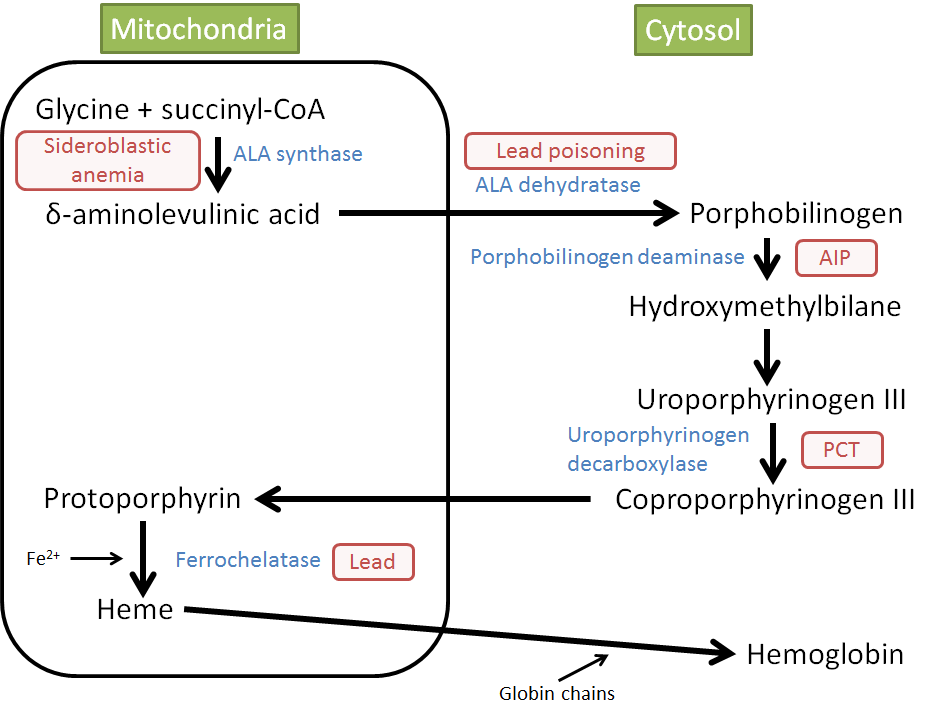
Sideroblastic anaemia is a condition where red cells fail to completely form haem, whose biosynthesis takes place partly in the mitochondrion. This leads to deposits of iron in the mitochondria that form a ring around the nucleus called a ring sideroblast. It may be congenital or acquired.Congenital cause: delta-aminolevulinate synthase-2 deficiency
Acquired causes
- myelodysplasia
- alcohol
- lead
- anti-TB medications
Investigations
- full blood count
- hypochromic microcytic anaemia (more so in congenital)
- iron studies
- high ferritin
- high iron
- high transferrin saturation
- blood film
- basophilic stippling of red blood cells
- bone marrow
- Prussian blue staining will show ringed sideroblasts
Management
- supportive
- treat any underlying cause
- pyridoxine may help
+PassMedicine Notes
Sideroblastic anaemia is a condition where red cells fail to completely form haem, whose biosynthesis takes place partly in the mitochondrion. This leads to deposits of iron in the mitochondria that form a ring around the nucleus called a ring sideroblast. It may be congenital or acquired.
Congenital cause: delta-aminolevulinate synthase-2 deficiency
Acquired causes- myelodysplasia
- alcohol
- lead
- anti-TB medications
- full blood count
- hypochromic microcytic anaemia (more so in congenital)
- iron studies
- high ferritin
- high iron
- high transferrin saturation
- blood film
- basophilic stippling of red blood cells
- bone marrow
- Prussian blue staining will show ringed sideroblasts
- supportive
- treat any underlying cause
- pyridoxine may help
pdd510.png#