Cellulitis
Cellulitis
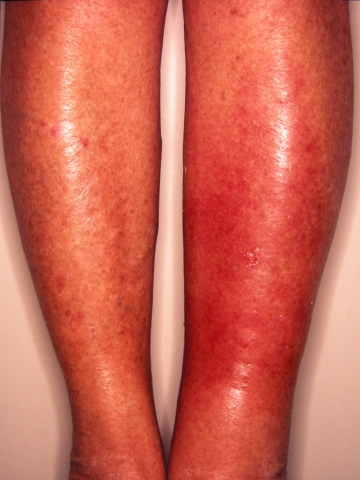
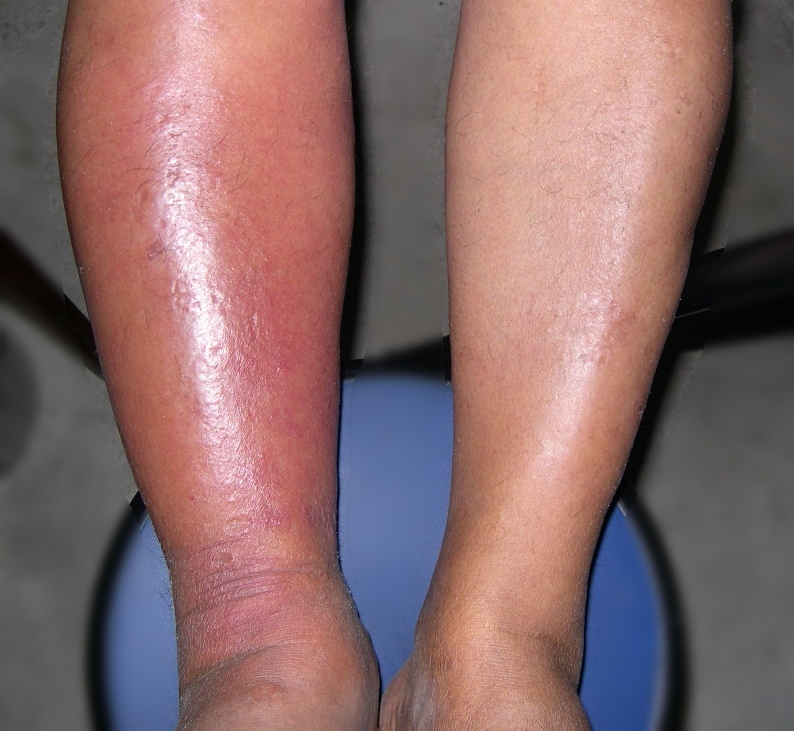
Cellulitis is a bacterial infection that affects the dermis and the deeper subcutaneous tissues. It is one of the most common conditions seen in the acute medical setting and is usually diagnosed clinically. Cellulitis is most commonly caused by infection with Streptococcus pyogenes or less commonly Staphylcoccus aureus. The majority of cases resolve with oral antibiotics.Features
- commonly occurs on the shins
- usually unilateral - bilateral cellulitis is rare and suggests an alterative diagnosis
- erythema
- generally reasonably well-defined margins but some cases may present with diffuse erythema
- blisters and bullae may be seen with more severe disease
- swelling
- systemic upset
- fever
- malaise
- nausea
The diagnosis of cellulitis is clinical. No further investigations are required in primary care. Bloods and blood cultures may be requested if the patient is admitted and septicaemia is suspected.
Criteria for admission
The Eron classification system can be used to guide how we manage patients with cellulitis: #link1
| Class | Features |
|---|---|
| I | There are no signs of systemic toxicity and the person has no uncontrolled co-morbidities |
| II | The person is either systemically unwell or systemically well but with a co-morbidity (for example peripheral arterial disease, chronic venous insufficiency, or morbid obesity) which may complicate or delay resolution of infection |
| III | The person has significant systemic upset such as acute confusion, tachycardia, tachypnoea, hypotension, or unstable co-morbidities that may interfere with a response to treatment, or a limb-threatening infection due to vascular compromize |
| IV | The person has sepsis syndrome or a severe life-threatening infection such as necrotizing fasciitis |
They recommend the following that we admit for intravenous antibiotics the following patients: #link2
- Has Eron Class III or Class IV cellulitis.
- Has severe or rapidly deteriorating cellulitis (for example extensive areas of skin).
- Is very young (under 1 year of age) or frail.
- Is immunocompromized.
- Has significant lymphoedema.
- Has facial cellulitis (unless very mild) or periorbital cellulitis.
The following is recommended regarding Eron Class II cellulitis:
Admission may not be necessary if the facilities and expertise are available in the community to give intravenous antibiotics and monitor the person - check local guidelines.
Other patients can be treated with oral antibiotics.
Management
Management is guided by the Eron classification.
Eron Class I
- oral antibiotics NICE
- oral flucloxacillin as first-line treatment for mild/moderate cellulitis
- oral clarithromycin, erythromycin (in pregnancy) or doxycycline is recommended in patients allergic to penicillin
Eron Class II
- NICE recommend: 'Admission may not be necessary if the facilities and expertise are available in the community to give intravenous antibiotics and monitor the person - check local guidelines.'
Eron Class III-IV
- admit
- NICE recommend: oral/IV co-amoxiclav, oral/IV clindamycin, IV cefuroxime or IV ceftriaxone
+PassMedicine Notes
Cellulitis is a bacterial infection that affects the dermis and the deeper subcutaneous tissues. It is one of the most common conditions seen in the acute medical setting and is usually diagnosed clinically. Cellulitis is most commonly caused by infection with Streptococcus pyogenes or less commonly Staphylcoccus aureus. The majority of cases resolve with oral antibiotics.
Features- commonly occurs on the shins
- usually unilateral - bilateral cellulitis is rare and suggests an alterative diagnosis
- erythema
- generally reasonably well-defined margins but some cases may present with diffuse erythema
- blisters and bullae may be seen with more severe disease
- swelling
- systemic upset
- fever
- malaise
- nausea
The diagnosis of cellulitis is clinical. No further investigations are required in primary care. Bloods and blood cultures may be requested if the patient is admitted and septicaemia is suspected.
Criteria for admission
The Eron classification system can be used to guide how we manage patients with cellulitis: #link1
Class _ Features| I _ There are no signs of systemic toxicity and the person has no uncontrolled co-morbidities| II _The person is either systemically unwell or systemically well but with a co-morbidity (for example peripheral arterial disease, chronic venous insufficiency, or morbid obesity) which may complicate or delay resolution of infection| III _ The person has significant systemic upset such as acute confusion, tachycardia, tachypnoea, hypotension, or unstable co-morbidities that may interfere with a response to treatment, or a limb-threatening infection due to vascular compromize| IV _ The person has sepsis syndrome or a severe life-threatening infection such as necrotizing fasciitis| They recommend the following that we admit for intravenous antibiotics the following patients: #link2- Has Eron Class III or Class IV cellulitis.
- Has severe or rapidly deteriorating cellulitis (for example extensive areas of skin).
- Is very young (under 1 year of age) or frail.
- Is immunocompromized.
- Has significant lymphoedema.
- Has facial cellulitis (unless very mild) or periorbital cellulitis.
The following is recommended regarding Eron Class II cellulitis:
Admission may not be necessary if the facilities and expertise are available in the community to give intravenous antibiotics and monitor the person - check local guidelines.
Other patients can be treated with oral antibiotics.
Management
Management is guided by the Eron classification.
Eron Class I- oral antibiotics NICE
- oral flucloxacillin as first-line treatment for mild/moderate cellulitis
- oral clarithromycin, erythromycin (in pregnancy) or doxycycline is recommended in patients allergic to penicillin
- NICE recommend: 'Admission may not be necessary if the facilities and expertise are available in the community to give intravenous antibiotics and monitor the person - check local guidelines.'
- admit
- NICE recommend: oral/IV co-amoxiclav, oral/IV clindamycin, IV cefuroxime or IV ceftriaxone