Highlighter is on. Drag to highlight text. Click a highlight to remove it.
ALL / Clinical Sciences
Cell division
Cell division
There are two types of cell division; mitosis and meiosis.The table below demonstrates the key differences:
| Mitosis | Meiosis |
|---|---|
| Occurs in somatic cells | Occurs in gametes |
| Results in 2 diploid daughter cells | Results in 4 haploid daughter cells |
| Daughter cells are genetically identical to parent cell | Daughter cells contain one homologue of each chromosome pair and are therefore genetically different |
Remember:
- somatic cells have 22 pairs of autosomes and 1 pair of sex chromosomes, i.e. 46XY or 46XX
- cells with a normal chromosome complement are known as diploid cells
- gametes (ova or spermatozoa) have a single copy of each chromosome and are known as haploid cells
Mitosis
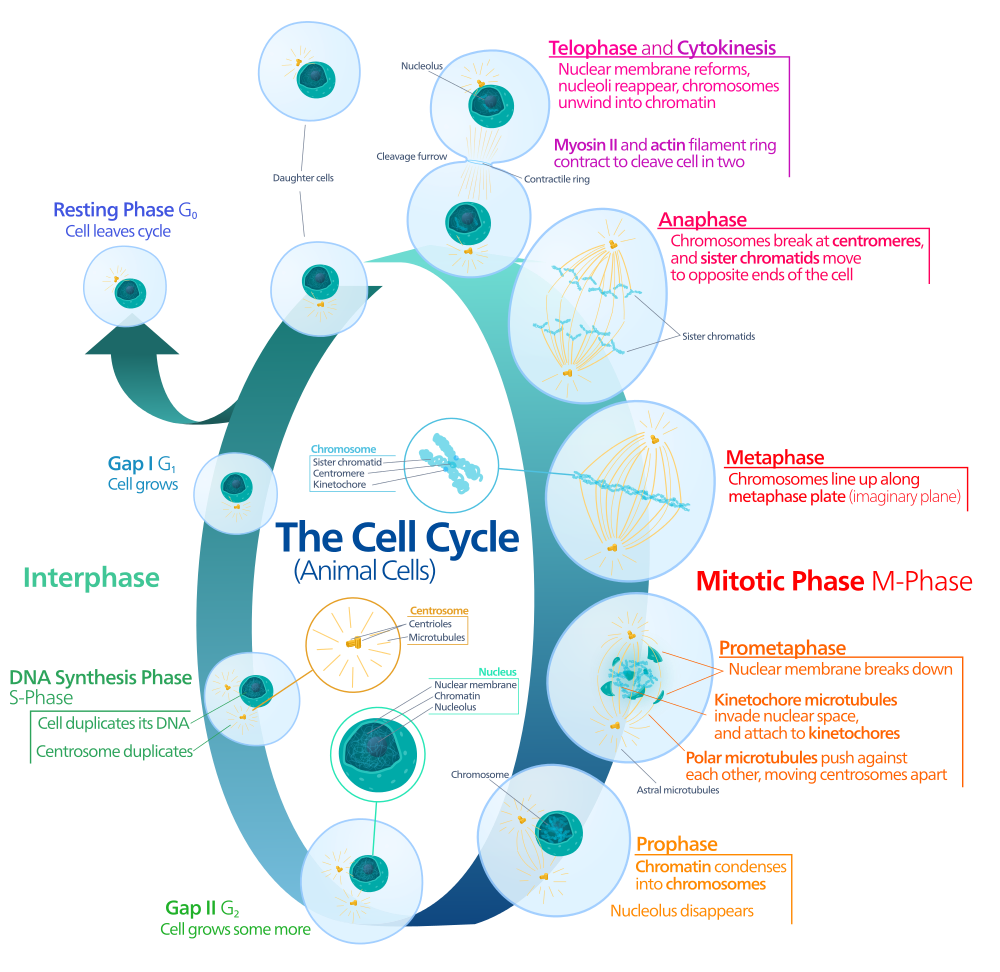
Mitosis occurs during the M phase of the cell cycle. It describes the process in which somatic cells divide and replicate producing genetically identical diploid daughter cells. This allows tissue to grow and renew itself.
During the S phase of the cell cycle the cell prepares itself for division by duplicating the chromosomes. The table below shows the phases of mitosis itself:
| Prophase | Chromatin in the nucleus condenses |
|---|---|
| Prometaphase | Nuclear membrane breaks down allowing the microtubules to attach to the chromosomes |
| Metaphase | Chromosomes aligned at middle of cell |
| Anaphase | The paired chromosomes separate at the kinetochores and move to opposite sides of the cell |
| Telophase | Chromatids arrive at opposite poles of cell |
| Cytokinesis | Actin-myosin complex in the centre of the cell contacts resulting in it being 'pinched' into two daughter cells |
+PassMedicine Notes
There are two types of cell division; mitosis and meiosis.
The table below demonstrates the key differences:
Mitosis _ Meiosis| Occurs in somatic cells _ Occurs in gametes| Results in 2 diploid daughter cells _ Results in 4 haploid daughter cells| Daughter cells are genetically identical to parent cell _ Daughter cells contain one homologue of each chromosome pair and are therefore genetically different| Remember:- somatic cells have 22 pairs of autosomes and 1 pair of sex chromosomes, i.e. 46XY or 46XX
- cells with a normal chromosome complement are known as diploid cells
- gametes (ova or spermatozoa) have a single copy of each chromosome and are known as haploid cells
Mitosis
Mitosis occurs during the M phase of the cell cycle. It describes the process in which somatic cells divide and replicate producing genetically identical diploid daughter cells. This allows tissue to grow and renew itself.
During the S phase of the cell cycle the cell prepares itself for division by duplicating the chromosomes. The table below shows the phases of mitosis itself:
Prophase _ Chromatin in the nucleus condenses| Prometaphase _ Nuclear membrane breaks down allowing the microtubules to attach to the chromosomes| Metaphase _ Chromosomes aligned at middle of cell| Anaphase _ The paired chromosomes separate at the kinetochores and move to opposite sides of the cell| Telophase _ Chromatids arrive at opposite poles of cell| Cytokinesis _ Actin-myosin complex in the centre of the cell contacts resulting in it being 'pinched' into two daughter cells |swb013.png#