Paracetamol overdose: management
Paracetamol overdose: management
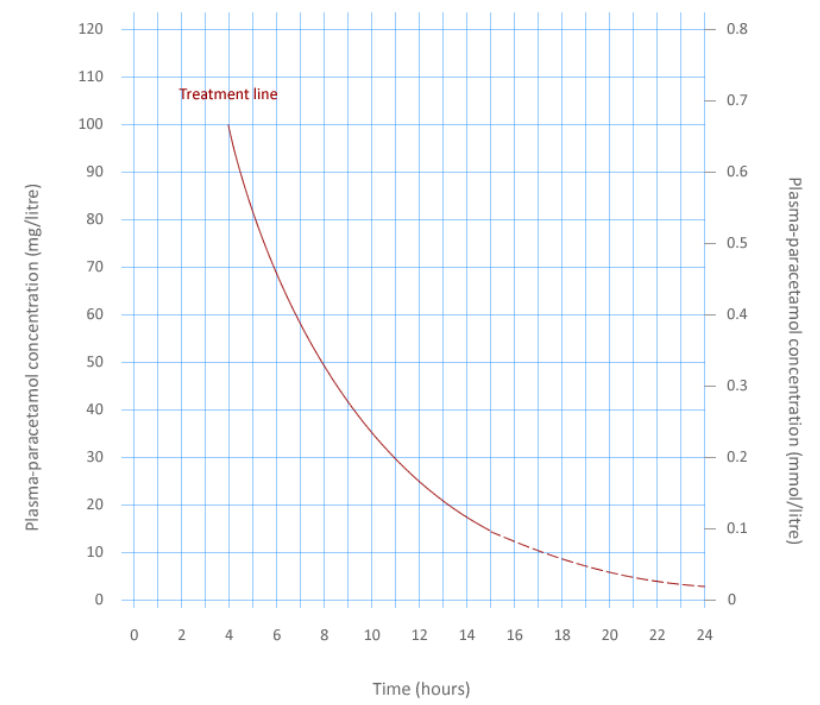
The following is based on the National Poisons Information Service(NPIS)/TOXBASE database of paracetamol overdose management. The big change in these guidelines was the removal of the 'high-risk' treatment line on the normogram. All patients are therefore treated the same regardless of risk factors for hepatotoxicity.The NPIS/TOXBASE should always be consulted for situations outside of the normal parameters.
- this includes overdoses from IV paracetamol, where advice from NPIS should always be sought
The minority of patients who present within 1 hour may benefit from activated charcoal to reduce absorption of the drug.
Acetylcysteine should be given if:
- the plasma paracetamol concentration is on or above a single treatment line joining points of 100 mg/L at 4 hours, 15 mg/L at 15 hours and 3.13 mg/L at 24 hours, regardless of risk factors of hepatotoxicity
- there is a staggered overdose or there is doubt over the time of paracetamol ingestion
- an overdose is considered staggered if all the tablets were not taken within 1 hour
- acetylcysteine can later be discontinued if, after at least 4 hours since last ingestion, the patient is asymptomatic, paracetamol is < 10 mg/L, ALT normal, and INR ≤ 1.3
- patients presenting 8–24 hours after an acute overdose if:
- dose is >150 mg/kg, or
- the amount ingested is unknown, or
- the patient is symptomatic with jaundice or hepatic tenderness
- patients who present > 24 hours if they are clearly jaundiced or have hepatic tenderness, their ALT is above the upper limit of normal
- acetylcysteine should be continued if the paracetamol concentration or ALT remains elevated whilst seeking specialist advice
Acetylcysteine is now infused over 1 hour (rather than the previous 15 minutes) to reduce the number of adverse effects. Acetylcysteine commonly causes an anaphylactoid reaction (non-IgE mediated mast cell release). Anaphylactoid reactions to IV acetylcysteine are generally treated by stopping the infusion, then restarting at a slower rate.
King's College Hospital criteria for liver transplantation (paracetamol liver failure)
Arterial pH < 7.3, 24 hours after ingestion
or all of the following:
- prothrombin time > 100 seconds
- creatinine > 300 µmol/l
- grade III or IV encephalopathy
+PassMedicine Notes
The following is based on the National Poisons Information Service(NPIS)/TOXBASE database of paracetamol overdose management. The big change in these guidelines was the removal of the 'high-risk' treatment line on the normogram. All patients are therefore treated the same regardless of risk factors for hepatotoxicity.
The NPIS/TOXBASE should always be consulted for situations outside of the normal parameters.- this includes overdoses from IV paracetamol, where advice from NPIS should always be sought
The minority of patients who present within 1 hour may benefit from activated charcoal to reduce absorption of the drug.
Acetylcysteine should be given if:- the plasma paracetamol concentration is on or above a single treatment line joining points of 100 mg/L at 4 hours, 15 mg/L at 15 hours and 3.13 mg/L at 24 hours, regardless of risk factors of hepatotoxicity
- there is a staggered overdose or there is doubt over the time of paracetamol ingestion
- an overdose is considered staggered if all the tablets were not taken within 1 hour
- acetylcysteine can later be discontinued if, after at least 4 hours since last ingestion, the patient is asymptomatic, paracetamol is < 10 mg/L, ALT normal, and INR ≤ 1.3
- patients presenting 8–24 hours after an acute overdose if:
- dose is >150 mg/kg, or
- the amount ingested is unknown, or
- the patient is symptomatic with jaundice or hepatic tenderness
- patients who present > 24 hours if they are clearly jaundiced or have hepatic tenderness, their ALT is above the upper limit of normal
- acetylcysteine should be continued if the paracetamol concentration or ALT remains elevated whilst seeking specialist advice
Acetylcysteine is now infused over 1 hour (rather than the previous 15 minutes) to reduce the number of adverse effects. Acetylcysteine commonly causes an anaphylactoid reaction (non-IgE mediated mast cell release). Anaphylactoid reactions to IV acetylcysteine are generally treated by stopping the infusion, then restarting at a slower rate.
pdd021.png#
King's College Hospital criteria for liver transplantation (paracetamol liver failure)
Arterial pH < 7.3, 24 hours after ingestion
or all of the following:- prothrombin time > 100 seconds
- creatinine > 300 µmol/l
- grade III or IV encephalopathy|
Saved ✓MEDIA