Highlighter is on. Drag to highlight text. Click a highlight to remove it.
ALL / Clinical Sciences
Polymerase chain reaction
Polymerase chain reaction
Polymerase chain reaction (PCR) is a molecular genetic investigation technique. The main advantage of PCR is its sensitivity: only one strand of sample DNA is needed to detect a particular DNA sequence. It now has many uses including prenatal diagnosis, detection of mutated oncogenes and diagnosis of infections. PCR is also extensively used in forensics. Prior to the procedure, it is necessary to have two DNA oligonucleotide primers. These are complementary to specific DNA sequences at either end of the target DNAInitial prep
- sample of DNA is added to the test tube along with two DNA primers
- a thermostable DNA polymerase (Taq) is added
The following cycle then takes place
- mixture is heated to almost boiling point causing denaturing (uncoiling) of DNA
- mixture is then allowed to cool: complimentary strands of DNA pair up, as there is an excess of the primer sequences they pair with DNA preferentially
The above cycle is then repeated, with the amount of DNA doubling each time
Reverse transcriptase PCR
- used to amplify RNA
- RNA is converted to DNA by reverse transcriptase
- gene expression in the form of mRNA (rather than the actually DNA sequence) can therefore be analyzed
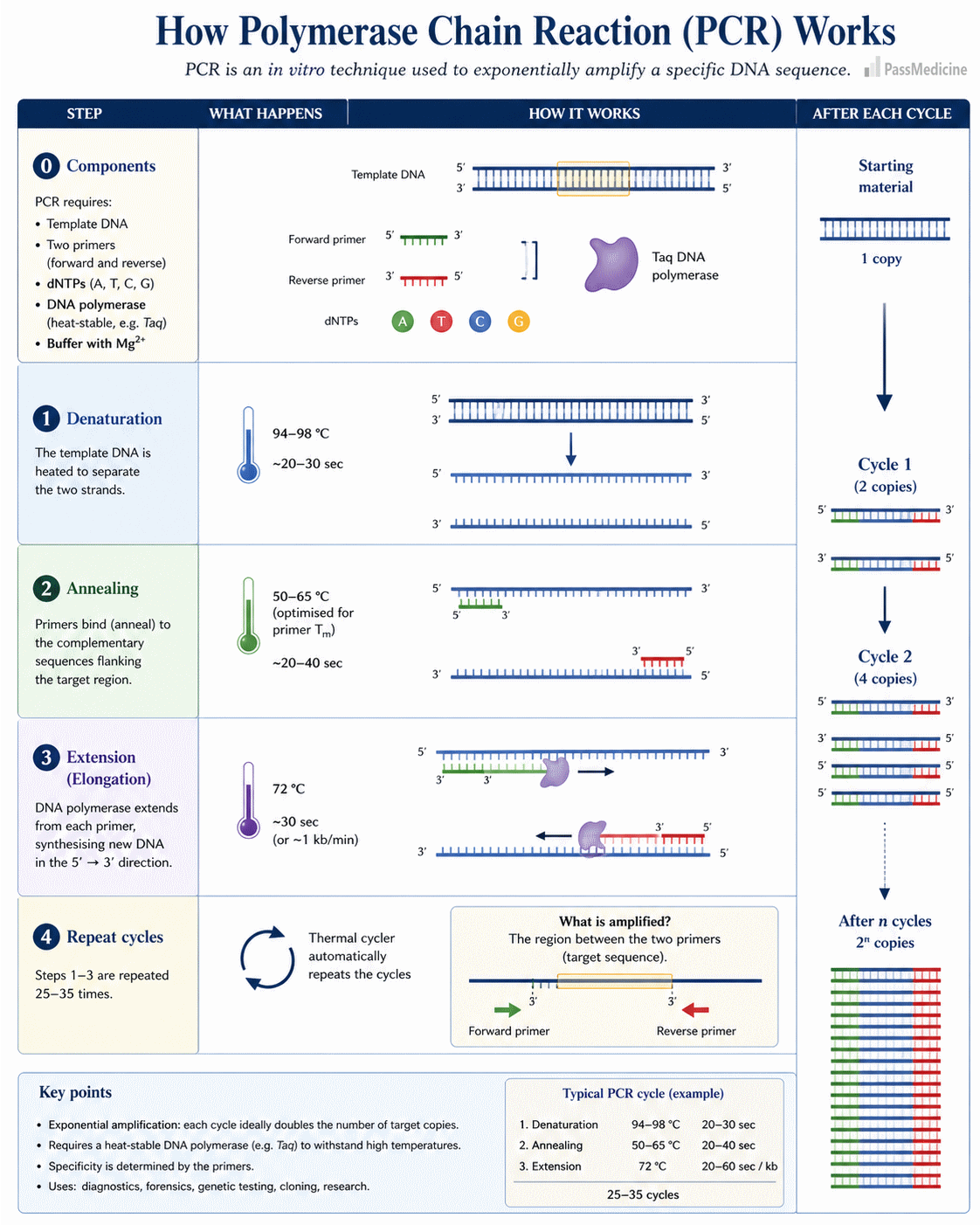
Steps in PCR
+PassMedicine Notes
Polymerase chain reaction (PCR) is a molecular genetic investigation technique. The main advantage of PCR is its sensitivity: only one strand of sample DNA is needed to detect a particular DNA sequence. It now has many uses including prenatal diagnosis, detection of mutated oncogenes and diagnosis of infections. PCR is also extensively used in forensics. Prior to the procedure, it is necessary to have two DNA oligonucleotide primers. These are complementary to specific DNA sequences at either end of the target DNA
Initial prep- sample of DNA is added to the test tube along with two DNA primers
- a thermostable DNA polymerase (Taq) is added
- mixture is heated to almost boiling point causing denaturing (uncoiling) of DNA
- mixture is then allowed to cool: complimentary strands of DNA pair up, as there is an excess of the primer sequences they pair with DNA preferentially
The above cycle is then repeated, with the amount of DNA doubling each time
Reverse transcriptase PCR- used to amplify RNA
- RNA is converted to DNA by reverse transcriptase
- gene expression in the form of mRNA (rather than the actually DNA sequence) can therefore be analyzed