Highlighter is on. Drag to highlight text. Click a highlight to remove it.
ALL / Clinical Sciences
Vitamin B6 (pyridoxine)
Vitamin B6 (pyridoxine)
Vitamin B6 is a water-soluble B vitamin. Its active form, pyridoxal phosphate (PLP), is an important cofactor in amino acid, haem and neurotransmitter metabolism, explaining the neurological and haematological features of deficiency.Pathophysiology / biochemical role
- pyridoxine is converted to pyridoxal phosphate (PLP)
- PLP is required for multiple enzyme reactions including:
- transamination and deamination (e.g. ALT and AST)
- decarboxylation reactions
- glycogen phosphorylase activity
- synthesis of cystathionine, haem, niacin, histamine and neurotransmitters
- neurotransmitters affected include serotonin, dopamine, noradrenaline, adrenaline and GABA
Causes of deficiency
- isoniazid therapy
- pyridoxine should be co-prescribed with isoniazid to reduce the risk of peripheral neuropathy
- oral contraceptive use may contribute
Features of deficiency
- peripheral neuropathy
- sideroblastic anaemia
- due to impaired haemoglobin synthesis with iron accumulation in erythroblasts
- convulsions / seizures
- related to reduced GABA synthesis
- hyperirritability
Exam points
- vitamin B6 deficiency is a classic adverse effect of isoniazid
- pyridoxine supplementation prevents isoniazid-induced neuropathy
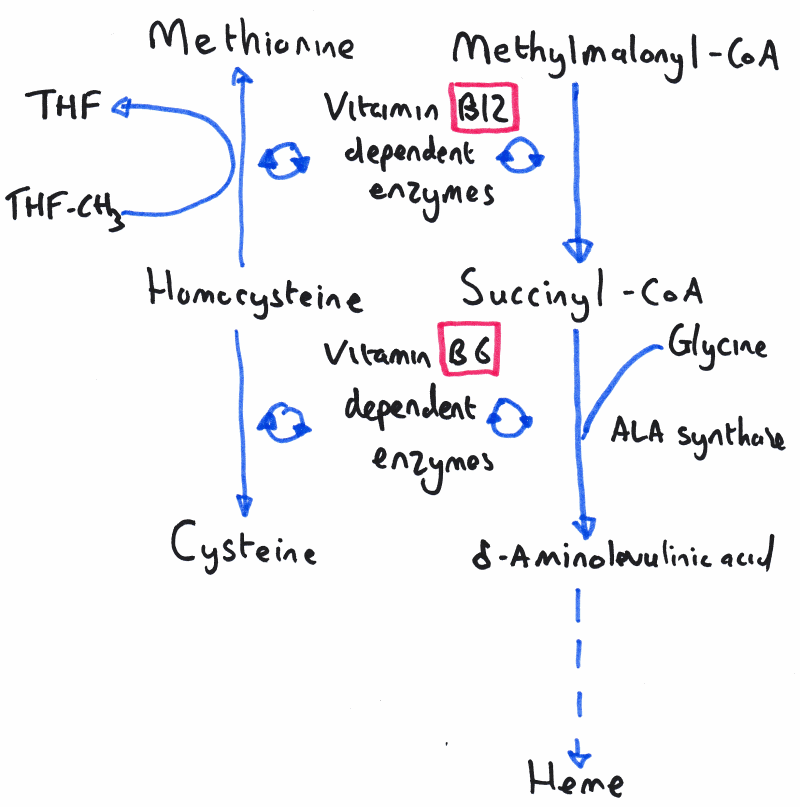
Diagram showing the biochemical role of vitamin B12 and vitamin B6
+PassMedicine Notes
Vitamin B6 is a water-soluble B vitamin. Its active form, pyridoxal phosphate (PLP), is an important cofactor in amino acid, haem and neurotransmitter metabolism, explaining the neurological and haematological features of deficiency.
Pathophysiology / biochemical role- pyridoxine is converted to pyridoxal phosphate (PLP)
- PLP is required for multiple enzyme reactions including:
- transamination and deamination (e.g. ALT and AST)
- decarboxylation reactions
- glycogen phosphorylase activity
- synthesis of cystathionine, haem, niacin, histamine and neurotransmitters
- neurotransmitters affected include serotonin, dopamine, noradrenaline, adrenaline and GABA
- isoniazid therapy
- pyridoxine should be co-prescribed with isoniazid to reduce the risk of peripheral neuropathy
- oral contraceptive use may contribute
- peripheral neuropathy
- sideroblastic anaemia
- due to impaired haemoglobin synthesis with iron accumulation in erythroblasts
- convulsions / seizures
- related to reduced GABA synthesis
- hyperirritability
- vitamin B6 deficiency is a classic adverse effect of isoniazid
- pyridoxine supplementation prevents isoniazid-induced neuropathy