Hyperlipidaemia: management
Hyperlipidaemia: management
In 2014 NICE updated their guidelines on lipid modification. This proved highly controversial as it meant that we should be recommending statins to a significant proportion of the population over the age of 60 years. Subsequent updates (most recently NG238, 2023) have refined risk assessment and expanded lipid-lowering options beyond statins. The key current principles relevant to UK trainee doctors are summarised below.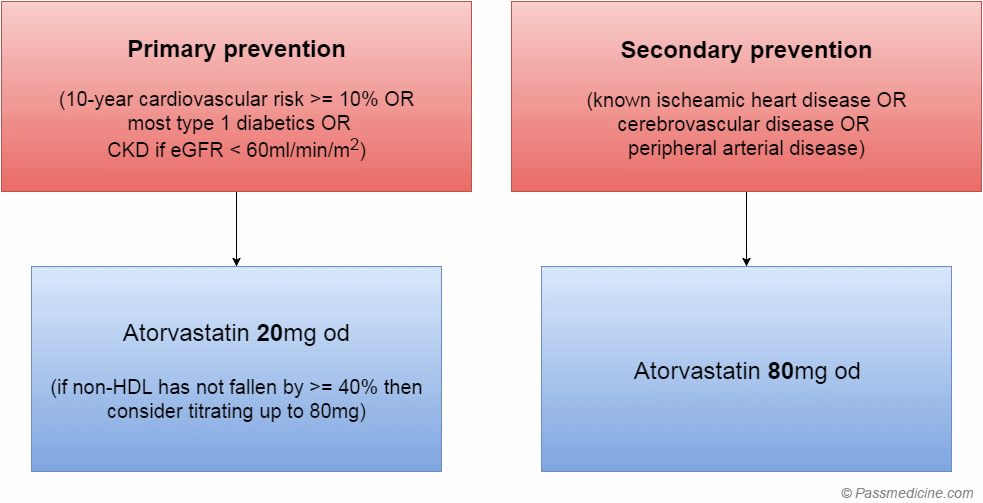
Primary prevention – who and how to assess risk
A systematic strategy should be used to identify people aged over 40 years who are likely to be at high risk of cardiovascular disease (CVD), defined as a 10-year risk of 10% or greater.
NICE recommend we use the QRISK3 CVD risk assessment tool for patients aged 25–84 years. Patients aged ≥85 years are considered to be at high risk of CVD because of age alone.
QRISK3 should not be used in the following situations, as there are more specific disease-based recommendations:
- type 1 diabetes mellitus
- chronic kidney disease with eGFR <60 ml/min/1.73 m² and/or significant albuminuria
- people with known familial hypercholesterolaemia
- people with established CVD (secondary prevention)
QRISK3 includes additional variables compared with QRISK2 (e.g. severe mental illness, migraine, corticosteroid use, SLE, erectile dysfunction) and provides more accurate risk estimation in modern UK populations.
NICE highlight that QRISK3 may still underestimate CVD risk in:
- people treated for HIV
- people with serious mental illness
- people taking medicines that cause dyslipidaemia (e.g. antipsychotics, long-term corticosteroids, immunosuppressants)
- people with chronic inflammatory or autoimmune disorders (e.g. rheumatoid arthritis, SLE)
Measuring lipid levels
When measuring lipids, both total cholesterol and HDL cholesterol should be checked to calculate non-HDL cholesterol and estimate CVD risk accurately. A full lipid profile (including triglycerides) should be performed before starting lipid-lowering therapy. Fasting samples are not routinely required.
If cholesterol levels are very high, consider familial hypercholesterolaemia. NICE recommend considering FH and arranging further assessment if:
- total cholesterol is >7.5 mmol/L, and/or
- there is a personal or family history of premature coronary heart disease (event before 60 years in a first-degree relative)
Interpreting the QRISK3 result
The key threshold remains a 10-year CVD risk of ≥10%.
NICE recommend offering a statin for primary prevention if QRISK3 ≥10%
Shared decision-making is essential. Lifestyle modification should be discussed, and patients may choose to delay statin therapy and reassess risk after a period of lifestyle change.
Atorvastatin 20 mg should be offered first-line for primary prevention.
Special situations
Type 1 diabetes mellitus
- NICE recommend considering statin treatment for the primary prevention of CVD in all adults with type 1 diabetes
- atorvastatin 20 mg should be offered if the person is:
- aged >40 years, or
- has had diabetes for >10 years, or
- has established nephropathy, or
- has other CVD risk factors
Chronic kidney disease (CKD)
- atorvastatin 20 mg should be offered for primary prevention in CKD
- increase the dose if a >40% reduction in non-HDL cholesterol is not achieved and eGFR >30 ml/min/1.73 m²
- if eGFR <30 ml/min/1.73 m², seek specialist advice before dose escalation
Secondary prevention
All patients with established CVD should receive high-intensity lipid-lowering therapy unless contraindicated.
Atorvastatin 80 mg should be offered first-line.
Non-statin and newer lipid-lowering therapies
If patients do not achieve adequate lipid reduction (≥40% fall in non-HDL cholesterol) on maximally tolerated statin therapy, or are truly statin-intolerant:
Ezetimibe
- should be added to statin therapy, or used alone if statins are contraindicated or not tolerated
PCSK9 inhibitors (evolocumab, alirocumab)
- considered in secondary prevention or very high-risk primary prevention (e.g. familial hypercholesterolaemia)
- initiated in specialist care
- used when LDL-C remains above NICE thresholds despite maximal tolerated statin ± ezetimibe
Inclisiran
- small interfering RNA therapy that reduces PCSK9 synthesis
- given as a subcutaneous injection (initial, 3 months, then 6-monthly)
- used in secondary prevention under specialist lipid services
Bempedoic acid
- oral ATP-citrate lyase inhibitor
- option for patients who are statin-intolerant or require further LDL-C lowering in combination with ezetimibe
Follow-up of people started on lipid-lowering therapy
NICE recommend review at around 3 months:
- repeat a full lipid profile
- assess percentage reduction in non-HDL cholesterol (target ≥40%)
- review adherence, side effects and lifestyle measures
- consider dose escalation or additional therapy if targets are not met
Thereafter, annual review is usually sufficient.
Lifestyle modifications
NICE continue to emphasise lifestyle measures alongside drug therapy:
Cardioprotective diet
- total fat intake ≤30% of total energy
- saturated fat ≤7% of total energy
- dietary cholesterol <300 mg/day
- replace saturated fats with mono- and polyunsaturated fats
- use olive oil or rapeseed oil in preference to butter
- choose wholegrain starchy carbohydrates
- reduce intake of refined sugars (including fructose)
- eat ≥5 portions of fruit and vegetables daily
- eat ≥2 portions of fish per week, including oily fish
- consume 4–5 portions of unsalted nuts, seeds or legumes per week
Physical activity
- ≥150 minutes/week of moderate-intensity aerobic activity or
- ≥75 minutes/week of vigorous-intensity aerobic activity
- muscle-strengthening activities on ≥2 days/week
Weight management
- manage overweight and obesity in line with relevant NICE guidance
Alcohol intake
- men and women should not regularly exceed 14 units per week
Smoking cessation
- all smokers should be strongly encouraged and supported to quit
+PassMedicine Notes
In 2014 NICE updated their guidelines on lipid modification. This proved highly controversial as it meant that we should be recommending statins to a significant proportion of the population over the age of 60 years. Subsequent updates (most recently NG238, 2023) have refined risk assessment and expanded lipid-lowering options beyond statins. The key current principles relevant to UK trainee doctors are summarised below.
pdd915.png Graphic showing choice of statin.Primary prevention – who and how to assess risk
A systematic strategy should be used to identify people aged over 40 years who are likely to be at high risk of cardiovascular disease (CVD), defined as a 10-year risk of 10% or greater.
NICE recommend we use the QRISK3 CVD risk assessment tool for patients aged 25–84 years. Patients aged ≥85 years are considered to be at high risk of CVD because of age alone.
QRISK3 should not be used in the following situations, as there are more specific disease-based recommendations:- type 1 diabetes mellitus
- chronic kidney disease with eGFR 7.5 mmol/L, and/or
- there is a personal or family history of premature coronary heart disease (event before 60 years in a first-degree relative)
Interpreting the QRISK3 result
The key threshold remains a 10-year CVD risk of ≥10%.
NICE recommend offering a statin for primary prevention if QRISK3 ≥10%
Shared decision-making is essential. Lifestyle modification should be discussed, and patients may choose to delay statin therapy and reassess risk after a period of lifestyle change.
Atorvastatin 20 mg should be offered first-line for primary prevention.
Special situations
Type 1 diabetes mellitus- NICE recommend considering statin treatment for the primary prevention of CVD in all adults with type 1 diabetes
- atorvastatin 20 mg should be offered if the person is:
- aged >40 years, or
- has had diabetes for >10 years, or
- has established nephropathy, or
- has other CVD risk factors
- atorvastatin 20 mg should be offered for primary prevention in CKD
- increase the dose if a >40% reduction in non-HDL cholesterol is not achieved and eGFR >30 ml/min/1.73 m²
- if eGFR