Meningitis: management of suspected bacterial meningitis
Meningitis: management of suspected bacterial meningitis
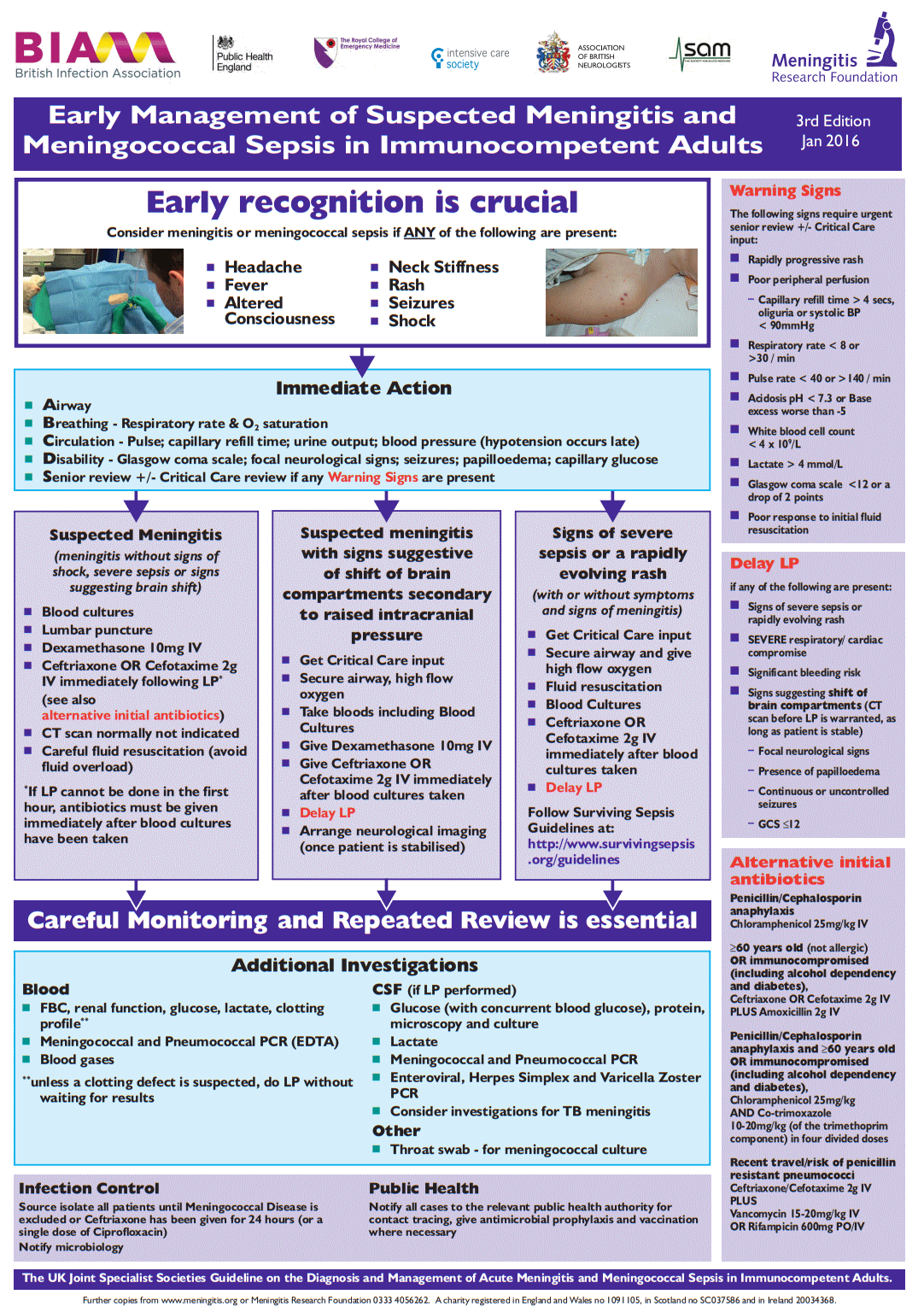
The investigation and management of suspected bacterial meningitis are usually intertwined given the potential negative impact of delayed antibiotic treatment.All patients should be transferred to hospital urgently. If patients are in a pre-hospital setting (for example a GP surgery) and meningococcal disease is suspected then intramuscular benzylpenicillin may be given, as long as this doesn't delay transit to hospital.
An ABC approach should be taken initially
- Airway
- Breathing
- Circulation
- Disability: GCS, ; focal neurological signs; seizures; papilloedema;
Senior review if any warning signs are present (please see the Meningitis Research Foundation algorithm link for the full list). Examples include:
- rapidly progressive rash
- poor peripheral perfusion
- respiratory rate < 8 or > 30 / min or pulse rate < 40 or > 140 / min
- pH < 7.3 or WBC< 4 *109/L or lactate > 4 mmol/L
- GCS < 12 or a drop of 2 points
- poor response to fluid resuscitation
A key decision is when/whether to attempt a lumbar puncture (LP)
- LPs require an aseptic technique and are potentially technically difficult - this means they may take time and delay other treatment
- on the other hand, having a cerebrospinal fluid (CSF) sample can be very useful in confirming the diagnosis and guiding antibiotic treatment
- as always, patient safety means that if there is any doubt IV antibiotics should be given as a priority
Lumbar puncture should be delayed in the following circumstances
- signs of severe sepsis or a rapidly evolving rash
- severe respiratory/cardiac compromise
- significant bleeding risk
- signs of raised intracranial pressure
- focal neurological signs
- papilloedema
- continuous or uncontrolled seizures
- GCS ≤ 9
Management of patients without indication for delayed LP
- IV access → take bloods and blood cultures
- lumbar puncture
- if this cannot be done within the first hour, IV antibiotics should be given after blood cultures have been taken
- IV antibiotics
- 3 months - 60 years: BNF recommends ceftriaxone
- ≥60 years: BNF recommends ceftriaxone + amoxicillin (or ampicillin) for adults
- add IV vancomycin if recent prolonged/multiple antibiotic use or travel to areas with highly resistant pneumococci
- IV dexamethasone
- the BNF recommend to 'consider adjunctive treatment with dexamethasone (particularly if pneumococcal meningitis suspected in adults), preferably starting before or with first dose of antibacterial, but no later than 12 hours after starting antibacterial; avoid dexamethasone in septic shock, meningococcal septicaemia, or if immunocompromised, or in meningitis following surgery'
- CT scan is not normally indicated
Management of patients with signs of raised intracranial pressure
- get critical care input
- secure airway + high-flow oxygen
- IV access → take bloods and blood cultures
- IV dexamethasone
- IV antibiotics as above
- arrange neuroimaging
Management of patients with signs of severe sepsis or a rapidly evolving rash
- get critical care input
- secure airway + high-flow oxygen
- IV access → take bloods and blood cultures
- IV fluid resuscitation
- IV antibiotics as above
Investigations
The bloods that have already been taken should be tested for the following:
- full blood count
- renal function
- glucose
- lactate
- clotting profile
- CRP
If an LP has been performed, the CSF should be tested for:
- glucose, protein, microscopy and culture
- lactate
- meningococcal and pneumococcal PCR
- enteroviral, herpes simplex and varicella-zoster PCR
- consider investigations for TB meningitis
Additional tests that may be helpful include:
- blood gases
- throat swab for meningococcal culture
BNF antibiotic guidelines
| Scenario | BNF recommendation |
|---|---|
| Initial empirical therapy aged < 3 months | IV cefotaxime + amoxicillin (or ampicillin) |
| Initial empirical therapy aged 3 months - 59 years | IV ceftriaxone |
| Initial empirical therapy aged ≥60 years | |
| IV ceftriaxone + amoxicillin (or ampicillin) | |
| Meningococcal meningitis | IV benzylpenicillin or IV ceftriaxone |
| Pneumococcal meningitis | IV ceftriaxone |
| Meningitis caused by Haemophilus influenzae | IV ceftriaxone) |
| Meningitis caused by Listeria | IV amoxicillin (or ampicillin) + gentamicin |
If the patient has a history of immediate hypersensitivity reaction to penicillin or to cephalosporins the BNF recommends using chloramphenicol.
Management of contacts
Prophylaxis needs to be offered to households and close contacts of patients affected with meningococcal meningitis. Prophylaxis should also be offered to people who have been exposed to respiratory secretion, regardless of the closeness of contact. The risk to contacts is highest in the first 7 days but persists for at least 4 weeks.
Management
- people who have been exposed to a patient with confirmed bacterial meningitis should be given prophylactic antibiotics if they have close contact within the 7 days before onset
- oral ciprofloxacin or rifampicin may be used. The Health Protection Agency (HPA) guidelines now state that whilst either may be used ciprofloxacin is the drug of choice as it is widely available and only requires one dose
- meningococcal vaccination should be offered to close contacts when serotype results are available, including booster doses to those who had the vaccine in infancy
- for pneumococcal meningitis, no prophylaxis is generally needed. There are however exceptions to this. If a cluster of cases of pneumococcal meningitis occurs the HPA have a protocol for offering close contacts antibiotic prophylaxis. Please see the link for more details
+PassMedicine Notes
The investigation and management of suspected bacterial meningitis are usually intertwined given the potential negative impact of delayed antibiotic treatment.
All patients should be transferred to hospital urgently. If patients are in a pre-hospital setting (for example a GP surgery) and meningococcal disease is suspected then intramuscular benzylpenicillin may be given, as long as this doesn't delay transit to hospital.
An ABC approach should be taken initially- Airway
- Breathing
- Circulation
- Disability: GCS, ; focal neurological signs; seizures; papilloedema;
- rapidly progressive rash
- poor peripheral perfusion
- respiratory rate < 8 or > 30 / min or pulse rate < 40 or > 140 / min
- pH < 7.3 or WBC< 4 *109/L or lactate > 4 mmol/L
- GCS < 12 or a drop of 2 points
- poor response to fluid resuscitation
- LPs require an aseptic technique and are potentially technically difficult - this means they may take time and delay other treatment
- on the other hand, having a cerebrospinal fluid (CSF) sample can be very useful in confirming the diagnosis and guiding antibiotic treatment
- as always, patient safety means that if there is any doubt IV antibiotics should be given as a priority
- signs of severe sepsis or a rapidly evolving rash
- severe respiratory/cardiac compromise
- significant bleeding risk
- signs of raised intracranial pressure
- focal neurological signs
- papilloedema
- continuous or uncontrolled seizures
- GCS ≤ 9
- IV access --> take bloods and blood cultures
- lumbar puncture
- if this cannot be done within the first hour, IV antibiotics should be given after blood cultures have been taken
- IV antibiotics
- 3 months - 60 years: BNF recommends ceftriaxone
- ≥60 years: BNF recommends ceftriaxone + amoxicillin (or ampicillin) for adults
- add IV vancomycin if recent prolonged/multiple antibiotic use or travel to areas with highly resistant pneumococci
- IV dexamethasone
- the BNF recommend to 'consider adjunctive treatment with dexamethasone (particularly if pneumococcal meningitis suspected in adults), preferably starting before or with first dose of antibacterial, but no later than 12 hours after starting antibacterial; avoid dexamethasone in septic shock, meningococcal septicaemia, or if immunocompromised, or in meningitis following surgery'
- CT scan is not normally indicated
- get critical care input
- secure airway + high-flow oxygen
- IV access --> take bloods and blood cultures
- IV dexamethasone
- IV antibiotics as above
- arrange neuroimaging
- get critical care input
- secure airway + high-flow oxygen
- IV access --> take bloods and blood cultures
- IV fluid resuscitation
- IV antibiotics as above
Investigations
The bloods that have already been taken should be tested for the following:- full blood count
- renal function
- glucose
- lactate
- clotting profile
- CRP
- glucose, protein, microscopy and culture
- lactate
- meningococcal and pneumococcal PCR
- enteroviral, herpes simplex and varicella-zoster PCR
- consider investigations for TB meningitis
- blood gases
- throat swab for meningococcal culture
BNF antibiotic guidelines
Scenario_ BNF recommendation| Initial empirical therapy aged < 3 months_ IV cefotaxime + amoxicillin (or ampicillin) | Initial empirical therapy aged 3 months - 59 years _ IV ceftriaxone| Initial empirical therapy aged ≥60 years |IV ceftriaxone + amoxicillin (or ampicillin) | Meningococcal meningitis _ IV benzylpenicillin or IV ceftriaxone| Pneumococcal meningitis _ IV ceftriaxone| Meningitis caused by Haemophilus influenzae _ IV ceftriaxone)| Meningitis caused by Listeria _ IV amoxicillin (or ampicillin) + gentamicin|If the patient has a history of immediate hypersensitivity reaction to penicillin or to cephalosporins the BNF recommends using chloramphenicol.
Management of contacts
Prophylaxis needs to be offered to households and close contacts of patients affected with meningococcal meningitis. Prophylaxis should also be offered to people who have been exposed to respiratory secretion, regardless of the closeness of contact. The risk to contacts is highest in the first 7 days but persists for at least 4 weeks.
Management- people who have been exposed to a patient with confirmed bacterial meningitis should be given prophylactic antibiotics if they have close contact within the 7 days before onset
- oral ciprofloxacin or rifampicin may be used. The Health Protection Agency (HPA) guidelines now state that whilst either may be used ciprofloxacin is the drug of choice as it is widely available and only requires one dose
- meningococcal vaccination should be offered to close contacts when serotype results are available, including booster doses to those who had the vaccine in infancy
- for pneumococcal meningitis, no prophylaxis is generally needed. There are however exceptions to this. If a cluster of cases of pneumococcal meningitis occurs the HPA have a protocol for offering close contacts antibiotic prophylaxis. Please see the link for more details