Highlighter is on. Drag to highlight text. Click a highlight to remove it.
ALL / Rheumatology
Psoriatic arthropathy
Psoriatic arthropathy
Psoriatic arthropathy is an inflammatory arthritis associated with psoriasis and is classed as one of the seronegative spondyloarthropathies. It correlates poorly with cutaneous psoriasis and often precedes the development of skin lesions. Around 10-20% of patients with skin lesions develop an arthropathy, with males and females being equally affected.Presentation
Patterns
- symmetric polyarthritis
- very similar to rheumatoid arthritis
- 30-40% of cases, most common type
- asymmetrical oligoarthritis: typically affects hands and feet (20-30%)
- historically thought to be the most common type, based on older data (e.g. 1973 Moll and Wright), though more recent studies suggest symmetric polyarthritis may now be more prevalent
- sacroiliitis
- DIP joint disease (around 10%)
- arthritis mutilans: a severe deforming form with 'telescoping fingers'
Other signs
- psoriatic skin lesions
- periarticular disease - tenosynovitis and soft tissue inflammation resulting in:
- enthesitis: inflammation at the site of tendon and ligament insertion (e.g. Achilles tendonitis, plantar fasciitis)
- tenosynovitis: typically of the flexor tendons of the hands
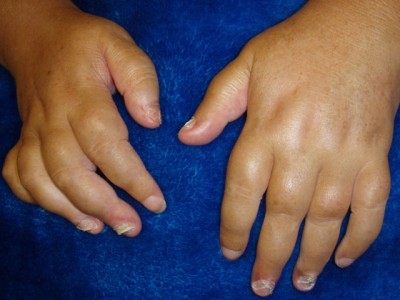
- dactylitis: diffuse swelling of an entire finger or toe
- nail changes
- pitting
- onycholysis
Investigation and Management
Bloods
- CRP/ESR typically elevated due to inflammation
- as a seronegative spondyloarthropathy, rheumatoid factor (RF) and anti-cyclic citrullinated peptide antibodies (anti-CCP) are usually negative
- HLA-B27 may be positive, particularly in patients with axial involvement
X-ray
- may show a combination of erosions and new bone formation
- periostitis
- 'pencil-in-cup' appearance in advanced disease
Management
- should be managed by a rheumatologist
- treatment is broadly similar to rheumatoid arthritis (RA), but with some important differences:
- mild peripheral arthritis or mild axial disease may be managed initially with NSAIDs alone
- for moderate to severe disease, methotrexate is commonly used, although its effect on axial disease is limited
- biologics may be required for more resistant or extensive disease
- monoclonal antibodies include ustekinumab (targets IL-12 and IL-23), secukinumab and ixekizumab (target IL-17), and adalimumab (anti-TNF)
- apremilast: an oral phosphodiesterase type-4 (PDE4) inhibitor that modulates inflammatory mediators
- Prognosis is generally better than in RA, though a subset of patients may develop progressive joint damage and disability
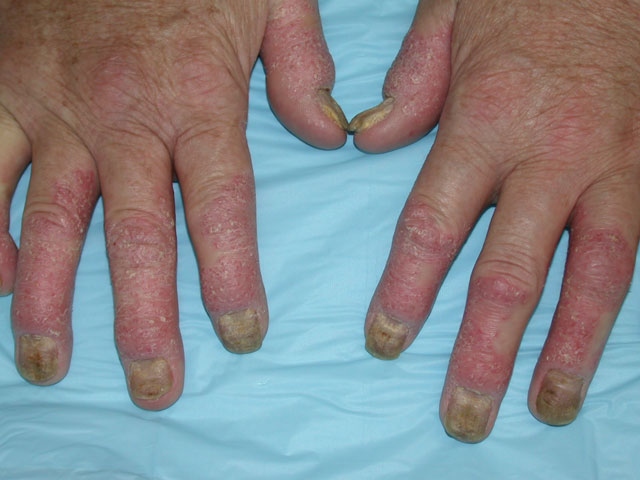
Notice the nail changes on this image as well
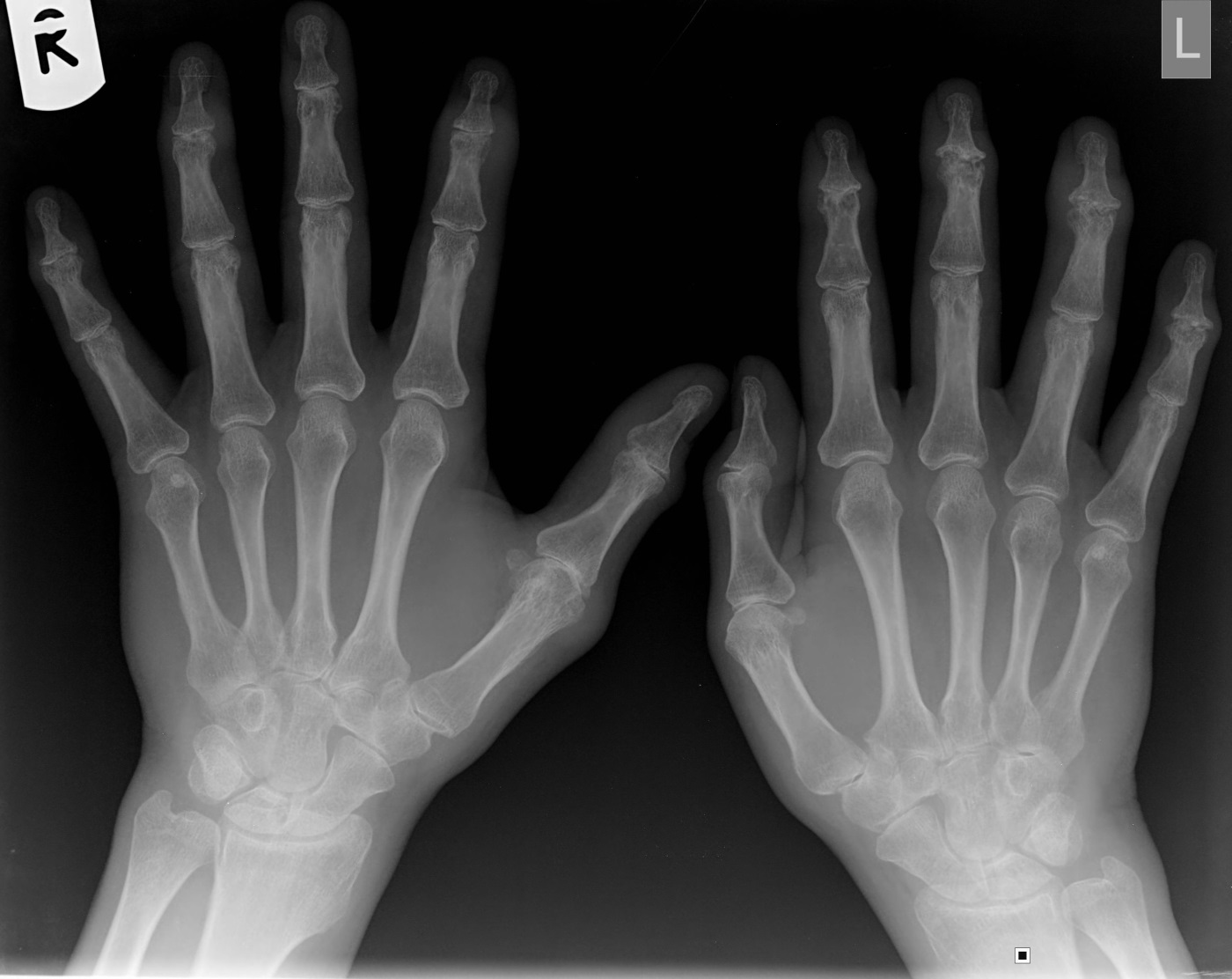
X-ray showing some of changes in seen in psoriatic arthropathy. Note that the DIPs are predominately affected, rather than the MCPs and PIPs as would be seen with rheumatoid. Extensive juxta-articular periostitis is seen in the DIPs but the changes have not yet progressed to the classic
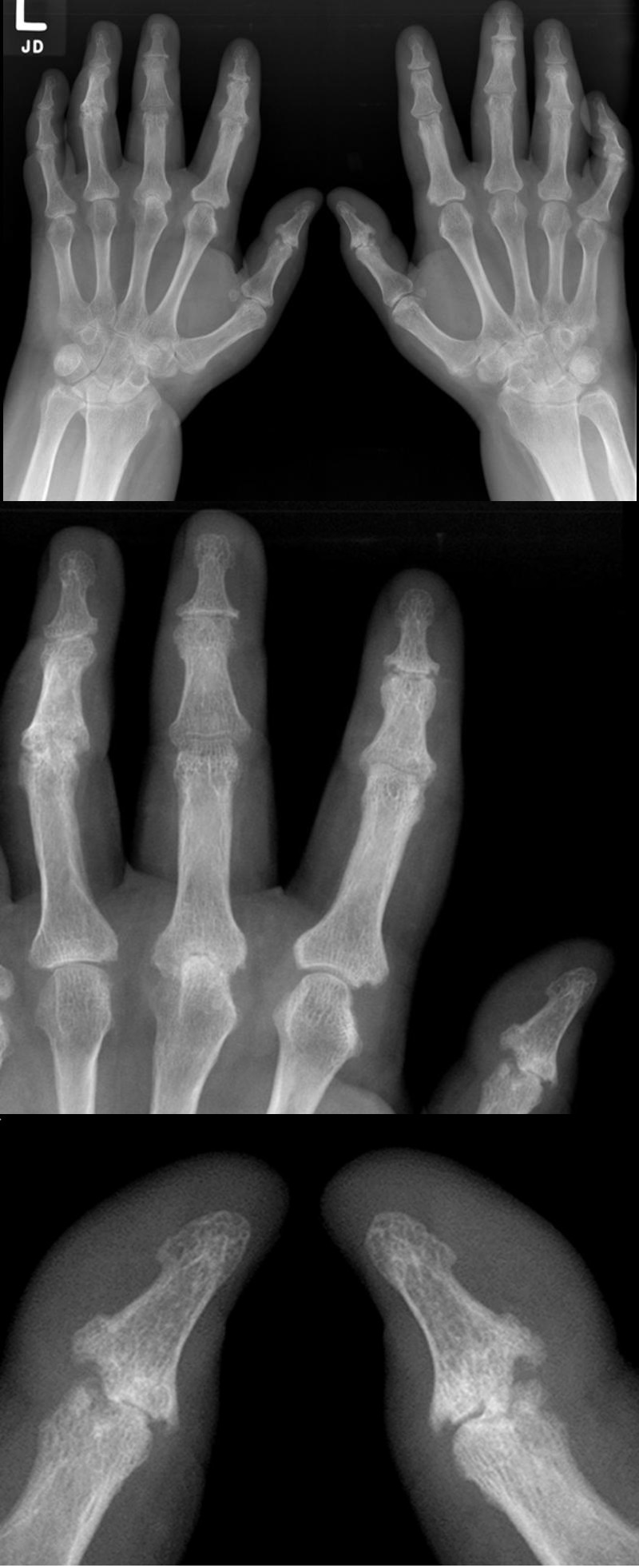
This x-ray shows changes affecting both the PIPs and DIPs. The close-up images show extensive changes including large eccentric erosions, tuft resorption and progression towards a
+PassMedicine Notes
Psoriatic arthropathy is an inflammatory arthritis associated with psoriasis and is classed as one of the seronegative spondyloarthropathies. It correlates poorly with cutaneous psoriasis and often precedes the development of skin lesions. Around 10-20% of patients with skin lesions develop an arthropathy, with males and females being equally affected.
Presentation
Patterns- symmetric polyarthritis
- very similar to rheumatoid arthritis
- 30-40% of cases, most common type
- asymmetrical oligoarthritis: typically affects hands and feet (20-30%)
- historically thought to be the most common type, based on older data (e.g. 1973 Moll and Wright), though more recent studies suggest symmetric polyarthritis may now be more prevalent
- sacroiliitis
- DIP joint disease (around 10%)
- arthritis mutilans: a severe deforming form with 'telescoping fingers'
- psoriatic skin lesions
- periarticular disease - tenosynovitis and soft tissue inflammation resulting in:
- enthesitis: inflammation at the site of tendon and ligament insertion (e.g. Achilles tendonitis, plantar fasciitis)
- tenosynovitis: typically of the flexor tendons of the hands
- dactylitis: diffuse swelling of an entire finger or toe
- nail changes
- pitting
- onycholysis
Investigation and Management
Bloods- CRP/ESR typically elevated due to inflammation
- as a seronegative spondyloarthropathy, rheumatoid factor (RF) and anti-cyclic citrullinated peptide antibodies (anti-CCP) are usually negative
- HLA-B27 may be positive, particularly in patients with axial involvement
- may show a combination of erosions and new bone formation
- periostitis
- 'pencil-in-cup' appearance in advanced disease
- should be managed by a rheumatologist
- treatment is broadly similar to rheumatoid arthritis (RA), but with some important differences:
- mild peripheral arthritis or mild axial disease may be managed initially with NSAIDs alone
- for moderate to severe disease, methotrexate is commonly used, although its effect on axial disease is limited
- biologics may be required for more resistant or extensive disease
- monoclonal antibodies include ustekinumab (targets IL-12 and IL-23), secukinumab and ixekizumab (target IL-17), and adalimumab (anti-TNF)
- apremilast: an oral phosphodiesterase type-4 (PDE4) inhibitor that modulates inflammatory mediators
- Prognosis is generally better than in RA, though a subset of patients may develop progressive joint damage and disability