Highlighter is on. Drag to highlight text. Click a highlight to remove it.
ALL / Cardiology
Carotid artery dissection
Carotid artery dissection
Carotid artery dissection occurs when a tear in the arterial intima allows blood to enter and split the vessel wall, creating a false lumen. It is an important, potentially reversible cause of stroke in younger adults and should be considered in patients presenting with head or neck pain, neurological deficits or signs of sympathetic disruption following minor trauma.Causes and risk factors
- Blunt trauma or rapid neck movement (e.g. whiplash)
- Connective tissue disorders (e.g. Ehlers–Danlos, Marfan syndrome)
- Recent upper respiratory infection or coughing bouts
- Fibromuscular dysplasia
- Hypertension
- Spontaneous cases with no clear precipitant
Pathophysiology
- Intimal tear allows blood to enter the vessel wall, forming a haematoma
- Narrowing of the true lumen reduces cerebral perfusion
- Thrombus formation at the dissection site may embolise distally
- Compression of adjacent sympathetic fibres can produce Horner’s syndrome
Features
- Unilateral neck pain or headache, often sudden in onset
- Ipsilateral Horner’s syndrome (ptosis, miosis, anhidrosis sparing the forehead)
- Transient ischaemic attack or stroke symptoms, especially in young or otherwise low-risk patients
- Pulsatile tinnitus
- Possible preceding neck trauma or manipulation, including minor trauma
Investigations
- CT angiography of head and neck (first-line in most UK emergency settings)
- MRI/MRA with fat-suppressed sequences to visualise mural haematoma
- Duplex ultrasound (limited sensitivity, supportive if positive)
- Stroke/TIA workup including ECG, blood tests and risk factor assessment
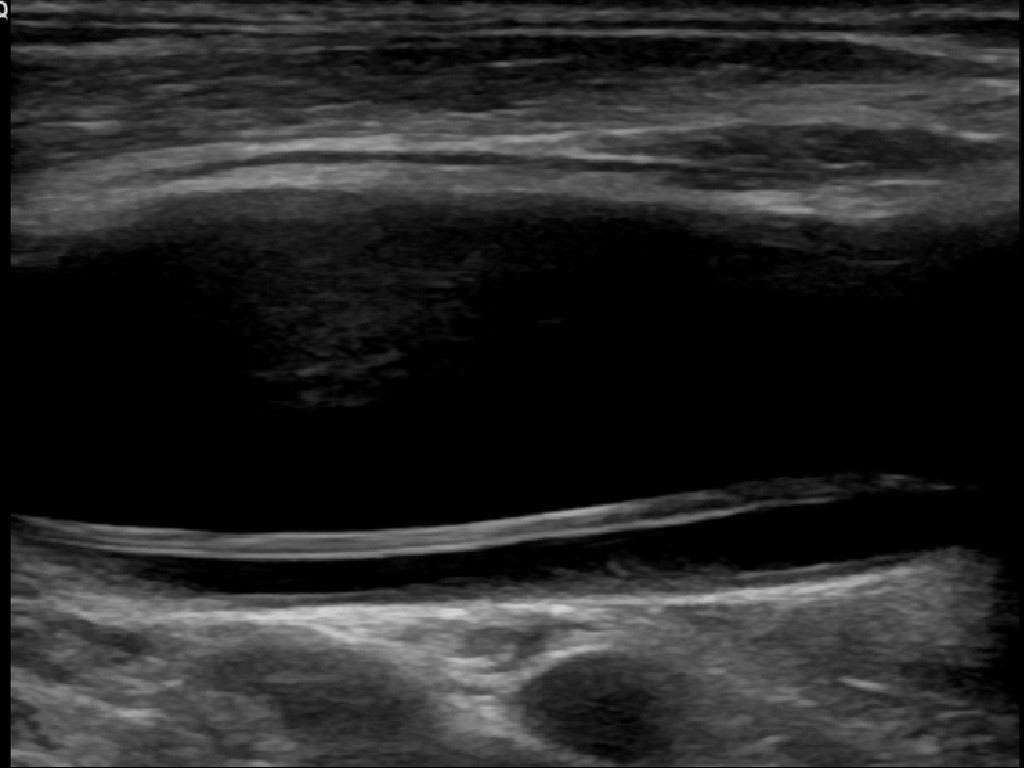
Ultrasound showing dissection of common carotid artery
Management
- Antithrombotic therapy: antiplatelet therapy is first-line for most; anticoagulation used selectively based on specialist advice
- BP control and vascular risk optimisation
- Neurology or stroke specialist input for all suspected cases
- Endovascular or surgical intervention only in rare cases (e.g. worsening neurological deficit despite treatment, expanding pseudoaneurysm)
- Avoid high-impact neck manipulation during recovery
+PassMedicine Notes
Carotid artery dissection occurs when a tear in the arterial intima allows blood to enter and split the vessel wall, creating a false lumen. It is an important, potentially reversible cause of stroke in younger adults and should be considered in patients presenting with head or neck pain, neurological deficits or signs of sympathetic disruption following minor trauma.
Causes and risk factors- Blunt trauma or rapid neck movement (e.g. whiplash)
- Connective tissue disorders (e.g. Ehlers–Danlos, Marfan syndrome)
- Recent upper respiratory infection or coughing bouts
- Fibromuscular dysplasia
- Hypertension
- Spontaneous cases with no clear precipitant
- Intimal tear allows blood to enter the vessel wall, forming a haematoma
- Narrowing of the true lumen reduces cerebral perfusion
- Thrombus formation at the dissection site may embolise distally
- Compression of adjacent sympathetic fibres can produce Horner’s syndrome
- Unilateral neck pain or headache, often sudden in onset
- Ipsilateral Horner’s syndrome (ptosis, miosis, anhidrosis sparing the forehead)
- Transient ischaemic attack or stroke symptoms, especially in young or otherwise low-risk patients
- Pulsatile tinnitus
- Possible preceding neck trauma or manipulation, including minor trauma
- CT angiography of head and neck (first-line in most UK emergency settings)
- MRI/MRA with fat-suppressed sequences to visualise mural haematoma
- Duplex ultrasound (limited sensitivity, supportive if positive)
- Stroke/TIA workup including ECG, blood tests and risk factor assessment
- Antithrombotic therapy: antiplatelet therapy is first-line for most; anticoagulation used selectively based on specialist advice
- BP control and vascular risk optimisation
- Neurology or stroke specialist input for all suspected cases
- Endovascular or surgical intervention only in rare cases (e.g. worsening neurological deficit despite treatment, expanding pseudoaneurysm)
- Avoid high-impact neck manipulation during recovery