Highlighter is on. Drag to highlight text. Click a highlight to remove it.
ALL / Dermatology
Actinic keratoses
Actinic keratoses
Actinic, or solar, keratoses (AK) is a common premalignant skin lesion that develops as a consequence of chronic sun exposureFeatures
- small, crusty or scaly, lesions
- may be pink, red, brown or the same colour as the skin
- typically on sun-exposed areas e.g. temples of head
- multiple lesions may be present
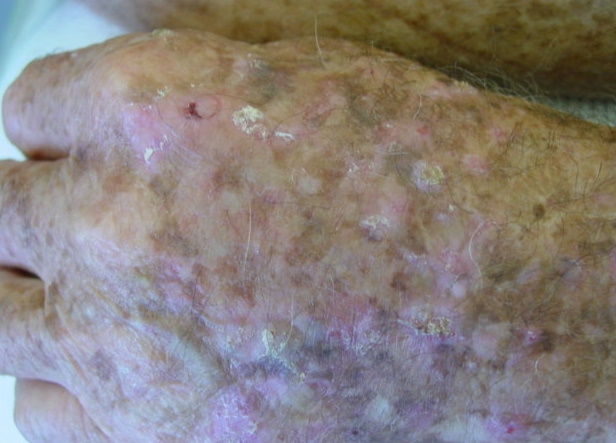
Multiple actinic keratoses - hyperkeratotic papules on a background of sun-damaged skin
Management options include
- prevention of further risk: e.g. sun avoidance, sun cream
- fluorouracil cream: typically a 2 to 3 week course. The skin will become red and inflamed - sometimes topical hydrocortisone is given following fluorouracil to help settle the inflammation
- topical diclofenac: may be used for mild AKs. Moderate efficacy but much fewer side-effects
- topical imiquimod: trials have shown good efficacy
- cryotherapy
- curettage and cautery
+PassMedicine Notes
Actinic, or solar, keratoses (AK) is a common premalignant skin lesion that develops as a consequence of chronic sun exposure
Features- small, crusty or scaly, lesions
- may be pink, red, brown or the same colour as the skin
- typically on sun-exposed areas e.g. temples of head
- multiple lesions may be present
- prevention of further risk: e.g. sun avoidance, sun cream
- fluorouracil cream: typically a 2 to 3 week course. The skin will become red and inflamed - sometimes topical hydrocortisone is given following fluorouracil to help settle the inflammation
- topical diclofenac: may be used for mild AKs. Moderate efficacy but much fewer side-effects
- topical imiquimod: trials have shown good efficacy
- cryotherapy
- curettage and cautery