Highlighter is on. Drag to highlight text. Click a highlight to remove it.
ALL / Dermatology
Pityriasis rosea
Pityriasis rosea
Pityriasis rosea describes an acute, self-limiting rash which tends to affect young adults. The aetiology is not fully understood but is thought that herpes hominis virus 7 (HHV-7) may play a role.Features
- in the majority of patients there is no prodrome, but a minority may give a history of a recent viral infection
- herald patch (usually on trunk)
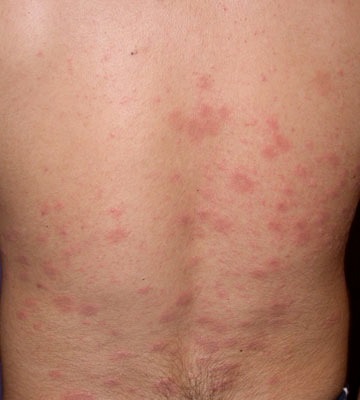
- followed by erythematous, oval, scaly patches which follow a characteristic distribution with the longitudinal diameters of the oval lesions running parallel to the line of Langer. This may produce a 'fir-tree' appearance
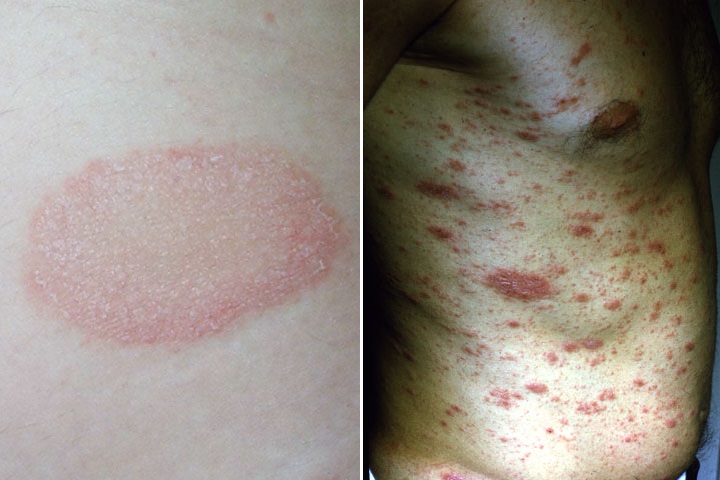
On the left a typical herald patch is seen. After a few days a more generalised
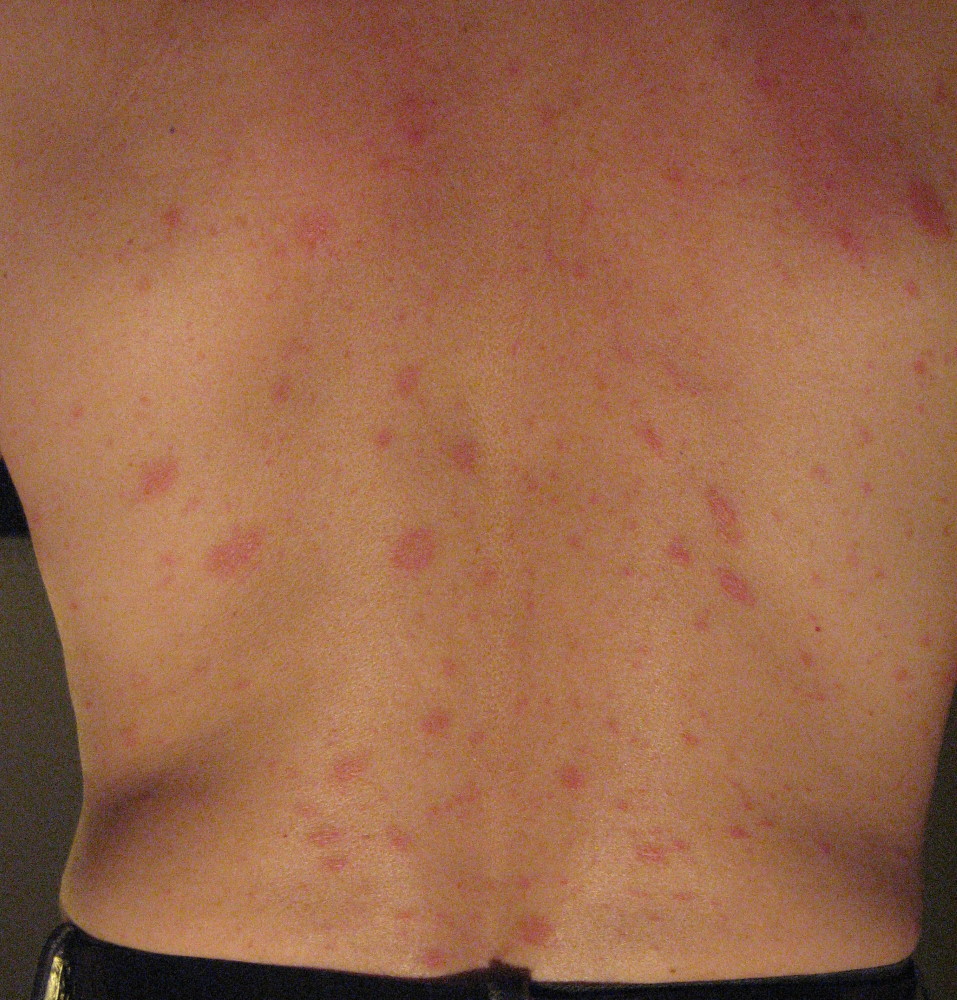
Pityriasis rosea on the back of a male. Note the
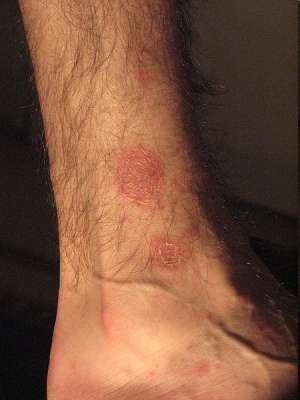
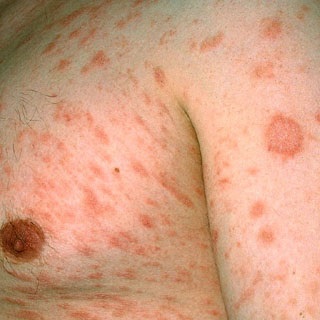
Management
- self-limiting - usually disappears after 6-12 weeks
Differentiating guttate psoriasis and pityriasis rosea
| Guttate psoriasis | Pityriasis rosea | |
|---|---|---|
| Prodrome | Classically preceded by a streptococcal sore throat 2-4 weeks | Many patients report recent respiratory tract infections but this is not common in questions |
| Appearance | 'Tear drop', scaly papules on the trunk and limbs | Herald patch followed 1-2 weeks later by multiple erythematous, slightly raised oval lesions with a fine scale confined to the outer aspects of the lesions. May follow a characteristic distribution with the longitudinal diameters of the oval lesions running parallel to the line of Langer. This may produce a 'fir-tree' appearance |
| Treatment / natural history | Most cases resolve spontaneously within 2-3 months Topical agents as per psoriasis UVB phototherapy | Self-limiting, resolves after around 6 weeks |
+PassMedicine Notes
Pityriasis rosea describes an acute, self-limiting rash which tends to affect young adults. The aetiology is not fully understood but is thought that herpes hominis virus 7 (HHV-7) may play a role.
Features- in the majority of patients there is no prodrome, but a minority may give a history of a recent viral infection
- herald patch (usually on trunk)
- followed by erythematous, oval, scaly patches which follow a characteristic distribution with the longitudinal diameters of the oval lesions running parallel to the line of Langer. This may produce a 'fir-tree' appearance
- self-limiting - usually disappears after 6-12 weeks