Highlighter is on. Drag to highlight text. Click a highlight to remove it.
ALL / Gastroenterology
Pancreatic cancer
Pancreatic cancer
Pancreatic cancer is often diagnosed late as it tends to present in a non-specific way. Over 80% of pancreatic tumours are adenocarcinomas which typically occur at the head of the pancreas.Associations
- increasing age
- smoking
- diabetes
- chronic pancreatitis (alcohol does not appear an independent risk factor though)
- hereditary non-polyposis colorectal carcinoma
- multiple endocrine neoplasia
- BRCA2 gene
- KRAS gene mutation
Features
- classically painless jaundice
- pale stools, dark urine, and pruritus
- cholestatic liver function tests
- the following abdominal masses may be found (in decreasing order of frequency)
- hepatomegaly: due to metastases
- gallbladder: Courvoisier's law states that in the presence of painless obstructive jaundice, a palpable gallbladder is unlikely to be due to gallstones
- epigastric mass: from the primary tumour
- many patients present in a non-specific way with anorexia, weight loss etc
- epigastric pain
- whilst 'painless jaundice' is the classic presentation many patients present with pain
- may radiate to the back
- often worse when lying flat or after eating
- loss of exocrine function (e.g. steatorrhoea)
- loss of endocrine function (e.g. diabetes mellitus)
- migratory thrombophlebitis (Trousseau's syndrome) is more common than with other cancers
Investigation
- ultrasound has a sensitivity of around 60-90%
- high-resolution CT scanning is the investigation of choice if the diagnosis is suspected
- imaging may demonstrate the 'double duct' sign - the presence of simultaneous dilatation of the common bile and pancreatic ducts
Management
- less than 20% are suitable for surgery at diagnosis
- a Whipple's resection (pancreaticoduodenectomy) is performed for resectable lesions in the head of pancreas. Side-effects of a Whipple's include dumping syndrome and peptic ulcer disease
- adjuvant chemotherapy is usually given following surgery
- ERCP with stenting is often used for palliation
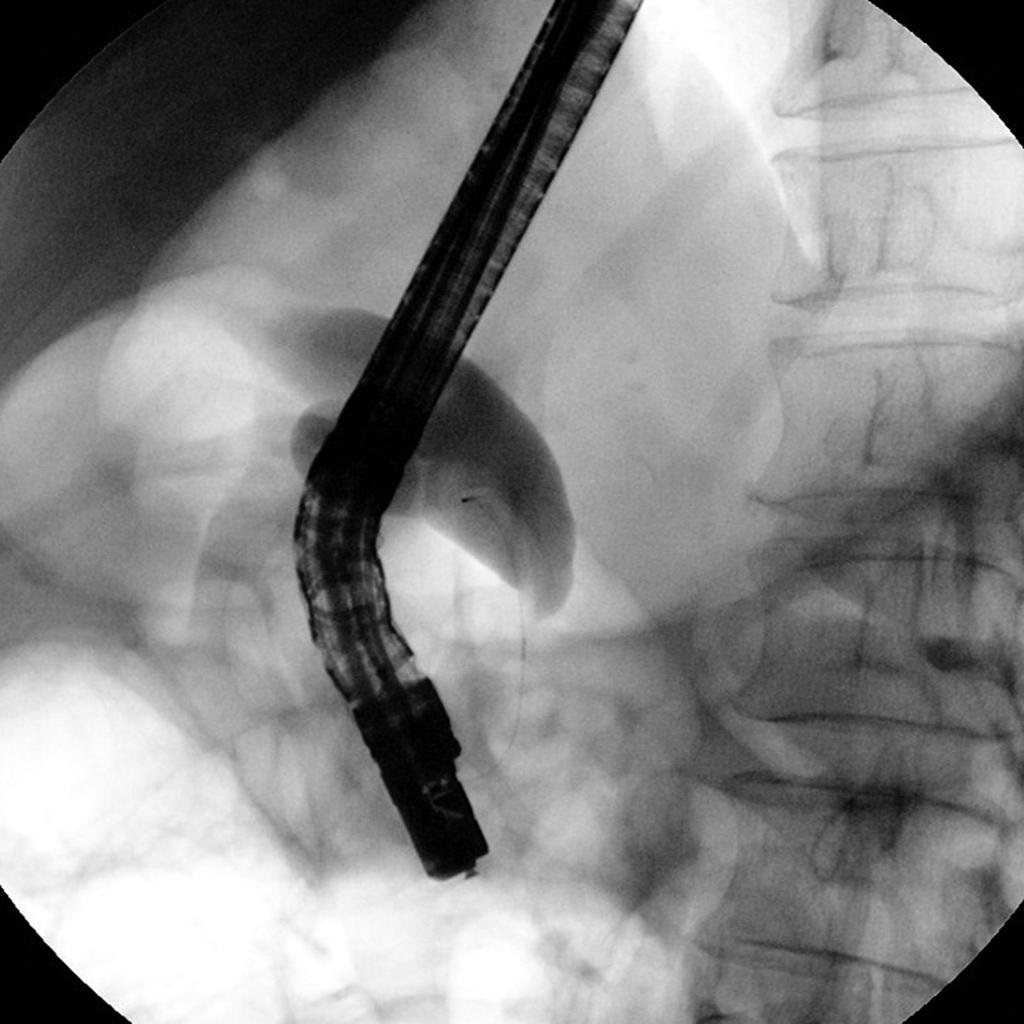
ERCP showing invasive ductal adenocarcinoma. Note the dilation of the common bile duct due to the pancreatic lesion
+PassMedicine Notes
Pancreatic cancer is often diagnosed late as it tends to present in a non-specific way. Over 80% of pancreatic tumours are adenocarcinomas which typically occur at the head of the pancreas.
Associations- increasing age
- smoking
- diabetes
- chronic pancreatitis (alcohol does not appear an independent risk factor though)
- hereditary non-polyposis colorectal carcinoma
- multiple endocrine neoplasia
- BRCA2 gene
- KRAS gene mutation
- classically painless jaundice
- pale stools, dark urine, and pruritus
- cholestatic liver function tests
- the following abdominal masses may be found (in decreasing order of frequency)
- hepatomegaly: due to metastases
- gallbladder: Courvoisier's law states that in the presence of painless obstructive jaundice, a palpable gallbladder is unlikely to be due to gallstones
- epigastric mass: from the primary tumour
- many patients present in a non-specific way with anorexia, weight loss etc
- epigastric pain
- whilst 'painless jaundice' is the classic presentation many patients present with pain
- may radiate to the back
- often worse when lying flat or after eating
- loss of exocrine function (e.g. steatorrhoea)
- loss of endocrine function (e.g. diabetes mellitus)
- migratory thrombophlebitis (Trousseau's syndrome) is more common than with other cancers
- ultrasound has a sensitivity of around 60-90%
- high-resolution CT scanning is the investigation of choice if the diagnosis is suspected
- imaging may demonstrate the 'double duct' sign - the presence of simultaneous dilatation of the common bile and pancreatic ducts
- less than 20% are suitable for surgery at diagnosis
- a Whipple's resection (pancreaticoduodenectomy) is performed for resectable lesions in the head of pancreas. Side-effects of a Whipple's include dumping syndrome and peptic ulcer disease
- adjuvant chemotherapy is usually given following surgery
- ERCP with stenting is often used for palliation