Highlighter is on. Drag to highlight text. Click a highlight to remove it.
ALL / Neurology
Guillain-Barre syndrome: management
Guillain-Barre syndrome: management
Guillain-Barre syndrome describes an immune-mediated demyelination of the peripheral nervous system often triggered by an infection (classically Campylobacter jejuni).Management
- IV immunoglobulins (IVIG) or plasma exchange can be used
- IVIG is as effective as plasma exchange better tolerated and easier to administer
- therefore IVIG is generally used first-line for Guillain-Barre syndrome where patients require immunomodulatory therapy
- no benefit in combining both treatments
- steroids and immunosuppressants have not been shown to be beneficial
- FVC regularly to monitor respiratory function
- > 20 mL/kg - usually safe
- 15-20 mL/kg - high risk – close monitoring / HDU
- < 15 mL/kg - impending respiratory failure → ICU
- < 10 mL/kg - urgent intubation likely
Prognosis
- severe motor problems persist in about 15%
- around 5% die
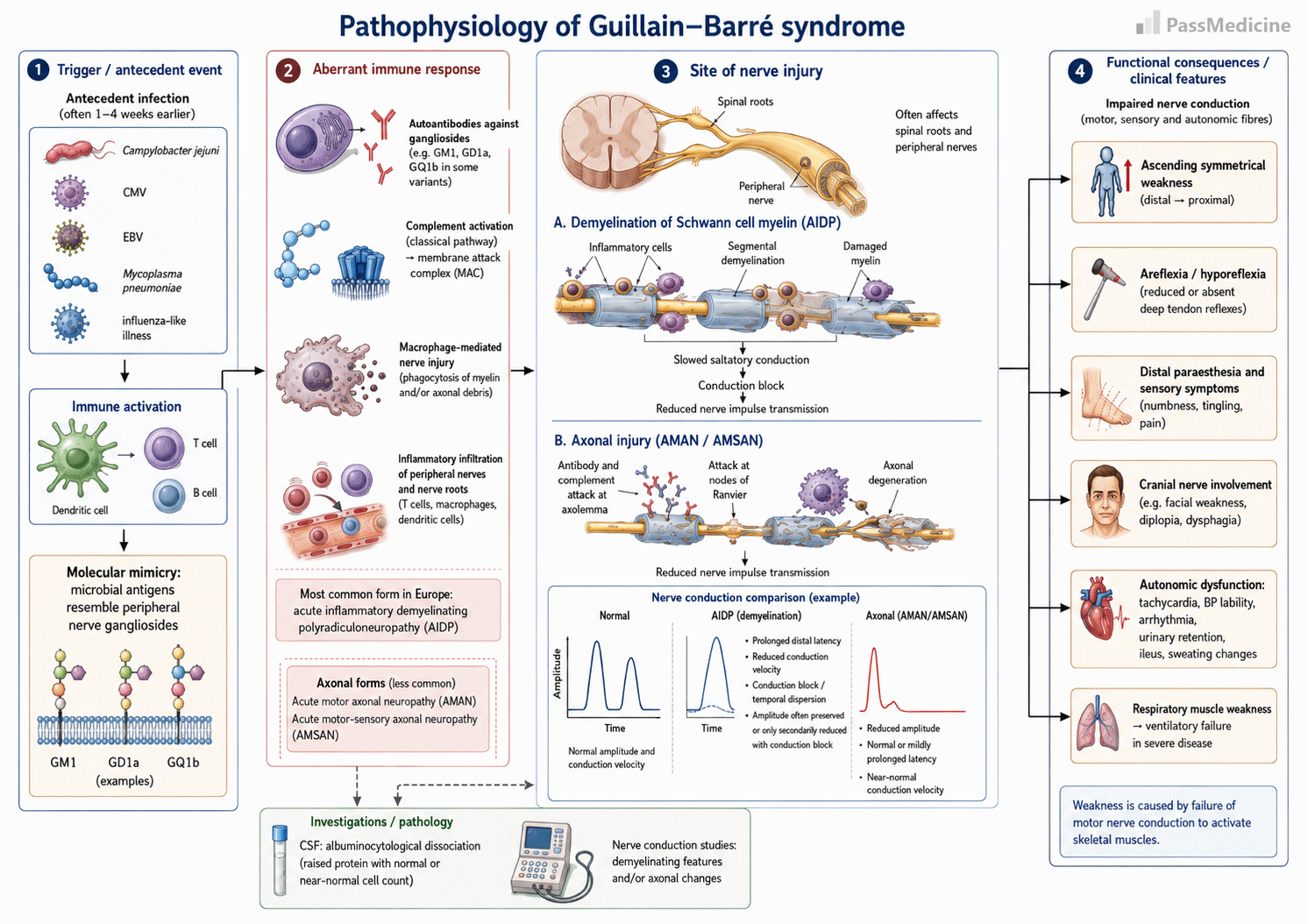
Pathophysiology of Guillain-Barre syndrome
+PassMedicine Notes
Guillain-Barre syndrome describes an immune-mediated demyelination of the peripheral nervous system often triggered by an infection (classically Campylobacter jejuni).
Management- IV immunoglobulins (IVIG) or plasma exchange can be used
- IVIG is as effective as plasma exchange better tolerated and easier to administer
- therefore IVIG is generally used first-line for Guillain-Barre syndrome where patients require immunomodulatory therapy
- no benefit in combining both treatments
- steroids and immunosuppressants have not been shown to be beneficial
- FVC regularly to monitor respiratory function
- > 20 mL/kg - usually safe
- 15-20 mL/kg - high risk – close monitoring / HDU
- < 15 mL/kg - impending respiratory failure → ICU
- < 10 mL/kg - urgent intubation likely
- severe motor problems persist in about 15%
- around 5% die