Highlighter is on. Drag to highlight text. Click a highlight to remove it.
ALL / Neurology
Neuroleptic malignant syndrome
Neuroleptic malignant syndrome
Neuroleptic malignant syndrome is a rare but dangerous condition seen in patients taking antipsychotic medication. It carries a mortality of up to 10% and can also occur with atypical antipsychotics. It may also occur with dopaminergic drugs (such as levodopa) for Parkinson's disease, usually when the drug is suddenly stopped or the dose reduced.The pathophysiology is unknown but one theory is that the dopamine blockade induced by antipsychotics triggers massive glutamate release and subsequent neurotoxicity and muscle damage.
It occurs within hours to days of starting an antipsychotic (antipsychotics are also known as neuroleptics, hence the name) and the typical features are:
- pyrexia
- muscle rigidity
- autonomic lability: typical features include hypertension, tachycardia and tachypnoea
- agitated delirium with confusion
A raised creatine kinase is present in most cases. Acute kidney injury (secondary to rhabdomyolysis) may develop in severe cases. A leukocytosis may also be seen
Management
- stop antipsychotic
- patients should be transferred to a medical ward if they are on a psychiatric ward and often they are nursed in intensive care units
- IV fluids to prevent renal failure
- dantrolene may be useful in selected cases
- thought to work by decreasing excitation-contraction coupling in skeletal muscle by binding to the ryanodine receptor, and decreasing the release of calcium from the sarcoplasmic reticulum
- bromocriptine, dopamine agonist, may also be used
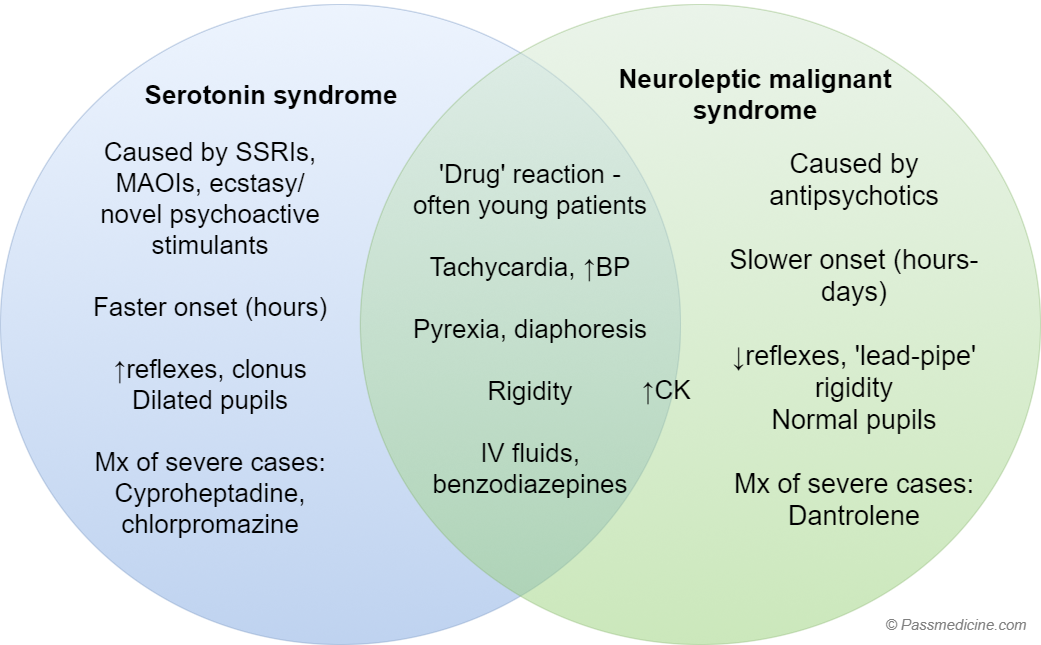
Venn diagram showing contrasting serotonin syndrome with neuroleptic malignant syndrome. Note that both conditions can cause a raised creatine kinase (CK) but it tends to be more associated with NMS.
+PassMedicine Notes
Neuroleptic malignant syndrome is a rare but dangerous condition seen in patients taking antipsychotic medication. It carries a mortality of up to 10% and can also occur with atypical antipsychotics. It may also occur with dopaminergic drugs (such as levodopa) for Parkinson's disease, usually when the drug is suddenly stopped or the dose reduced.
The pathophysiology is unknown but one theory is that the dopamine blockade induced by antipsychotics triggers massive glutamate release and subsequent neurotoxicity and muscle damage.
It occurs within hours to days of starting an antipsychotic (antipsychotics are also known as neuroleptics, hence the name) and the typical features are:- pyrexia
- muscle rigidity
- autonomic lability: typical features include hypertension, tachycardia and tachypnoea
- agitated delirium with confusion
A raised creatine kinase is present in most cases. Acute kidney injury (secondary to rhabdomyolysis) may develop in severe cases. A leukocytosis may also be seen
Management- stop antipsychotic
- patients should be transferred to a medical ward if they are on a psychiatric ward and often they are nursed in intensive care units
- IV fluids to prevent renal failure
- dantrolene may be useful in selected cases
- thought to work by decreasing excitation-contraction coupling in skeletal muscle by binding to the ryanodine receptor, and decreasing the release of calcium from the sarcoplasmic reticulum
- bromocriptine, dopamine agonist, may also be used