Highlighter is on. Drag to highlight text. Click a highlight to remove it.
ALL / Clinical Sciences
Autosomal dominant conditions
Autosomal dominant conditions
Autosomal recessive conditions are often thought to be 'metabolic' as opposed to autosomal dominant conditions being 'structural', notable exceptions:
- some 'metabolic' conditions such as Hunter's and G6PD are X-linked recessive whilst others such as hyperlipidaemia type II and hypokalaemic periodic paralysis are autosomal dominant
- some 'structural' conditions such as ataxia telangiectasia and Friedreich's ataxia are autosomal recessive
The following conditions are autosomal dominant:
- Achondroplasia
- Acute intermittent porphyria
- Adult polycystic disease
- Antithrombin III deficiency
- Ehlers-Danlos syndrome
- Familial adenomatous polyposis
- Hereditary haemorrhagic telangiectasia
- Hereditary spherocytosis
- Hereditary non-polyposis colorectal carcinoma
- Huntington's disease
- Hyperlipidaemia type II
- Hypokalaemic periodic paralysis
- Malignant hyperthermia
- Marfan's syndromes
- Myotonic dystrophy
- Neurofibromatosis
- Noonan syndrome
- Osteogenesis imperfecta
- Peutz-Jeghers syndrome
- Retinoblastoma
- Romano-Ward syndrome
- tuberous sclerosis
- Von Hippel-Lindau syndrome
- Von Willebrand's disease*
*type 3 von Willebrand's disease (most severe form) is inherited as an autosomal recessive trait. Around 80% of patients have type 1 disease
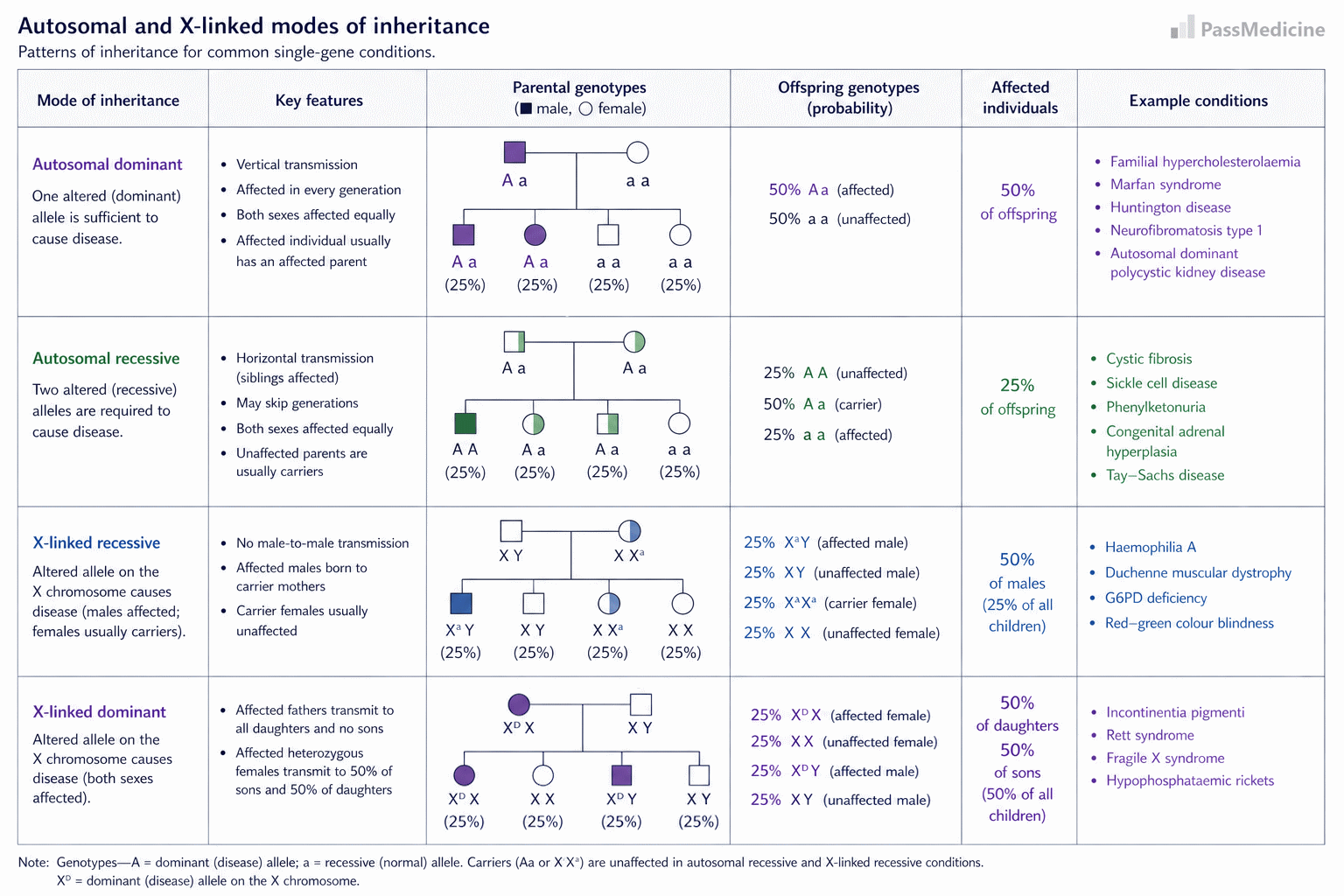
Autosomal and X-linked patterns of inheritance
+PassMedicine Notes
Autosomal recessive conditions are often thought to be 'metabolic' as opposed to autosomal dominant conditions being 'structural', notable exceptions:
- some 'metabolic' conditions such as Hunter's and G6PD are X-linked recessive whilst others such as hyperlipidaemia type II and hypokalaemic periodic paralysis are autosomal dominant
- some 'structural' conditions such as ataxia telangiectasia and Friedreich's ataxia are autosomal recessive
- Achondroplasia
- Acute intermittent porphyria
- Adult polycystic disease
- Antithrombin III deficiency
- Ehlers-Danlos syndrome
- Familial adenomatous polyposis
- Hereditary haemorrhagic telangiectasia
- Hereditary spherocytosis
- Hereditary non-polyposis colorectal carcinoma
- Huntington's disease
- Hyperlipidaemia type II
- Hypokalaemic periodic paralysis
- Malignant hyperthermia
- Marfan's syndromes
- Myotonic dystrophy
- Neurofibromatosis
- Noonan syndrome
- Osteogenesis imperfecta
- Peutz-Jeghers syndrome
- Retinoblastoma
- Romano-Ward syndrome
- tuberous sclerosis
- Von Hippel-Lindau syndrome
- Von Willebrand's disease*
*type 3 von Willebrand's disease (most severe form) is inherited as an autosomal recessive trait. Around 80% of patients have type 1 disease