Highlighter is on. Drag to highlight text. Click a highlight to remove it.
ALL / Endocrinology
Primary hyperaldosteronism
Primary hyperaldosteronism
Primary hyperaldosteronism was previously thought to be most commonly caused by an adrenal adenoma, termed Conn's syndrome. However, recent studies have shown that bilateral idiopathic adrenal hyperplasia is the most common cause. Differentiating between the two is important as this determines treatment.Causes
- bilateral idiopathic adrenal hyperplasia: the cause of around 60-70% of cases
- adrenal adenoma: 30-40% of cases
- rarer causes:
- unilateral hyperplasia
- familial hyperaldosteronism
- adrenal carcinoma
Pathophysiology
- aldosterone is high
- renin is low (suppressed by volume expansion)
- consequences:
- aldosterone → ↑ renal tubular sodium resorption (via ENaC channels in the collecting duct)
- ↑ K⁺ excretion → hypokalaemia
- ↑ H⁺ excretion → metabolic alkalosis
- hypertension from sodium/water retention
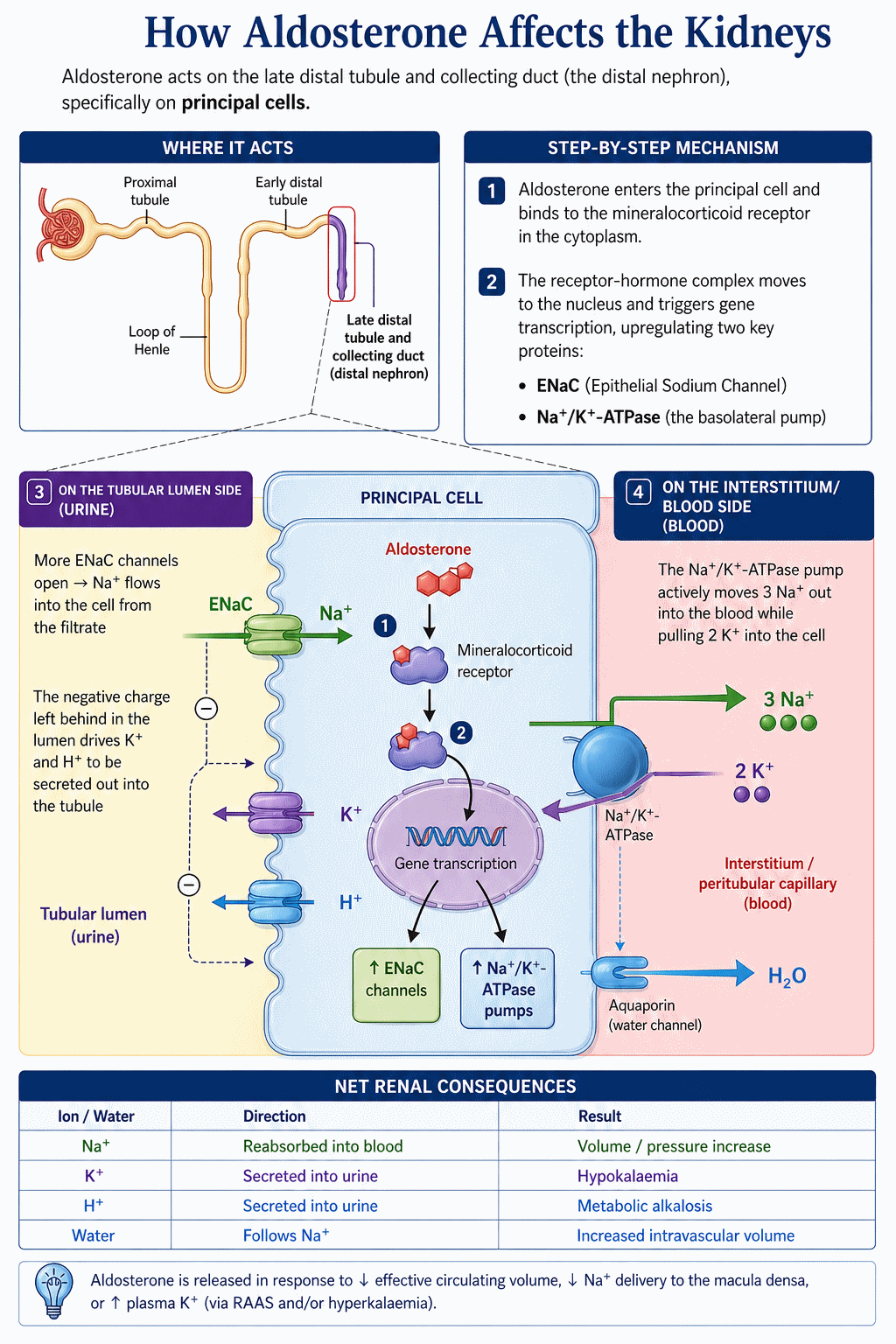
Aldosterone effects on the kidneys
Features
- hypertension
- increasingly recognised but still underdiagnosed cause of hypertension
- hypokalaemia
- e.g. muscle weakness
- this is a classical feature in exams but studies suggest this is seen in only 10-40% of patients, and is more common with adrenal adenomas
- metabolic alkalosis
Investigations
- guidelines vary but certain patients should be screened for primary hyperaldosteronism, e.g.
- hypertension with hypokalemia
- treatment-resistant hypertension
- the 2016 Endocrine Society recommend that a plasma aldosterone/renin ratio is the first-line investigation in suspected primary hyperaldosteronism
- should show high aldosterone levels alongside low renin levels (negative feedback due to sodium retention from aldosterone)
- following this a high-resolution CT abdomen and adrenal vein sampling is used to differentiate between unilateral and bilateral sources of aldosterone excess
- if the CT is normal adrenal venous sampling (AVS) can be used to distinguish between unilateral adenoma and bilateral hyperplasia
Management
- adrenal adenoma: surgery (laparoscopic adrenalectomy)
- bilateral adrenocortical hyperplasia: aldosterone antagonist e.g. spironolactone
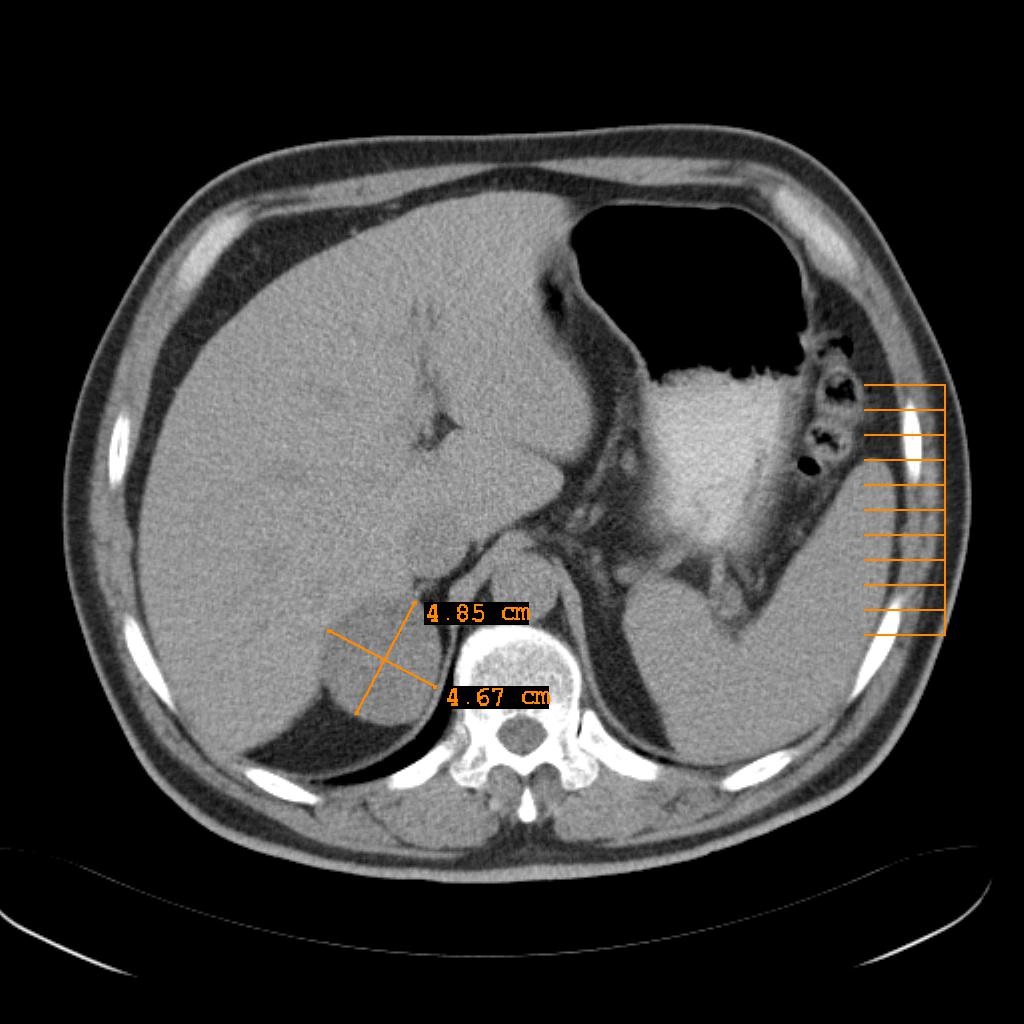
CT abdomen showing a right-sided adrenal adenoma in a patient who presented with hypertension and hypokalaemia. The adenoma can be seen
+PassMedicine Notes
Primary hyperaldosteronism was previously thought to be most commonly caused by an adrenal adenoma, termed Conn's syndrome. However, recent studies have shown that bilateral idiopathic adrenal hyperplasia is the most common cause. Differentiating between the two is important as this determines treatment.
Causes- bilateral idiopathic adrenal hyperplasia: the cause of around 60-70% of cases
- adrenal adenoma: 30-40% of cases
- rarer causes:
- unilateral hyperplasia
- familial hyperaldosteronism
- adrenal carcinoma
- aldosterone is high
- renin is low (suppressed by volume expansion)
- consequences:
- aldosterone --> ↑ renal tubular sodium resorption (via ENaC channels in the collecting duct)
- ↑ K⁺ excretion → hypokalaemia
- ↑ H⁺ excretion → metabolic alkalosis
- hypertension from sodium/water retention
- hypertension
- increasingly recognised but still underdiagnosed cause of hypertension
- hypokalaemia
- e.g. muscle weakness
- this is a classical feature in exams but studies suggest this is seen in only 10-40% of patients, and is more common with adrenal adenomas
- metabolic alkalosis
- guidelines vary but certain patients should be screened for primary hyperaldosteronism, e.g.
- hypertension with hypokalemia
- treatment-resistant hypertension
- the 2016 Endocrine Society recommend that a plasma aldosterone/renin ratio is the first-line investigation in suspected primary hyperaldosteronism
- should show high aldosterone levels alongside low renin levels (negative feedback due to sodium retention from aldosterone)
- following this a high-resolution CT abdomen and adrenal vein sampling is used to differentiate between unilateral and bilateral sources of aldosterone excess
- if the CT is normal adrenal venous sampling (AVS) can be used to distinguish between unilateral adenoma and bilateral hyperplasia
- adrenal adenoma: surgery (laparoscopic adrenalectomy)
- bilateral adrenocortical hyperplasia: aldosterone antagonist e.g. spironolactone