Neurofibromatosis
There are two types of neurofibromatosis, NF1 and NF2. Both are inherited in an
autosomal dominantNeurofibromatosis is autosomal dominant
You've never been tested on this concept
You've not yet rated this concept.
Importance: 38
fashion.
Comparison
| NF1 Cafe-au-lait spots, axillary freckles, iris harmatomas, phaeochromacytoma - neurofibromatosis type 1 You've never been tested on this concept You've not yet rated this concept. Importance: 48 | NF2 |
|---|
| Incidence | 1 in 4,000 | 1 in 100,000 |
| Gene & protein | Mutation in the NF1 gene on chromosome 17 Neurofibromatosis type 1 - chromosome 17 You've never been tested on this concept You've not yet rated this concept. Importance: 43 → loss of neurofibromin, a negative regulator of RAS signalling | Mutation in the NF2 gene on chromosome 22 Neurofibromatosis type 2 - chromosome 22 You've never been tested on this concept You've not yet rated this concept. Importance: 25 → loss of merlin, which controls Schwann cell growth and contact inhibition |
| Primary cell type affected | Affects neural crest–derived cells broadly (Schwann cells, melanocytes, fibroblasts) | Predominantly affects Schwann cells |
| Features | Cafe-au-lait spots Neurofibromatosis - cafe-au-lait spots You've never been tested on this concept You've not yet rated this concept. Importance: 32 (>= 6, 15 mm in diameter)
Axillary/groin frecklesAxillary freckles are indicative of neurofibromatosis type 1 You've never been tested on this concept You've not yet rated this concept. Importance: 9
Peripheral neurofibromas
Iris hamartomas (Lisch nodules)Neurofibromatosis - Lisch nodules in the iris You've never been tested on this concept You've not yet rated this concept. Importance: 35 in > 90%
Scoliosis
PheochromocytomasRegular blood pressure checks are recommended for neurofibromatosis type I patients due to the risk of phaeochromocytoma You've never been tested on this concept You've not yet rated this concept. Importance: 30 | Bilateral vestibular schwannomas Neurofibromatosis type 2 is associated with bilateral vestibular schwannomas You've never been tested on this concept You've not yet rated this concept. Importance: 49
Multiple intracranial schwannomas, menigiomas and ependymomas |
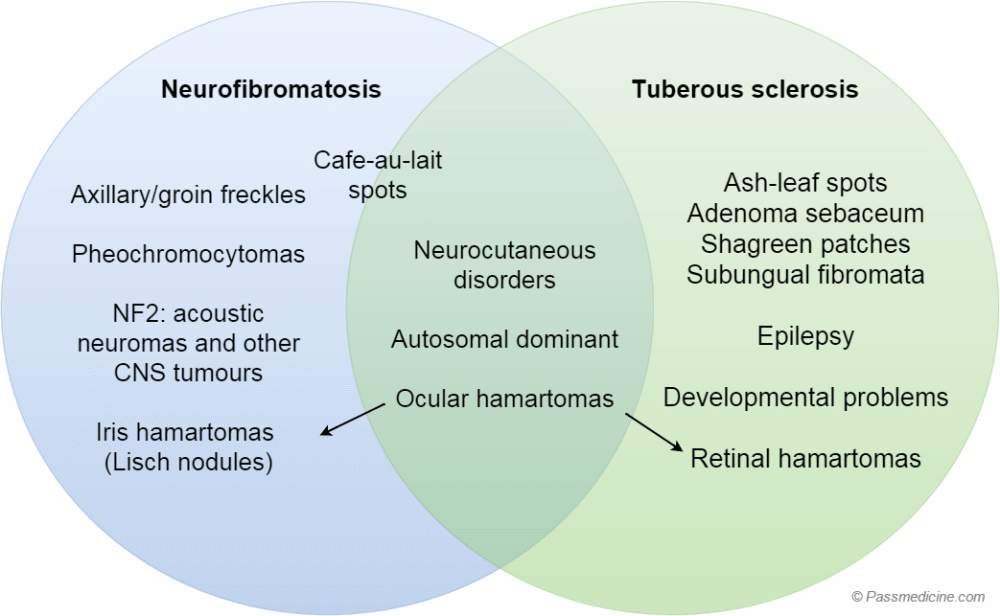
Comparison of neurofibromatosis and tuberous sclerosis. Note that whilst they are both autosomal dominant neurocutaneous disorders there is little overlap otherwise
+PassMedicine Notes
There are two types of neurofibromatosis, NF1 and NF2. Both are inherited in an autosomal dominant fashion.
Comparison
_NF1_NF2|
Incidence _ 1 in 4,000 _ 1 in 100,000|
Gene & protein _Mutation in the NF1 gene on chromosome 17 → loss of neurofibromin, a negative regulator of RAS signalling _ Mutation in the NF2 gene on chromosome 22 → loss of merlin, which controls Schwann cell growth and contact inhibition|
Primary cell type affected _ Affects neural crest–derived cells broadly (Schwann cells, melanocytes, fibroblasts) _ Predominantly affects Schwann cells|
Features_ Cafe-au-lait spots (>= 6, 15 mm in diameter)
Axillary/groin freckles
Peripheral neurofibromas
Iris hamartomas (Lisch nodules) in > 90%
Scoliosis
Pheochromocytomas _
Bilateral vestibular schwannomas
Multiple intracranial schwannomas, menigiomas and ependymomas|
pdd911.png
Comparison of neurofibromatosis and tuberous sclerosis. Note that whilst they are both autosomal dominant neurocutaneous disorders there is little overlap otherwise