Highlighter is on. Drag to highlight text. Click a highlight to remove it.
ALL / Cardiology
Infective endocarditis: prognosis and management
Infective endocarditis: prognosis and management
Poor prognostic factors- Staphylococcus aureus infection (see below)
- prosthetic valve (especially 'early', acquired during surgery)
- culture negative endocarditis
- low complement levels
Mortality according to organism
- staphylococci - 30%
- bowel organisms - 15%
- streptococci - 5%
Current antibiotic guidelines (source: British National Formulary)
| Scenario | Suggested antibiotic therapy |
|---|---|
| Initial blind therapy | Native valve
If penicillin allergic, MRSA or severe sepsis
If prosthetic valve
|
| Native valve endocarditis caused by staphylococci | Flucloxacillin If penicillin allergic or MRSA
|
| Prosthetic valve endocarditis caused by staphylococci | Flucloxacillin + rifampicin + low-dose gentamicin If penicillin allergic or MRSA
|
| Endocarditis caused by fully-sensitive streptococci (e.g. viridans) | Benzylpenicillin If penicillin allergic
|
| Endocarditis caused by less sensitive streptococci | Benzylpenicillin + low-dose gentamicin If penicillin allergic
|
Indications for surgery
- severe valvular incompetence
- aortic abscess (often indicated by a lengthening PR interval)
- infections resistant to antibiotics/fungal infections
- cardiac failure refractory to standard medical treatment
- recurrent emboli after antibiotic therapy
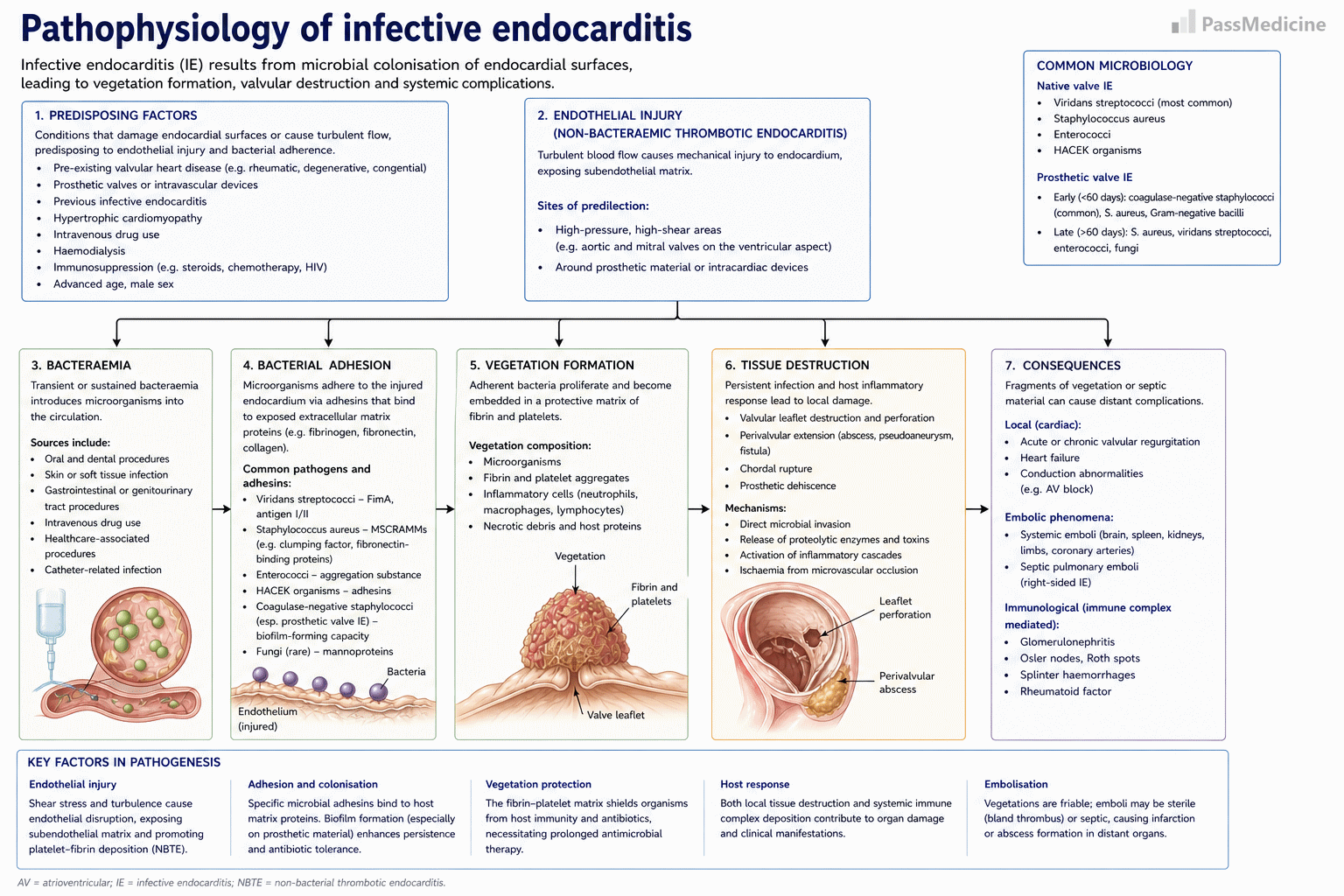
Pathophysiology of infective endocarditis
+PassMedicine Notes
Poor prognostic factors
- Staphylococcus aureus infection (see below)
- prosthetic valve (especially 'early', acquired during surgery)
- culture negative endocarditis
- low complement levels
- staphylococci - 30%
- bowel organisms - 15%
- streptococci - 5%
Current antibiotic guidelines (source: British National Formulary)
Scenario _ Suggested antibiotic therapy| Initial blind therapy _ Native valve- amoxicillin, consider adding low-dose gentamicin
- vancomycin + low-dose gentamicin
- vancomycin + rifampicin + low-dose gentamicin|
- vancomycin + rifampicin |
- vancomycin + rifampicin + low-dose gentamicin|
- vancomycin + low-dose gentamicin |
- vancomycin + low-dose gentamicin|
- severe valvular incompetence
- aortic abscess (often indicated by a lengthening PR interval)
- infections resistant to antibiotics/fungal infections
- cardiac failure refractory to standard medical treatment
- recurrent emboli after antibiotic therapy