Highlighter is on. Drag to highlight text. Click a highlight to remove it.
ALL / Neurology
Guillain-Barre syndrome: features
Guillain-Barre syndrome: features
Guillain-Barre syndrome describes an immune-mediated demyelination of the peripheral nervous system often triggered by an infection (classically Campylobacter jejuni).Initial symptoms
- around 65% of patients experience back/leg pain in the initial stages of the illness
The characteristic features of Guillain-Barre syndrome is progressive, symmetrical weakness of all the limbs.
- the weakness is classically ascending i.e. the legs are affected first
- reflexes are reduced or absent
- sensory symptoms tend to be mild (e.g. distal paraesthesia) with very few sensory signs
Other features
- there may be a history of gastroenteritis
- respiratory muscle weakness
- cranial nerve involvement
- diplopia
- bilateral facial nerve palsy
- oropharyngeal weakness is common
- autonomic involvement
- urinary retention
- diarrhoea
Less common findings
- papilloedema: thought to be secondary to reduced CSF resorption
Investigations
- lumbar puncture
- rise in protein with a normal white blood cell count (albuminocytologic dissociation) - found in 66%
- nerve conduction studies may be performed
- decreased motor nerve conduction velocity (due to demyelination)
- prolonged distal motor latency
- increased F wave latency
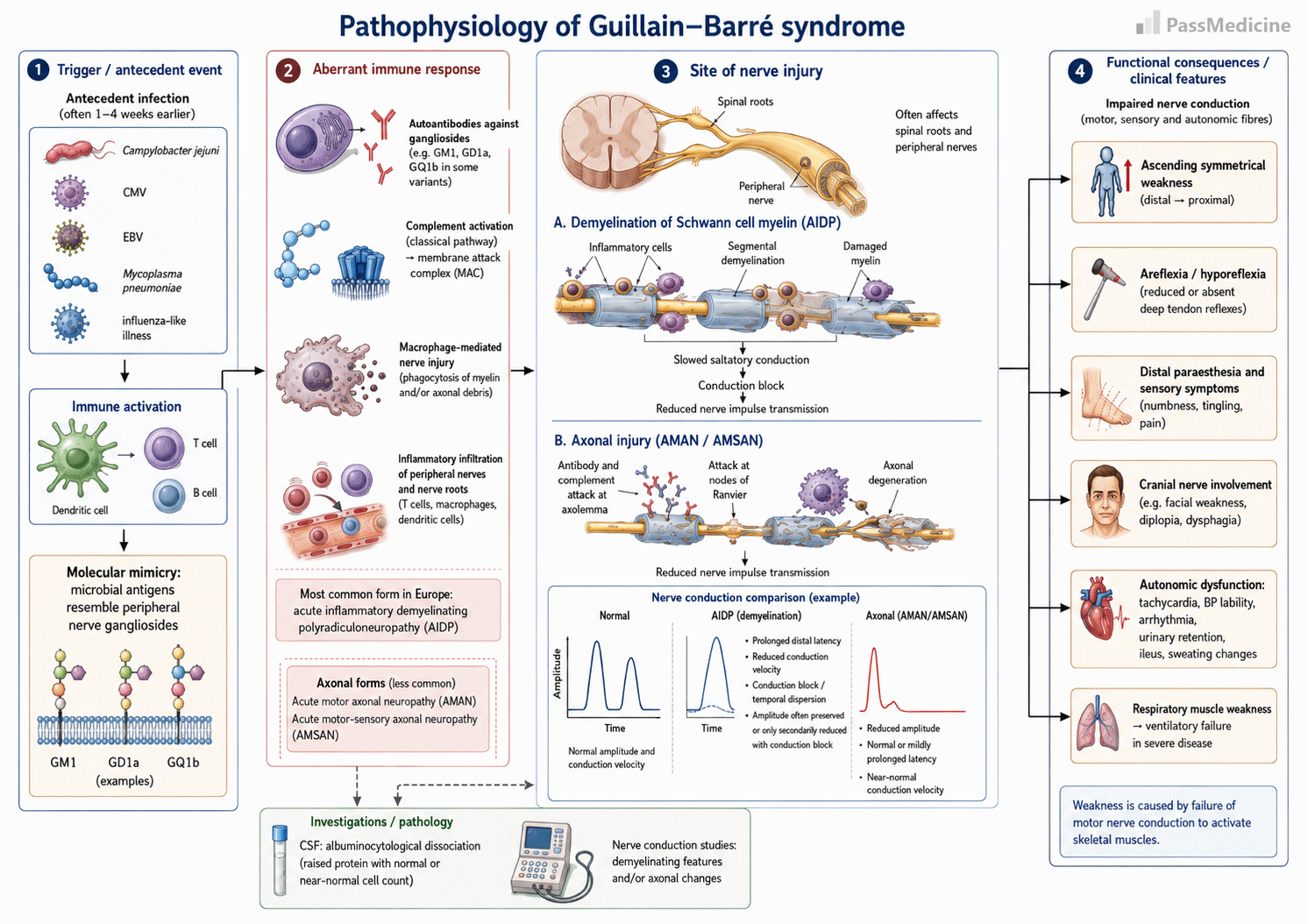
Pathophysiology of Guillain-Barre syndrome
+PassMedicine Notes
Guillain-Barre syndrome describes an immune-mediated demyelination of the peripheral nervous system often triggered by an infection (classically Campylobacter jejuni).
Initial symptoms- around 65% of patients experience back/leg pain in the initial stages of the illness
- the weakness is classically ascending i.e. the legs are affected first
- reflexes are reduced or absent
- sensory symptoms tend to be mild (e.g. distal paraesthesia) with very few sensory signs
- there may be a history of gastroenteritis
- respiratory muscle weakness
- cranial nerve involvement
- diplopia
- bilateral facial nerve palsy
- oropharyngeal weakness is common
- autonomic involvement
- urinary retention
- diarrhoea
- papilloedema: thought to be secondary to reduced CSF resorption
- lumbar puncture
- rise in protein with a normal white blood cell count (albuminocytologic dissociation) - found in 66%
- nerve conduction studies may be performed
- decreased motor nerve conduction velocity (due to demyelination)
- prolonged distal motor latency
- increased F wave latency