Asthma: management in adults
Asthma: management in adults
In 2024 NICE, the British Thoracic Society and SIGN produced joint guidelines on the management of asthma following many years of conflicting guidelines. The new guidelines represent a major step change in the management of asthma is both diagnosed and treated.For many years patients with asthma were started on a short-acting beta-2 agonist (SABA) inhaler before 'stepping up' to a regular inhaled corticosteroid with a SABA as required. The new guidelines now advocate the use of combined inhalers (ICS + long-acting beta-2 agonist) as reliever therapy or regularly, depending on the severity of asthma. Given the prevalence of asthma, it is likely that doctors will have to deal with patients on 'conventional' asthma treatments for many years to come. The joint guidelines therefore include guidance on how to manage these patients if their current treatment is controlling their symptoms sufficiently.
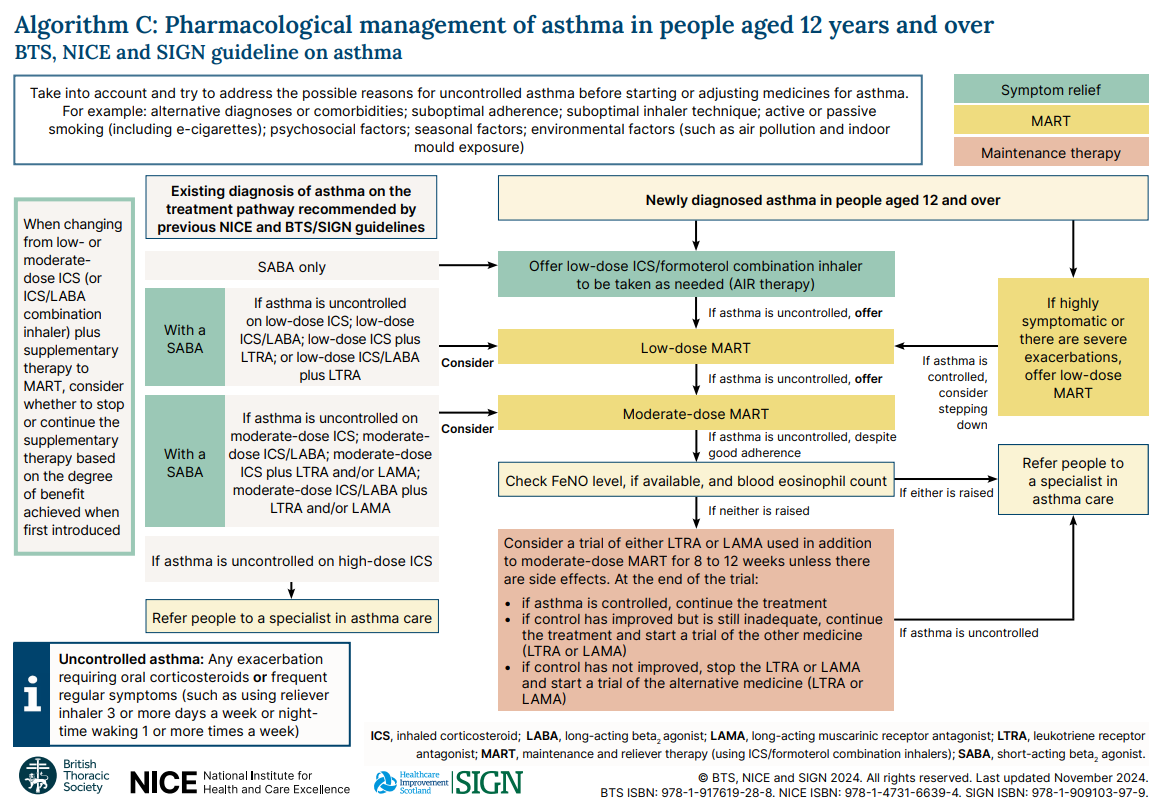
Management of adult patients aged children aged ≥ 12 years with newly diagnosed asthma
Step 1 NICE
- a low-dose inhaled corticosteroid (ICS)/formoterol combination inhaler to be taken as needed for symptom relief
- this is termed anti-inflammatory reliever (AIR) therapy
- if the patient presents highly symptomatic (for example, regular nocturnal waking) or with a severe exacerbation:
- start treatment with low-dose MART (maintenance and reliever therapy, see below)
- treat the acute symptoms as appropriate (e.g. a course of oral corticosteroids may be indicated)
Step 2 NICE
- a low-dose MART
- MART describes using an inhaled corticosteroid (ICS)/formoterol combination inhaler for daily maintenance therapy and the relief of symptoms as needed, i.e. regularly and as required
Step 3
- a moderate-dose MART
Step 4
- check the fractional exhaled nitric oxide (FeNO) level if available, and the blood eosinophil count NICE
- if either of these is raised, refer to a specialist in asthma care
- if neither FeNO nor eosinophil count is raised, consider a trial of either a leukotriene receptor antagonist (LTRA) or a long-acting muscarinic receptor antagonist (LAMA) used in addition to moderate-dose MART
- if control has not improved, stop the LTRA or LAMA and start a trial of the alternative medicine (LTRA or LAMA)
Step 5
- refer people to a specialist in asthma care when asthma is not controlled despite treatment with moderate-dose MART, and trials of an LTRA and a LAMA
Transferring people aged 12 and over from other treatment pathways
There will be many people whose asthma was managed according to the previous guidelines that present with uncontrolled asthmatic symptoms. The guidelines give advice on how these people should be switched: NICE
| Existing asthma treatment | New asthma treatment |
|---|---|
| SABA as required only | Low-dose ICS/formoterol combination inhaler used as needed (as-needed AIR therapy) |
| SABA as required + regular low-dose ICS SABA as required + regular low-dose ICS/LABA SABA as required + regular low-dose ICS + LTRA SABA as required + regular low-dose ICS/LABA + LTRA | Regular low-dose regular ICS/formoterol combination inhaler (MART therapy) |
| SABA as required + regular moderate-dose ICS SABA as required + regular moderate-dose ICS/LABA SABA as required + regular moderate-dose ICS + LTRA or LAMA SABA as required + regular moderate-dose ICS/LABA + LTRA or LAMA | Regular moderate-dose MART therapy |
| Treatment regime containing a high-dose ICS | Refer to a respiratory specialist |
+PassMedicine Notes
In 2024 NICE, the British Thoracic Society and SIGN produced joint guidelines on the management of asthma following many years of conflicting guidelines. The new guidelines represent a major step change in the management of asthma is both diagnosed and treated.
For many years patients with asthma were started on a short-acting beta-2 agonist (SABA) inhaler before 'stepping up' to a regular inhaled corticosteroid with a SABA as required. The new guidelines now advocate the use of combined inhalers (ICS + long-acting beta-2 agonist) as reliever therapy or regularly, depending on the severity of asthma. Given the prevalence of asthma, it is likely that doctors will have to deal with patients on 'conventional' asthma treatments for many years to come. The joint guidelines therefore include guidance on how to manage these patients if their current treatment is controlling their symptoms sufficiently.
Management of adult patients aged children aged ≥ 12 years with newly diagnosed asthma
Step 1 NICE- a low-dose inhaled corticosteroid (ICS)/formoterol combination inhaler to be taken as needed for symptom relief
- this is termed anti-inflammatory reliever (AIR) therapy
- if the patient presents highly symptomatic (for example, regular nocturnal waking) or with a severe exacerbation:
- start treatment with low-dose MART (maintenance and reliever therapy, see below)
- treat the acute symptoms as appropriate (e.g. a course of oral corticosteroids may be indicated)
- a low-dose MART
- MART describes using an inhaled corticosteroid (ICS)/formoterol combination inhaler for daily maintenance therapy and the relief of symptoms as needed, i.e. regularly and as required
- a moderate-dose MART
- check the fractional exhaled nitric oxide (FeNO) level if available, and the blood eosinophil count NICE
- if either of these is raised, refer to a specialist in asthma care
- if neither FeNO nor eosinophil count is raised, consider a trial of either a leukotriene receptor antagonist (LTRA) or a long-acting muscarinic receptor antagonist (LAMA) used in addition to moderate-dose MART
- if control has not improved, stop the LTRA or LAMA and start a trial of the alternative medicine (LTRA or LAMA)
- refer people to a specialist in asthma care when asthma is not controlled despite treatment with moderate-dose MART, and trials of an LTRA and a LAMA
Transferring people aged 12 and over from other treatment pathways
There will be many people whose asthma was managed according to the previous guidelines that present with uncontrolled asthmatic symptoms. The guidelines give advice on how these people should be switched: NICE
Existing asthma treatment _ New asthma treatment| SABA as required only _ Low-dose ICS/formoterol combination inhaler used as needed (as-needed AIR therapy)| SABA as required + regular low-dose ICS SABA as required + regular low-dose ICS/LABA SABA as required + regular low-dose ICS + LTRA SABA as required + regular low-dose ICS/LABA + LTRA _ Regular low-dose regular ICS/formoterol combination inhaler (MART therapy)| SABA as required + regular moderate-dose ICS SABA as required + regular moderate-dose ICS/LABA SABA as required + regular moderate-dose ICS + LTRA or LAMA SABA as required + regular moderate-dose ICS/LABA + LTRA or LAMA _ Regular moderate-dose MART therapy| Treatment regime containing a high-dose ICS _ Refer to a respiratory specialist|