Highlighter is on. Drag to highlight text. Click a highlight to remove it.
ALL / Endocrinology
Renal tubular acidosis
Renal tubular acidosis
All three types of renal tubular acidosis (RTA) are associated with hyperchloraemic metabolic acidosis (normal anion gap).Type 1 RTA (distal)
- inability to generate acid urine (secrete H+) in distal tubule
- causes hypokalaemia
- complications include nephrocalcinosis and renal stones
- causes include idiopathic, rheumatoid arthritis, SLE, Sjogren's, amphotericin B toxicity, analgesic nephropathy
nephrocalcinosis - a classical finding in type 1 RTA">
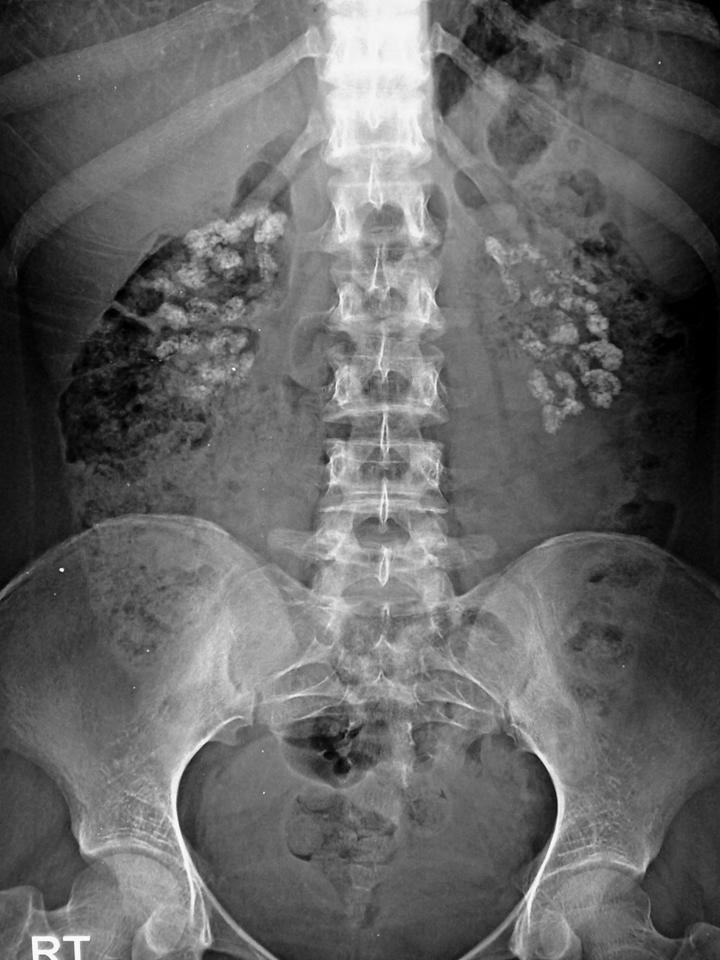
Abdominal x-ray showing
Type 2 RTA (proximal)
- decreased HCO3- reabsorption in proximal tubule
- causes hypokalaemia
- complications include osteomalacia
- causes include idiopathic, as part of Fanconi syndrome, Wilson's disease, cystinosis, outdated tetracyclines, carbonic anhydrase inhibitors (acetazolamide, topiramate)
Type 3 RTA (mixed)
- extremely rare
- caused by carbonic anhydrase II deficiency
- results in hypokalaemia
Type 4 RTA (hyperkalaemic)
- reduction in aldosterone leads in turn to a reduction in proximal tubular ammonium excretion
- causes hyperkalaemia
- causes include hypoaldosteronism, diabetes
+PassMedicine Notes
All three types of renal tubular acidosis (RTA) are associated with hyperchloraemic metabolic acidosis (normal anion gap).
Type 1 RTA (distal)- inability to generate acid urine (secrete H+) in distal tubule
- causes hypokalaemia
- complications include nephrocalcinosis and renal stones
- causes include idiopathic, rheumatoid arthritis, SLE, Sjogren's, amphotericin B toxicity, analgesic nephropathy
- decreased HCO3- reabsorption in proximal tubule
- causes hypokalaemia
- complications include osteomalacia
- causes include idiopathic, as part of Fanconi syndrome, Wilson's disease, cystinosis, outdated tetracyclines, carbonic anhydrase inhibitors (acetazolamide, topiramate)
- extremely rare
- caused by carbonic anhydrase II deficiency
- results in hypokalaemia
- reduction in aldosterone leads in turn to a reduction in proximal tubular ammonium excretion
- causes hyperkalaemia
- causes include hypoaldosteronism, diabetes