Highlighter is on. Drag to highlight text. Click a highlight to remove it.
ALL / Dermatology
Acne vulgaris: management
Acne vulgaris: management
Acne vulgaris is a common skin disorder which usually occurs in adolescence. It typically affects the face, neck and upper trunk and is characterised by the obstruction of the pilosebaceous follicles with keratin plugs which results in comedones, inflammation and pustules.Acne may be classified into mild, moderate or severe:
- mild: open and closed comedones with or without sparse inflammatory lesions
- moderate acne: widespread non-inflammatory lesions and numerous papules and pustules
- severe acne: extensive inflammatory lesions, which may include nodules, pitting, and scarring
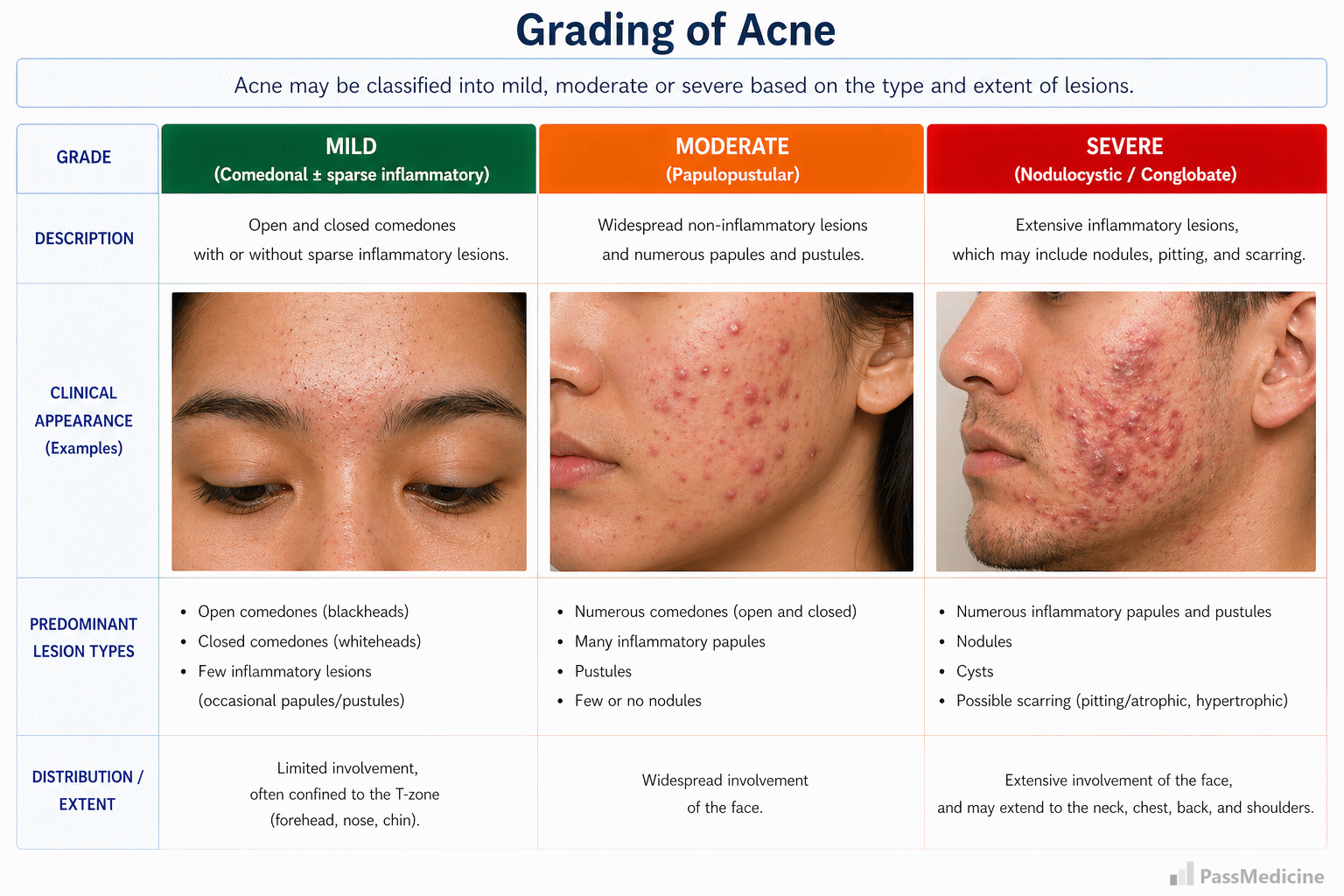
Grading of acne vulgaris
For people with mild to moderate acne:
- a 12-week course of topical combination therapy should be tried first-line:
- a fixed combination of topical adapalene with topical benzoyl peroxide
- a fixed combination of topical tretinoin with topical clindamycin
- a fixed combination of topical benzoyl peroxide with topical clindamycin
- topical benzoyl peroxide may be used as monotherapy if these options are contraindicated or the person wishes to avoid using a topical retinoid or an antibiotic
For people with moderate to severe acne:
- a 12-week course of one of the following options:
- a fixed combination of topical adapalene with topical benzoyl peroxide
- a fixed combination of topical tretinoin with topical clindamycin
- a fixed combination of topical adapalene with topical benzoyl peroxide + either oral lymecycline or oral doxycycline
- a topical azelaic acid + either oral lymecycline or oral doxycycline
- important points about oral antibiotic usage:
- tetracyclines should be avoided in pregnant or breastfeeding women and in children younger than 12 years of age. Erythromycin may be used in pregnancy
- minocycline is now considered less appropriate due to the possibility of irreversible pigmentation
- only continue a treatment option that includes an antibiotic (topical or oral) for more than 6 months in exceptional circumstances
- a topical retinoid (if not contraindicated) or benzoyl peroxide should always be co-prescribed with oral antibiotics to reduce the risk of antibiotic resistance developing. Topical and oral antibiotics should not be used in combination
- Gram-negative folliculitis may occur as a complication of long-term antibiotic use - high-dose oral trimethoprim is effective if this occurs
- combined oral contraceptives (COCP) are an alternative to oral antibiotics in women
- as with antibiotics, they should be used in combination with topical agents
- Dianette (co-cyprindiol) is sometimes used as it has anti-androgen properties. However, it has an increased risk of venous thromboembolism compared to other COCPs, therefore it should generally be used second-line, only be given for 3 months and women should be appropriately counselled about the risks
- oral isotretinoin: only under specialist supervision
- pregnancy is a contraindication to topical and oral retinoid treatment
To reduce the risk of antibiotic resistance developing the following should not be used to treat acne:
- monotherapy with a topical antibiotic
- monotherapy with an oral antibiotic
- a combination of a topical antibiotic and an oral antibiotic
NICE referral criteria
- the following patients should be referred to a dermatologist:
- patients with acne conglobate acne: a rare and severe form of acne found mostly in men that presents with extensive inflammatory papules, suppurative nodules (that may coalesce to form sinuses) and cysts on the trunk.
- patients with nodulo-cystic acne
- referral should be considered in the following scenarios:
- mild to moderate acne has not responded to two completed courses of treatment
- moderate to severe acne has not responded to previous treatment that includes an oral antibiotic
- acne with scarring
- acne with persistent pigmentary changes
- acne is causing or contributing to persistent psychological distress or a mental health disorder
+PassMedicine Notes
Acne vulgaris is a common skin disorder which usually occurs in adolescence. It typically affects the face, neck and upper trunk and is characterised by the obstruction of the pilosebaceous follicles with keratin plugs which results in comedones, inflammation and pustules.
Acne may be classified into mild, moderate or severe:- mild: open and closed comedones with or without sparse inflammatory lesions
- moderate acne: widespread non-inflammatory lesions and numerous papules and pustules
- severe acne: extensive inflammatory lesions, which may include nodules, pitting, and scarring
- a 12-week course of topical combination therapy should be tried first-line:
- a fixed combination of topical adapalene with topical benzoyl peroxide
- a fixed combination of topical tretinoin with topical clindamycin
- a fixed combination of topical benzoyl peroxide with topical clindamycin
- topical benzoyl peroxide may be used as monotherapy if these options are contraindicated or the person wishes to avoid using a topical retinoid or an antibiotic
- a 12-week course of one of the following options:
- a fixed combination of topical adapalene with topical benzoyl peroxide
- a fixed combination of topical tretinoin with topical clindamycin
- a fixed combination of topical adapalene with topical benzoyl peroxide + either oral lymecycline or oral doxycycline
- a topical azelaic acid + either oral lymecycline or oral doxycycline
- important points about oral antibiotic usage:
- tetracyclines should be avoided in pregnant or breastfeeding women and in children younger than 12 years of age. Erythromycin may be used in pregnancy
- minocycline is now considered less appropriate due to the possibility of irreversible pigmentation
- only continue a treatment option that includes an antibiotic (topical or oral) for more than 6 months in exceptional circumstances
- a topical retinoid (if not contraindicated) or benzoyl peroxide should always be co-prescribed with oral antibiotics to reduce the risk of antibiotic resistance developing. Topical and oral antibiotics should not be used in combination
- Gram-negative folliculitis may occur as a complication of long-term antibiotic use - high-dose oral trimethoprim is effective if this occurs
- combined oral contraceptives (COCP) are an alternative to oral antibiotics in women
- as with antibiotics, they should be used in combination with topical agents
- Dianette (co-cyprindiol) is sometimes used as it has anti-androgen properties. However, it has an increased risk of venous thromboembolism compared to other COCPs, therefore it should generally be used second-line, only be given for 3 months and women should be appropriately counselled about the risks
- oral isotretinoin: only under specialist supervision
- pregnancy is a contraindication to topical and oral retinoid treatment
Initial management for acne vulgaris
To reduce the risk of antibiotic resistance developing the following should not be used to treat acne:- monotherapy with a topical antibiotic
- monotherapy with an oral antibiotic
- a combination of a topical antibiotic and an oral antibiotic
- the following patients should be referred to a dermatologist:
- patients with acne conglobate acne: a rare and severe form of acne found mostly in men that presents with extensive inflammatory papules, suppurative nodules (that may coalesce to form sinuses) and cysts on the trunk.
- patients with nodulo-cystic acne
- referral should be considered in the following scenarios:
- mild to moderate acne has not responded to two completed courses of treatment
- moderate to severe acne has not responded to previous treatment that includes an oral antibiotic
- acne with scarring
- acne with persistent pigmentary changes
- acne is causing or contributing to persistent psychological distress or a mental health disorder