Highlighter is on. Drag to highlight text. Click a highlight to remove it.
ALL / Endocrinology
Diabetes mellitus: management of type 2
Diabetes mellitus: management of type 2
NICE updated its guidance on the management of type 2 diabetes mellitus (T2DM) in 2026. This update reflected the advances in drug therapy and improved evidence regarding newer therapies such as SGLT-2 inhibitors.HbA1c targets
Approach
- individual targets should be agreed with patients to encourage motivation
- HbA1c should be checked every 3-6 months until stable, then 6 monthly
- NICE encourage us to consider relaxing targets on 'a case-by-case basis, with particular consideration for people who are older or frail, for adults with type 2 diabetes'
Targets
- aim for 48 mmol/mol (6.5%) if managed by healthy living alone, or with an initial drug regimen not associated with hypoglycaemia
- aim for 53 mmol/mol (7.0%) if taking a medicine associated with hypoglycaemia
- if HbA1c rises to 58 mmol/mol (7.5%) or higher on the initial medication regimen, NICE says to:
- reinforce advice about diet, healthy living and adherence
- support the person to aim for 53 mmol/mol (7.0%)
- intensify medicines
Initial medication
Previously standard-release metformin was the cornerstone of T2DM management. Now, adults should be started on the two following core drugs:
- modified-release metformin
- should be started first
- an SGLT-2 inhibitor
- start this as soon as metformin is at the maximum tolerated dose
If metformin contraindicated or not tolerated then add an SGLT-2 inhibitor alone.
Specific scenarios:
- a history of cardiovascular disease
- subcutaneous semaglutide should be added to two core drugs
- patients develop early-onset T2DM (< 40 years)
- consider adding a GLP-1 receptor agonist or tirzepatide to two core drugs
- chronic kidney disease (eGFR 20-30 ml/min/1.73 m²)
- metformin is contraindicated, therefore:
- dapagliflozin or empagliflozin and
- a DPP-4 inhibitor
- chronic kidney disease (eGFR < 20 ml/min/1.73 m²)
- both core drugs are contraindicated, therefore:
- a DPP-4 inhibitor
- people with frailty
- modified-release metformin
- only offer an SGLT2 inhibitor if the person's level of frailty does not place them at risk of adverse events from such a medicine (for example, volume depletion or hypotension)
Next step
If no-relevant comorbidities:
- add a DPP-4 inhibitor as the standard 'second step' drug for patients who have not achieved their glycaemic targets despite taking the two core drugs
- if a DPP-4 inhibitor is contraindicated, not tolerated or is not effective, add:
- a sulfonylurea or
- pioglitazone (contraindicated by heart failure) or
- an insulin-based treatment
Obesity
- consider adding a GLP-1 receptor agonist or tirzepatide, if:
- they have been taking initial therapy for at least 3 months and
- further medicines are needed to reach their individualised glycaemic targets and
- they are not already taking a GLP-1 receptor agonist or tirzepatide.
- if still not controlled add a DPP-4 inhibitor
- if this is contraindicated, not tolerated or not effective, add a sulfonylurea or pioglitazone or an insulin-based treatment
Management of existing patients with T2DM
Given the significant changes to the 2026 guidelines, it is important to know how to manage the vast majority of patients who are already taking medications.
If a patient is taking standard-release metformin:
- continue with this treatment or
- switch to modified-release metformin if standard-release metformin is not tolerated or if this is the person's preference.
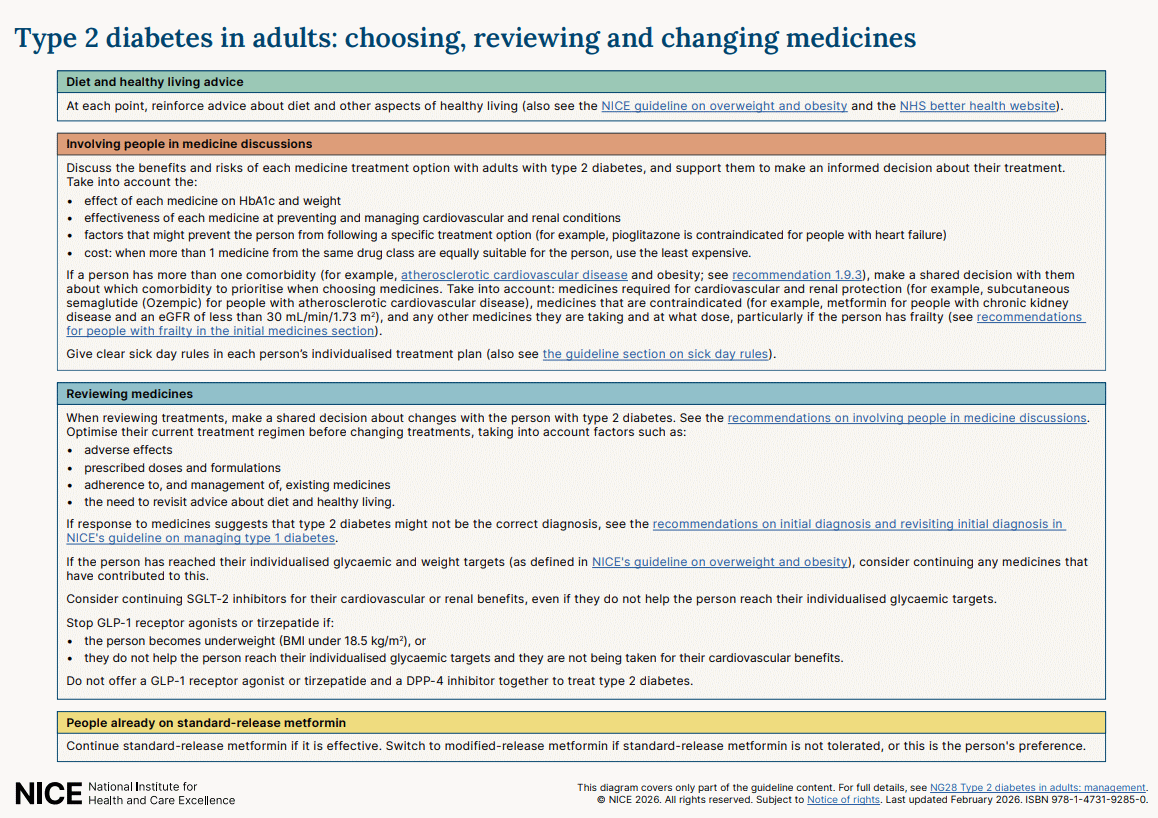
NICE summary - Type 2 diabetes in adults: choosing, reviewing and changing medicines
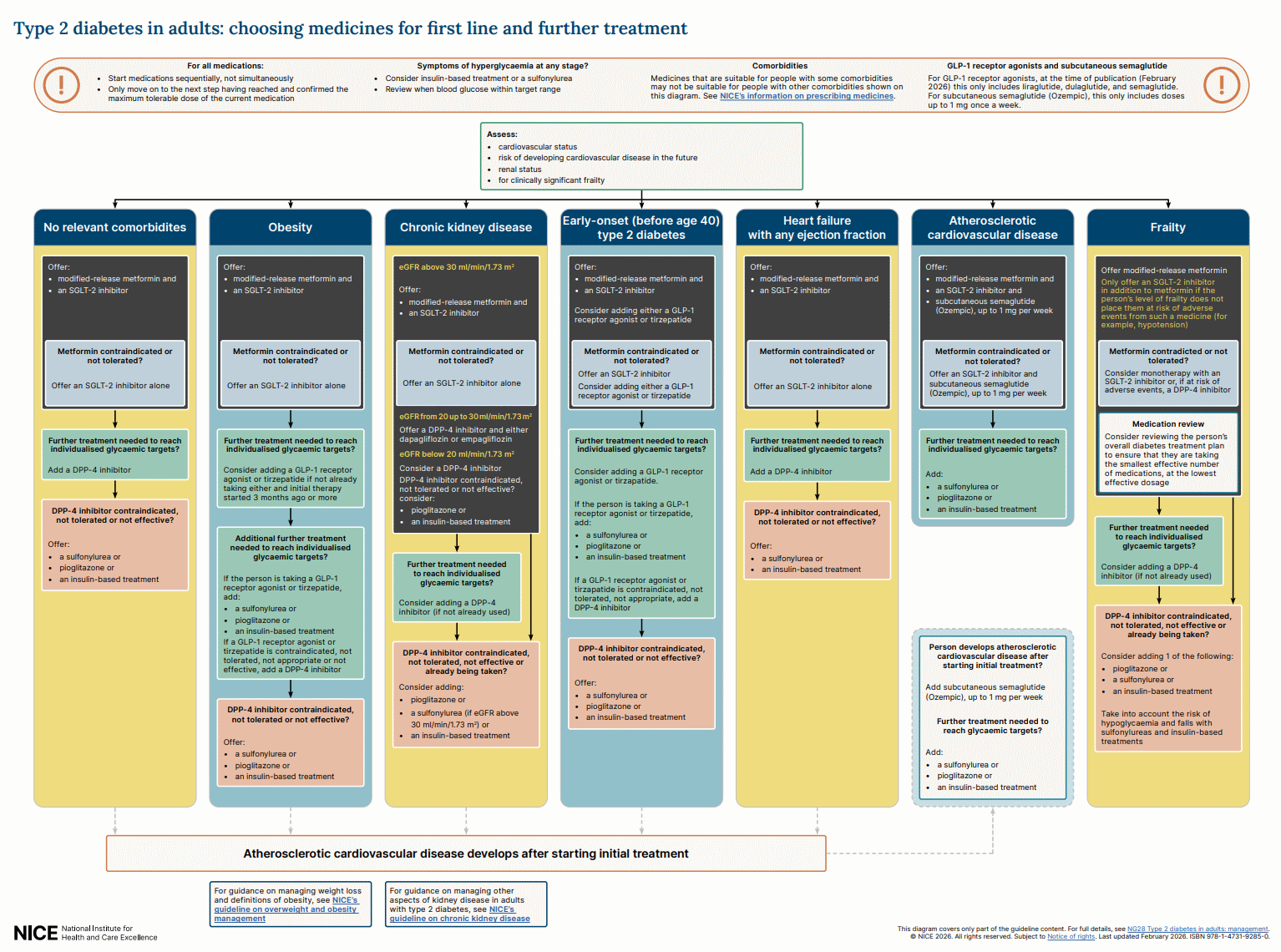
NICE summary - Type 2 diabetes in adults: choosing medicines for first line and further treatment
Other aspects of care
Dietary advice
- encourage high fibre, low glycaemic index sources of carbohydrates
- include low-fat dairy products and oily fish
- control the intake of foods containing saturated fats and trans fatty acids
- limited substitution of sucrose-containing foods for other carbohydrates is allowable, but care should be taken to avoid excess energy intake
- discourage the use of foods marketed specifically at people with diabetes
- initial target weight loss in an overweight person is 5-10%
Risk factor modification
Hypertension
- blood pressure targets are the same as for patients without type 2 diabetes (see table below)
- ACE inhibitors or angiotensin II receptor blockers (ARB) are first-line
- an ARB is preferred if the patient has a black African or African-Caribbean family origin
| Clinic BP | ABPM / HBPM | |
|---|---|---|
| Age < 80 years | 140/90 mmHg | 135/85 mmHg |
| Age > 80 years | 150/90 mmHg | 145/85 mmHg |
Antiplatelets
- should not be offered unless a patient has existing cardiovascular disease
Lipids
- following the 2014 NICE lipid modification guidelines only patients with a 10-year cardiovascular risk > 10% (using QRISK3) should be offered a statin. The first-line statin of choice is atorvastatin 20mg on
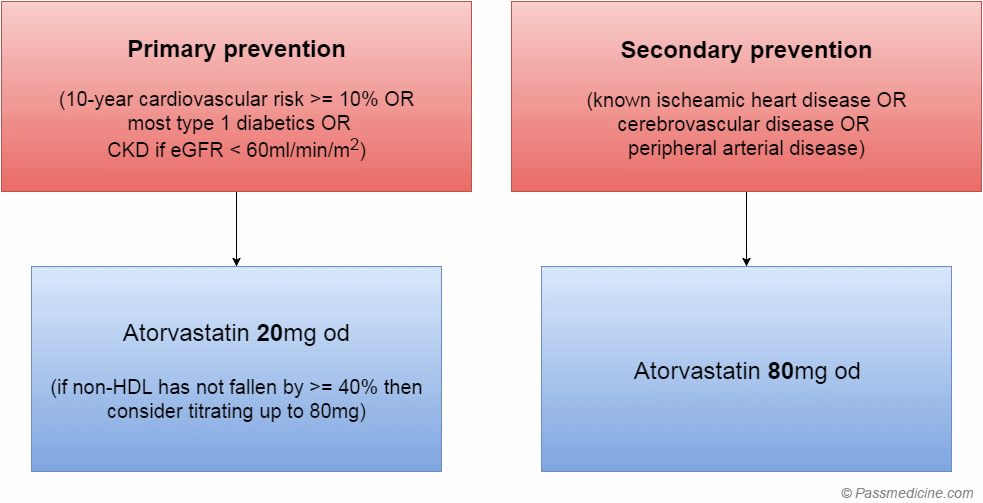
Graphic showing choice of statin.
+PassMedicine Notes
NICE updated its guidance on the management of type 2 diabetes mellitus (T2DM) in 2026. This update reflected the advances in drug therapy and improved evidence regarding newer therapies such as SGLT-2 inhibitors.
HbA1c targets
Approach- individual targets should be agreed with patients to encourage motivation
- HbA1c should be checked every 3-6 months until stable, then 6 monthly
- NICE encourage us to consider relaxing targets on 'a case-by-case basis, with particular consideration for people who are older or frail, for adults with type 2 diabetes'
- aim for 48 mmol/mol (6.5%) if managed by healthy living alone, or with an initial drug regimen not associated with hypoglycaemia
- aim for 53 mmol/mol (7.0%) if taking a medicine associated with hypoglycaemia
- if HbA1c rises to 58 mmol/mol (7.5%) or higher on the initial medication regimen, NICE says to:
- reinforce advice about diet, healthy living and adherence
- support the person to aim for 53 mmol/mol (7.0%)
- intensify medicines
Initial medication
Previously standard-release metformin was the cornerstone of T2DM management. Now, adults should be started on the two following core drugs:- modified-release metformin
- should be started first
- an SGLT-2 inhibitor
- start this as soon as metformin is at the maximum tolerated dose
If metformin contraindicated or not tolerated then add an SGLT-2 inhibitor alone.
Specific scenarios:- a history of cardiovascular disease
- subcutaneous semaglutide should be added to two core drugs
- patients develop early-onset T2DM (< 40 years)
- consider adding a GLP-1 receptor agonist or tirzepatide to two core drugs
- chronic kidney disease (eGFR 20-30 ml/min/1.73 m²)
- metformin is contraindicated, therefore:
- dapagliflozin or empagliflozin and
- a DPP-4 inhibitor
- chronic kidney disease (eGFR < 20 ml/min/1.73 m²)
- both core drugs are contraindicated, therefore:
- a DPP-4 inhibitor
- people with frailty
- modified-release metformin
- only offer an SGLT2 inhibitor if the person's level of frailty does not place them at risk of adverse events from such a medicine (for example, volume depletion or hypotension)
Next step
If no-relevant comorbidities:- add a DPP-4 inhibitor as the standard 'second step' drug for patients who have not achieved their glycaemic targets despite taking the two core drugs
- if a DPP-4 inhibitor is contraindicated, not tolerated or is not effective, add:
- a sulfonylurea or
- pioglitazone (contraindicated by heart failure) or
- an insulin-based treatment
- consider adding a GLP-1 receptor agonist or tirzepatide, if:
- they have been taking initial therapy for at least 3 months and
- further medicines are needed to reach their individualised glycaemic targets and
- they are not already taking a GLP-1 receptor agonist or tirzepatide.
- if still not controlled add a DPP-4 inhibitor
- if this is contraindicated, not tolerated or not effective, add a sulfonylurea or pioglitazone or an insulin-based treatment
Management of existing patients with T2DM
Given the significant changes to the 2026 guidelines, it is important to know how to manage the vast majority of patients who are already taking medications.
If a patient is taking standard-release metformin:- continue with this treatment or
- switch to modified-release metformin if standard-release metformin is not tolerated or if this is the person's preference.
Other aspects of care
Dietary advice- encourage high fibre, low glycaemic index sources of carbohydrates
- include low-fat dairy products and oily fish
- control the intake of foods containing saturated fats and trans fatty acids
- limited substitution of sucrose-containing foods for other carbohydrates is allowable, but care should be taken to avoid excess energy intake
- discourage the use of foods marketed specifically at people with diabetes
- initial target weight loss in an overweight person is 5-10%
Risk factor modification
Hypertension- blood pressure targets are the same as for patients without type 2 diabetes (see table below)
- ACE inhibitors or angiotensin II receptor blockers (ARB) are first-line
- an ARB is preferred if the patient has a black African or African-Caribbean family origin
- should not be offered unless a patient has existing cardiovascular disease
- following the 2014 NICE lipid modification guidelines only patients with a 10-year cardiovascular risk > 10% (using QRISK3) should be offered a statin. The first-line statin of choice is atorvastatin 20mg on