Highlighter is on. Drag to highlight text. Click a highlight to remove it.
ALL / Clinical Sciences
Diabetic nephropathy
Diabetic nephropathy
Basics- commonest cause of end-stage renal disease (ESRD) in the western world
- 33% of patients with type 1 diabetes mellitus have diabetic nephropathy by the age of 40 years
- approximately 5-10% of patients with type 1 diabetes mellitus develop (ESRD)
The pathophysiology is poorly understood, however:
- changes to the haemodynamics of the glomerulus is thought to be key, which leads to an increased glomerular capillary pressure
- non-enzymatic glycosylation of the basement membrane is thought to play a key role
- histological changes include: basement membrane thickening, capillary obliteration, mesangial widening. Nodulular hyaline areas develop in the glomuli - Kimmelstiel-Wilson nodules
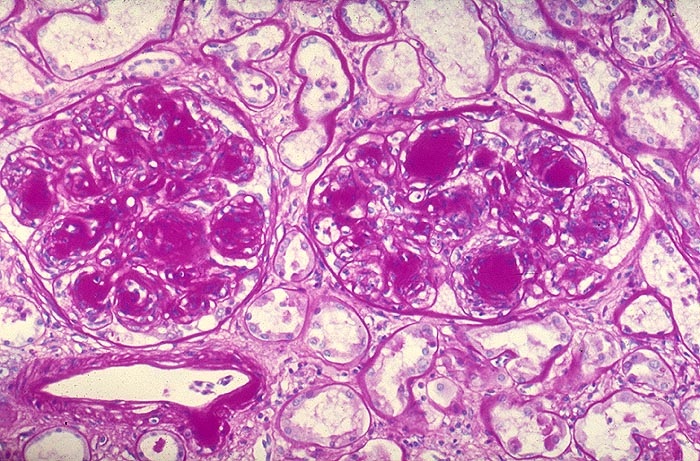
Thickening of the basement membrane is seen alongside multiple Kimmelstiel-Wilson nodules
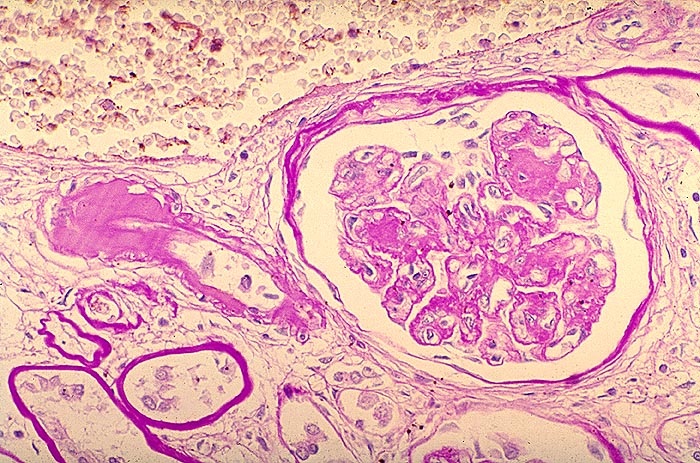
Severe arteriolosclerosis is seen in the afferent arteriole on the left of the slide. Multiple, smaller acellular nodules are seen in the glomerulus - Kimmelstiel-Wilson nodules. The tubular basement membrane is also thickened
Risk factors for developing diabetic nephropathy
| Modifiable | Non-modifiable |
|---|---|
| Hypertension Hyperlipidaemia Smoking Poor glycaemic control Raised dietary protein | Male sex Duration of diabetes Genetic predisposition (e.g. ACE gene polymorphisms) |
+PassMedicine Notes
Basics
- commonest cause of end-stage renal disease (ESRD) in the western world
- 33% of patients with type 1 diabetes mellitus have diabetic nephropathy by the age of 40 years
- approximately 5-10% of patients with type 1 diabetes mellitus develop (ESRD)
- changes to the haemodynamics of the glomerulus is thought to be key, which leads to an increased glomerular capillary pressure
- non-enzymatic glycosylation of the basement membrane is thought to play a key role
- histological changes include: basement membrane thickening, capillary obliteration, mesangial widening. Nodulular hyaline areas develop in the glomuli - Kimmelstiel-Wilson nodules
Risk factors for developing diabetic nephropathy
Modifiable_Non-modifiable| Hypertension Hyperlipidaemia Smoking Poor glycaemic control Raised dietary protein _Male sex Duration of diabetes Genetic predisposition (e.g. ACE gene polymorphisms)|