Highlighter is on. Drag to highlight text. Click a highlight to remove it.
ALL / Ophthalmology
Acute angle-closure glaucoma
Acute angle-closure glaucoma
Glaucoma is a group of disorders characterised by optic neuropathy due, in the majority of patients, to raised intraocular pressure (IOP). It is now recognised that a minority of patients with raised IOP do not have glaucoma and vice versa.In acute angle-closure glaucoma (AACG) there is a rise in IOP secondary to an impairment of aqueous outflow. Factors predisposing to AACG include:
- hypermetropia (long-sightedness)
- pupillary dilatation
- lens growth associated with age
Features
- severe pain: may be ocular or headache
- decreased visual acuity
- symptoms worse with mydriasis (e.g. watching TV in a dark room)
- hard, red-eye
- haloes around lights
- semi-dilated non-reacting pupil
- corneal oedema results in dull or hazy cornea
- systemic upset may be seen, such as nausea and vomiting and even abdominal pain
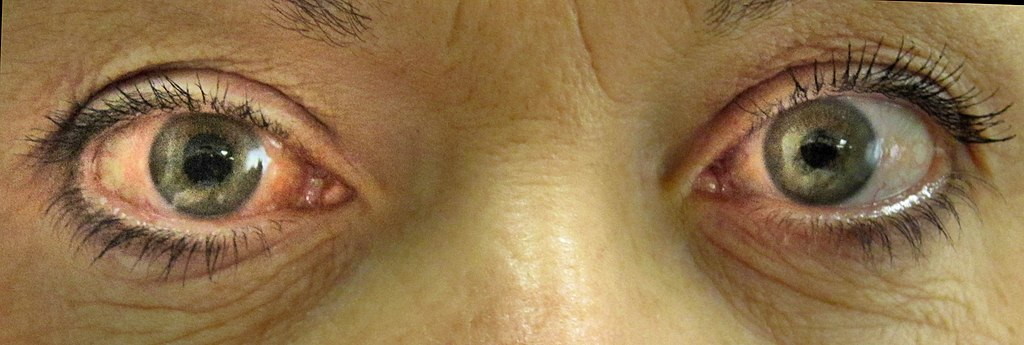
Acute angle closure glaucoma of the right eye - note the semi-dilated pupil and erythema
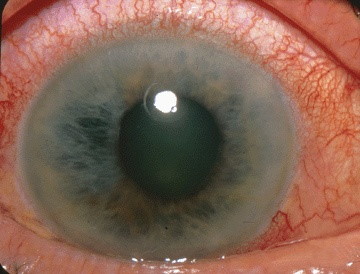
Photograph showing acute angle-closure glaucoma
Investigations
- tonometry to assess for elevated IOP
- gonioscopy (literally looking, oscopy, at the angle, gonio): a special lens for the slit lamp that allows visualisation of the angle
Management
The management of AACG is an emergency and should prompt urgent referral to an ophthalmologist. Emergency medical treatment is required to lower the IOP with more definitive surgical treatment given once the acute attack has settled.
There are no guidelines for the initial medical treatment emergency treatment. An example regime would be:
- combination of eye drops, for example:
- a direct parasympathomimetic (e.g. pilocarpine, causes contraction of the ciliary muscle → opening the trabecular meshwork → increased outflow of the aqueous humour)
- a beta-blocker (e.g. timolol, decreases aqueous humour production)
- an alpha-2 agonist (e.g. apraclonidine, dual mechanism, decreasing aqueous humour production and increasing uveoscleral outflow)
- intravenous acetazolamide
- reduces aqueous secretions
- some guidelines also recommend the use of topical steroids to reduce inflammation
Definitive management
- laser peripheral iridotomy
- creates a tiny hole in the peripheral iris → aqueous humour flowing to the angle
+PassMedicine Notes
Glaucoma is a group of disorders characterised by optic neuropathy due, in the majority of patients, to raised intraocular pressure (IOP). It is now recognised that a minority of patients with raised IOP do not have glaucoma and vice versa.
In acute angle-closure glaucoma (AACG) there is a rise in IOP secondary to an impairment of aqueous outflow. Factors predisposing to AACG include:- hypermetropia (long-sightedness)
- pupillary dilatation
- lens growth associated with age
- severe pain: may be ocular or headache
- decreased visual acuity
- symptoms worse with mydriasis (e.g. watching TV in a dark room)
- hard, red-eye
- haloes around lights
- semi-dilated non-reacting pupil
- corneal oedema results in dull or hazy cornea
- systemic upset may be seen, such as nausea and vomiting and even abdominal pain
- tonometry to assess for elevated IOP
- gonioscopy (literally looking, oscopy, at the angle, gonio): a special lens for the slit lamp that allows visualisation of the angle
Management
The management of AACG is an emergency and should prompt urgent referral to an ophthalmologist. Emergency medical treatment is required to lower the IOP with more definitive surgical treatment given once the acute attack has settled.
There are no guidelines for the initial medical treatment emergency treatment. An example regime would be:- combination of eye drops, for example:
- a direct parasympathomimetic (e.g. pilocarpine, causes contraction of the ciliary muscle --> opening the trabecular meshwork --> increased outflow of the aqueous humour)
- a beta-blocker (e.g. timolol, decreases aqueous humour production)
- an alpha-2 agonist (e.g. apraclonidine, dual mechanism, decreasing aqueous humour production and increasing uveoscleral outflow)
- intravenous acetazolamide
- reduces aqueous secretions
- some guidelines also recommend the use of topical steroids to reduce inflammation
- laser peripheral iridotomy
- creates a tiny hole in the peripheral iris --> aqueous humour flowing to the angle