Highlighter is on. Drag to highlight text. Click a highlight to remove it.
ALL / Cardiology
Atrial fibrillation: rate control and maintenance of sinus rhythm
Atrial fibrillation: rate control and maintenance of sinus rhythm
NICE updated its guidelines on the management of atrial fibrillation (AF) in 2021. The following is also based on the joint American Heart Association (AHA), American College of Cardiology (ACC) and European Society of Cardiology (ESC) 2012 guidelinesPatients presenting acutely with AF
If a patient has signs of haemodynamic instability (e.g. hypotension, heart failure) they should be electrically cardioverted, as per the peri-arrest tachycardia guidelines.
For haemodynamically stable patients, the management depends on how acute the AF is:
- < 48 hours: rate or rhythm control
- ≥ 48 hours or uncertain (e.g. patient not sure when symptoms started): rate control
- if considered for long-term rhythm control, delay cardioversion until they have been maintained on therapeutic anticoagulation for a minimum of 3 weeks
- anticoagulation
- all patients with new-onset AF require anticoagulation, regardless of onset
- long-term anticoagulation is based on the CHA2DS2-VASc score
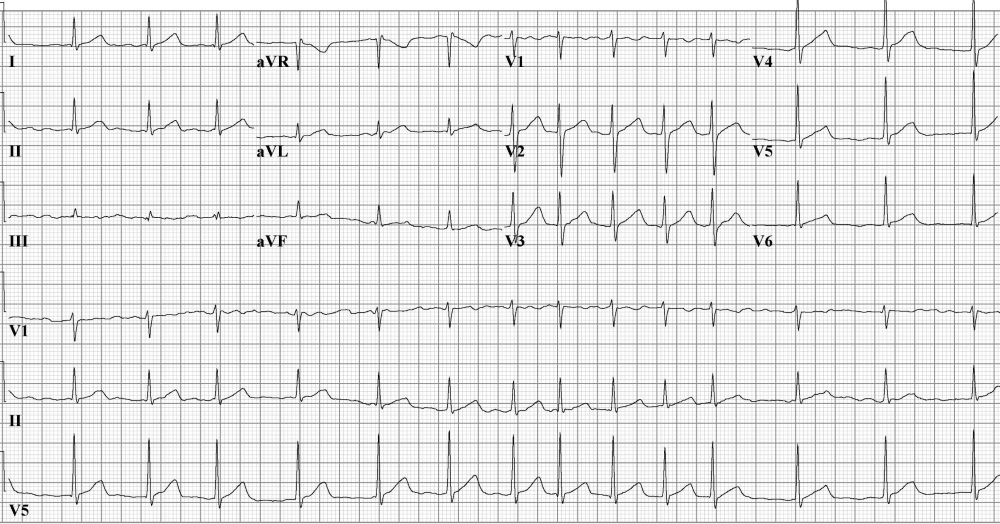
Atrial fibrillation - e Image used on license from Dr Smith, University of Minnesota
Rate control
Rate control should be offered as the first-line treatment strategy for atrial fibrillation except in people:
- whose atrial fibrillation has a reversible cause
- who have heart failure thought to be primarily caused by atrial fibrillation
- with new-onset atrial fibrillation (< 48 hours)
- with atrial flutter whose condition is considered suitable for an ablation strategy to restore sinus rhythm
- for whom a rhythm-control strategy would be more suitable based on clinical judgement
Medications
Agents used to control rate in patients with atrial fibrillation
- beta-blockers
- a common contraindication for beta-blockers is asthma
- calcium channel blockers
- digoxin
- not considered first-line anymore as they are less effective at controlling the heart rate during exercise
- should only be considered if the person does no or very little physical exercise or other rate-limiting drug options are ruled out because of comorbidities
- may have a role if there is coexistent heart failure
Rhythm control
Agents used to maintain sinus rhythm in patients with a history of atrial fibrillation
- beta-blockers
- dronedarone: second-line in patients following cardioversion
- amiodarone: particularly if coexisting heart failure
Catheter ablation
NICE recommends the use of catheter ablation for those with AF who have not responded to or wish to avoid, antiarrhythmic medication.
Technical aspects
- the aim is to ablate the faulty electrical pathways that are resulting in atrial fibrillation. This is typically due to aberrant electrical activity between the pulmonary veins and left atrium
- the procedure is performed percutaneously, typically via the groin
- both radiofrequency (uses heat generated from medium frequency alternating current) and cryotherapy can be used to ablate the tissue
Anticoagulation
- should be used 4 weeks before and during the procedure
- it should be remember that catheter ablation controls the rhythm but does not reduce the stroke risk, even if patients remain in sinus rhythm. Therefore, patients still require anticoagulation as per their CHA2DS2-VASc score
- if score = 0: 2 months anticoagulation recommended
- if score > 1: longterm anticoagulation recommended
Outcome
- notable complications include
- cardiac tamponade
- stroke
- pulmonary vein stenosis
- success rate
- around 50% of patients experience an early recurrence (within 3 months) of AF that often resolves spontaneously
- longer term, after 3 years, around 55% of patients who've had a single procedure remain in sinus rhythm. Of patients who've undergone multiple procedures around 80% are in sinus rhythm
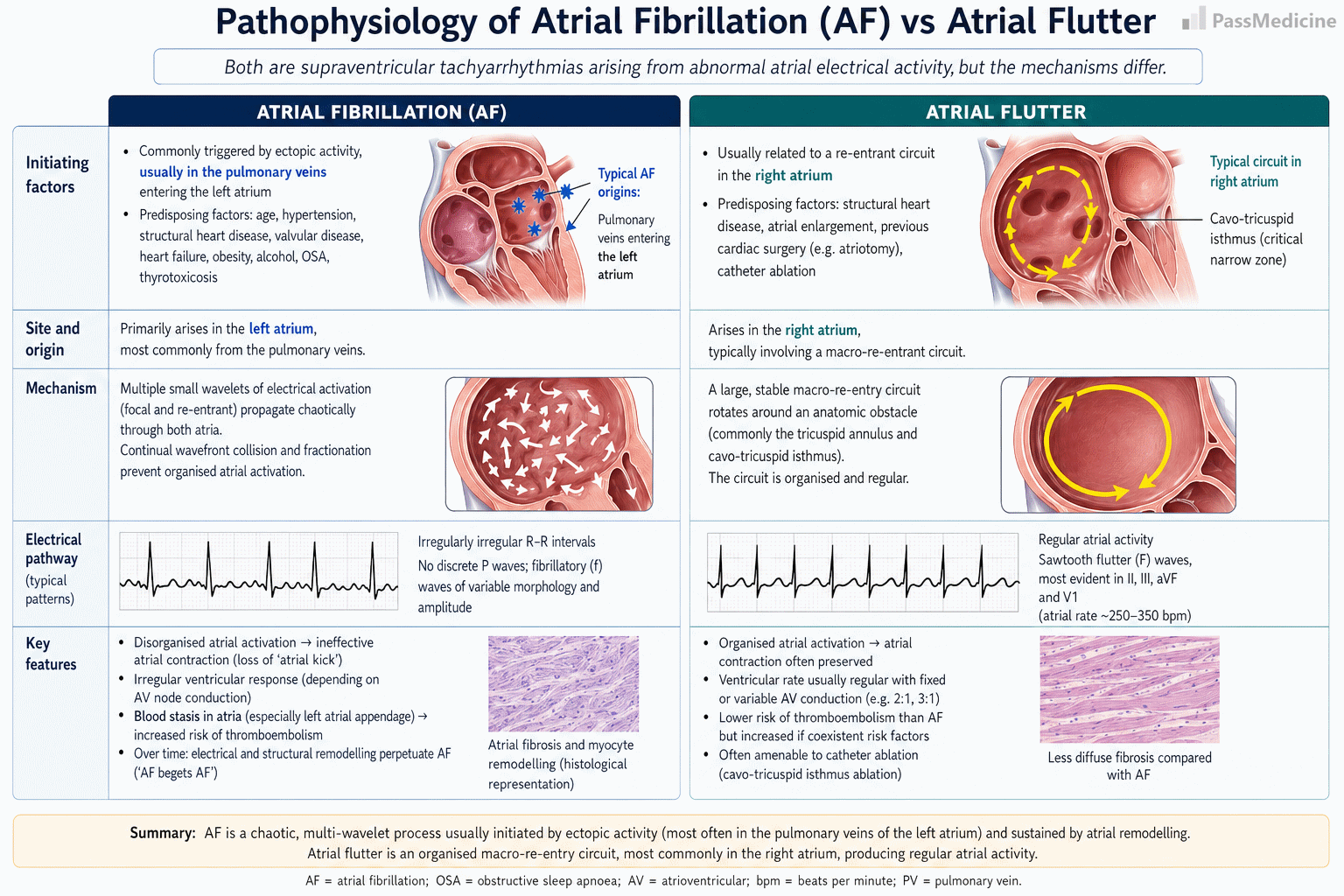
Pathophysiology of atrial fibrillation vs atrial flutter
+PassMedicine Notes
NICE updated its guidelines on the management of atrial fibrillation (AF) in 2021. The following is also based on the joint American Heart Association (AHA), American College of Cardiology (ACC) and European Society of Cardiology (ESC) 2012 guidelines
Patients presenting acutely with AF
If a patient has signs of haemodynamic instability (e.g. hypotension, heart failure) they should be electrically cardioverted, as per the peri-arrest tachycardia guidelines.
For haemodynamically stable patients, the management depends on how acute the AF is:- < 48 hours: rate or rhythm control
- ≥ 48 hours or uncertain (e.g. patient not sure when symptoms started): rate control
- if considered for long-term rhythm control, delay cardioversion until they have been maintained on therapeutic anticoagulation for a minimum of 3 weeks
- anticoagulation
- all patients with new-onset AF require anticoagulation, regardless of onset
- long-term anticoagulation is based on the CHA2DS2-VASc score
Rate control
Rate control should be offered as the first-line treatment strategy for atrial fibrillation except in people:- whose atrial fibrillation has a reversible cause
- who have heart failure thought to be primarily caused by atrial fibrillation
- with new-onset atrial fibrillation (< 48 hours)
- with atrial flutter whose condition is considered suitable for an ablation strategy to restore sinus rhythm
- for whom a rhythm-control strategy would be more suitable based on clinical judgement
Medications
Agents used to control rate in patients with atrial fibrillation- beta-blockers
- a common contraindication for beta-blockers is asthma
- calcium channel blockers
- digoxin
- not considered first-line anymore as they are less effective at controlling the heart rate during exercise
- should only be considered if the person does no or very little physical exercise or other rate-limiting drug options are ruled out because of comorbidities
- may have a role if there is coexistent heart failure
Rhythm control
Agents used to maintain sinus rhythm in patients with a history of atrial fibrillation- beta-blockers
- dronedarone: second-line in patients following cardioversion
- amiodarone: particularly if coexisting heart failure
Catheter ablation
NICE recommends the use of catheter ablation for those with AF who have not responded to or wish to avoid, antiarrhythmic medication.
Technical aspects- the aim is to ablate the faulty electrical pathways that are resulting in atrial fibrillation. This is typically due to aberrant electrical activity between the pulmonary veins and left atrium
- the procedure is performed percutaneously, typically via the groin
- both radiofrequency (uses heat generated from medium frequency alternating current) and cryotherapy can be used to ablate the tissue
- should be used 4 weeks before and during the procedure
- it should be remember that catheter ablation controls the rhythm but does not reduce the stroke risk, even if patients remain in sinus rhythm. Therefore, patients still require anticoagulation as per their CHA2DS2-VASc score
- if score = 0: 2 months anticoagulation recommended
- if score > 1: longterm anticoagulation recommended
- notable complications include
- cardiac tamponade
- stroke
- pulmonary vein stenosis
- success rate
- around 50% of patients experience an early recurrence (within 3 months) of AF that often resolves spontaneously
- longer term, after 3 years, around 55% of patients who've had a single procedure remain in sinus rhythm. Of patients who've undergone multiple procedures around 80% are in sinus rhythm