Highlighter is on. Drag to highlight text. Click a highlight to remove it.
ALL / Rheumatology
Osteoporosis: management
Osteoporosis: management
The National Osteoporosis Guideline Group (NOGG) updated their guidelines in 2021. NICE guidelines also have a section on the management of osteoporosis, largely based on the NOGG guidelines. Remember that osteporosis is usually asymptomatic until a fracture occurs. When thinking about osteoporosis management it is useful to think about a number of potential clinical scenarios:- a patient who has been identified as being at high risk of a fragility fracture based on a QFracture or FRAX score (please see the textbook entry on 'Osteoporosis: assessing risk')
- a patient who is about to start treatment that puts them at significant risk of developing osteoporosis - the most common example is longer-term glucocorticoids
- a patient who has just had a fragility fracture e.g. a symptomatic osteoporotic vertebral fracture
General management points
General points about the management of all patients
- all patients who are at risk of osteoporosis or have osteoporosis should be given advice regarding:
- lifestyle changes: a healthy, balanced diet, moderation of alcohol consumption and avoidance of smoking
- a sufficient dietary calcium and vitamin D intake: supplementation should be offered to all women unless the clinician is confident they have adequate calcium intake and are vitamin D replete
- encourage a combination of regular weight-bearing and muscle strengthening exercise
- secondary causes of osteoporosis should be considered and treated
- e.g. hypogonadism in women or men e.g. hormone replacement therapy for premature menopause
- bisphosphonates are the first-line drug treatment for patients at risk of fragility fractures
- oral bisphosphonates such as alendronate and risedronate are typically first-line. These are often taken weekly are need taking in a particular way to minimise the risk of oesophageal side-effects
- however, the NOGG recommend IV zoledronate as the first-line treatment following a hip fracture. This is given yearly
- denosumab is generally used as a second-line treatment
- other possible treatment options include:
- strontium ranelate
- raloxifene
- teriparatide
- romosozumab
Clinical scenarios
Fragility risk fracture assessment
- if a patient is deemed high-risk based on a QFracture or FRAX score they should have a DEXA scan to assess bone mineral density (BMD)
- the BMD threshold for defining osteoporosis is a T-score of - 2.5 SD or below
- some patients may not be suitable for BMD assessment due to frailty etc.
- general osteoporosis management as above
- oral bisphosphonates are used first-line e.g. alendronate or risedronate
Postmenopausal women, and men age ≥50, who are treated with oral glucocorticoids:
- if starting ≥7.5 mg/day prednisolone or equivalent for the next 3 months, start bone protective treatment at the same time
- general osteoporosis management as above
- don't wait for a DEXA scan before starting treatment
- oral bisphosphonates are used first-line e.g. alendronate or risedronate
A postmenopausal woman, or a man age ≥50 has a symptomatic osteoporotic vertebral fracture:
- general osteoporosis management as above
- start treatment straight away - oral bisphosphonates are used first-line e.g. alendronate or risedronate
Hip fracture in older adults
- in older adults a hip fracture is a manifestation of osteoporosis
- following a fragility fracture in women ≥ 75 years, a DEXA scan is not necessary to diagnose osteoporosis and hence commence a bisphosphonate
- BMD should be measured, but this acts as a baseline rather than determining whether treatment should be given
- bisphosphonates should be given first-line
- NOGG recommends IV zoledronate but local guidelines may vary and oral bisphosphonates are often used
Follow-up
Plan to prescribe oral bisphosphonates for at least 5 years, or intravenous bisphosphonates for at least 3 years and then re-assess fracture risk.
Supplementary notes on treatment
Bisphosphonates
- bisphosphonates bind to hydroxyapatite in bone, inhibiting osteoclast-mediated bone resorption
- common side effects include gastrointestinal discomfort, oesophagitis, and hypocalcaemia. Atypical femoral fractures and osteonecrosis of the jaw are rare but serious risks.
- available in oral and intravenous formulations. Oral bisphosphonates should be taken with a full glass of water, on an empty stomach, and the patient should remain upright for at least 30 minutes afterwards.
Denosumab
- human monoclonal antibody that inhibits RANK ligand, which in turn inhibits the maturation of osteoclasts
- also used for cancer patients with bone metastases to reduce skeletal-related events.
- given as a single subcutaneous injection every 6 months
Raloxifene
- selective oestrogen receptor modulator (SERM)
- has been shown to prevent bone loss and to reduce the risk of vertebral fractures, but has not yet been shown to reduce the risk of non-vertebral fractures
- has been shown to increase bone density in the spine and proximal femur
- may worsen menopausal symptoms
- increased risk of thromboembolic events
- may decrease the risk of breast cancer
Strontium ranelate
- 'dual action bone agent' - increases deposition of new bone by osteoblasts (promotes differentiation of pre-osteoblast to osteoblast) and reduces the resorption of bone by inhibiting osteoclasts
- concerns regarding the safety profile of strontium have been raised recently. It should only be prescribed by a specialist in secondary care
- due to these concerns the European Medicines Agency in 2014 said it should only be used by people for whom there are no other treatments for osteoporosis
- increased risk of cardiovascular events: any history of cardiovascular disease or significant risk of cardiovascular disease is a contraindication
- increased risk of thromboembolic events: a Drug Safety Update in 2012 recommended it is not used in patients with a history of venous thromboembolism
- may cause serious skin reactions such as Stevens Johnson syndrome
Teriparatide
- recombinant form of parathyroid hormone
- very effective at increasing bone mineral density but role in the management of osteoporosis yet to be clearly defined
Romosozumab
- a monoclonal antibody that inhibits sclerostin, thereby increasing bone formation and decreasing bone resorption
- this dual action significantly improves bone density and reduces fracture risk.
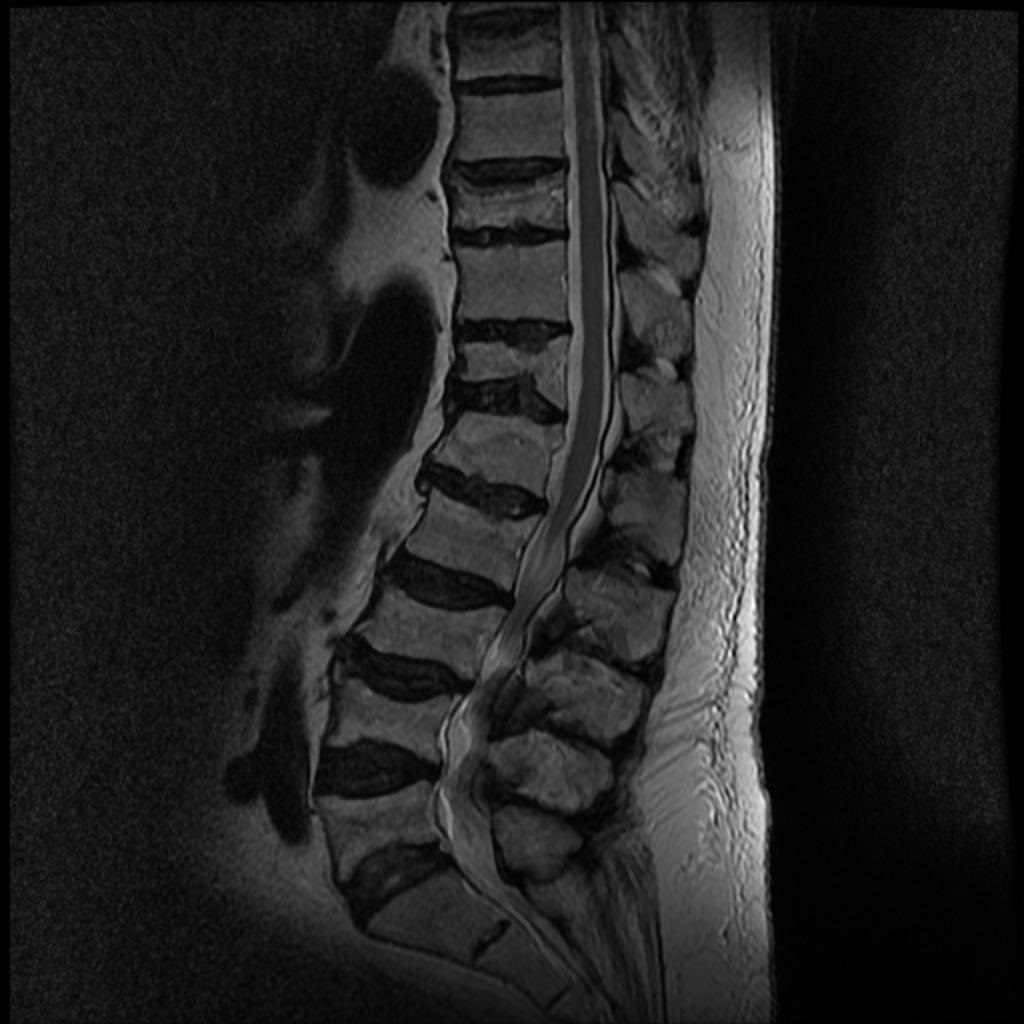

MRI showing osteoporotic fractures of the 10th and 12th thoracic vertebrae.
+PassMedicine Notes
The National Osteoporosis Guideline Group (NOGG) updated their guidelines in 2021. NICE guidelines also have a section on the management of osteoporosis, largely based on the NOGG guidelines. Remember that osteporosis is usually asymptomatic until a fracture occurs. When thinking about osteoporosis management it is useful to think about a number of potential clinical scenarios:
- a patient who has been identified as being at high risk of a fragility fracture based on a QFracture or FRAX score (please see the textbook entry on 'Osteoporosis: assessing risk')
- a patient who is about to start treatment that puts them at significant risk of developing osteoporosis - the most common example is longer-term glucocorticoids
- a patient who has just had a fragility fracture e.g. a symptomatic osteoporotic vertebral fracture
General management points
General points about the management of all patients- all patients who are at risk of osteoporosis or have osteoporosis should be given advice regarding:
- lifestyle changes: a healthy, balanced diet, moderation of alcohol consumption and avoidance of smoking
- a sufficient dietary calcium and vitamin D intake: supplementation should be offered to all women unless the clinician is confident they have adequate calcium intake and are vitamin D replete
- encourage a combination of regular weight-bearing and muscle strengthening exercise
- secondary causes of osteoporosis should be considered and treated
- e.g. hypogonadism in women or men e.g. hormone replacement therapy for premature menopause
- bisphosphonates are the first-line drug treatment for patients at risk of fragility fractures
- oral bisphosphonates such as alendronate and risedronate are typically first-line. These are often taken weekly are need taking in a particular way to minimise the risk of oesophageal side-effects
- however, the NOGG recommend IV zoledronate as the first-line treatment following a hip fracture. This is given yearly
- denosumab is generally used as a second-line treatment
- other possible treatment options include:
- strontium ranelate
- raloxifene
- teriparatide
- romosozumab
Clinical scenarios
Fragility risk fracture assessment- if a patient is deemed high-risk based on a QFracture or FRAX score they should have a DEXA scan to assess bone mineral density (BMD)
- the BMD threshold for defining osteoporosis is a T-score of - 2.5 SD or below
- some patients may not be suitable for BMD assessment due to frailty etc.
- general osteoporosis management as above
- oral bisphosphonates are used first-line e.g. alendronate or risedronate
- if starting ≥7.5 mg/day prednisolone or equivalent for the next 3 months, start bone protective treatment at the same time
- general osteoporosis management as above
- don't wait for a DEXA scan before starting treatment
- oral bisphosphonates are used first-line e.g. alendronate or risedronate
- general osteoporosis management as above
- start treatment straight away - oral bisphosphonates are used first-line e.g. alendronate or risedronate
- in older adults a hip fracture is a manifestation of osteoporosis
- following a fragility fracture in women ≥ 75 years, a DEXA scan is not necessary to diagnose osteoporosis and hence commence a bisphosphonate
- BMD should be measured, but this acts as a baseline rather than determining whether treatment should be given
- bisphosphonates should be given first-line
- NOGG recommends IV zoledronate but local guidelines may vary and oral bisphosphonates are often used
Follow-up
Plan to prescribe oral bisphosphonates for at least 5 years, or intravenous bisphosphonates for at least 3 years and then re-assess fracture risk.
Supplementary notes on treatment
Bisphosphonates- bisphosphonates bind to hydroxyapatite in bone, inhibiting osteoclast-mediated bone resorption
- common side effects include gastrointestinal discomfort, oesophagitis, and hypocalcaemia. Atypical femoral fractures and osteonecrosis of the jaw are rare but serious risks.
- available in oral and intravenous formulations. Oral bisphosphonates should be taken with a full glass of water, on an empty stomach, and the patient should remain upright for at least 30 minutes afterwards.
- human monoclonal antibody that inhibits RANK ligand, which in turn inhibits the maturation of osteoclasts
- also used for cancer patients with bone metastases to reduce skeletal-related events.
- given as a single subcutaneous injection every 6 months
- selective oestrogen receptor modulator (SERM)
- has been shown to prevent bone loss and to reduce the risk of vertebral fractures, but has not yet been shown to reduce the risk of non-vertebral fractures
- has been shown to increase bone density in the spine and proximal femur
- may worsen menopausal symptoms
- increased risk of thromboembolic events
- may decrease the risk of breast cancer
- 'dual action bone agent' - increases deposition of new bone by osteoblasts (promotes differentiation of pre-osteoblast to osteoblast) and reduces the resorption of bone by inhibiting osteoclasts
- concerns regarding the safety profile of strontium have been raised recently. It should only be prescribed by a specialist in secondary care
- due to these concerns the European Medicines Agency in 2014 said it should only be used by people for whom there are no other treatments for osteoporosis
- increased risk of cardiovascular events: any history of cardiovascular disease or significant risk of cardiovascular disease is a contraindication
- increased risk of thromboembolic events: a Drug Safety Update in 2012 recommended it is not used in patients with a history of venous thromboembolism
- may cause serious skin reactions such as Stevens Johnson syndrome
- recombinant form of parathyroid hormone
- very effective at increasing bone mineral density but role in the management of osteoporosis yet to be clearly defined
- a monoclonal antibody that inhibits sclerostin, thereby increasing bone formation and decreasing bone resorption
- this dual action significantly improves bone density and reduces fracture risk.