Highlighter is on. Drag to highlight text. Click a highlight to remove it.
ALL / Cardiology
Aortic dissection: features and classification
Aortic dissection: features and classification
Aortic dissection is a rare but serious cause of chest pain.Pathophysiology
- tear in the tunica intima of the wall of the aorta
Associations
- hypertension: the most important risk factor
- trauma
- bicuspid aortic valve
- collagens: Marfan's syndrome, Ehlers-Danlos syndrome
- Turner's and Noonan's syndrome
- pregnancy
- syphilis
Features:
- chest/back pain
- typically severe and 'sharp', 'tearing' in nature
- pain is typically maximal at onset
- classically chest pain is more common in type A dissection and upper back pain is more common in type B dissection. However, there is considerable overlap and both chest and back pain are present in many patients
- pulse deficit
- weak or absent carotid, brachial, or femoral pulse
- variation (>20 mmHg) in systolic blood pressure between the arms
- aortic regurgitation
- hypertension
- other features may result from the involvement of specific arteries. For example:
- coronary arteries → angina
- spinal arteries → paraplegia
- distal aorta → limb ischaemia
- the majority of patients have no or non-specific ECG changes. In a minority of patients, ST-segment elevation may be seen in the inferior leads
Classification
Stanford classification
- type A - ascending aorta, 2/3 of cases
- type B - descending aorta, distal to left subclavian origin, 1/3 of cases
DeBakey classification
- type I - originates in ascending aorta, propagates to at least the aortic arch and possibly beyond it distally
- type II - originates in and is confined to the ascending aorta
- type III - originates in descending aorta, rarely extends proximally but will extend distally
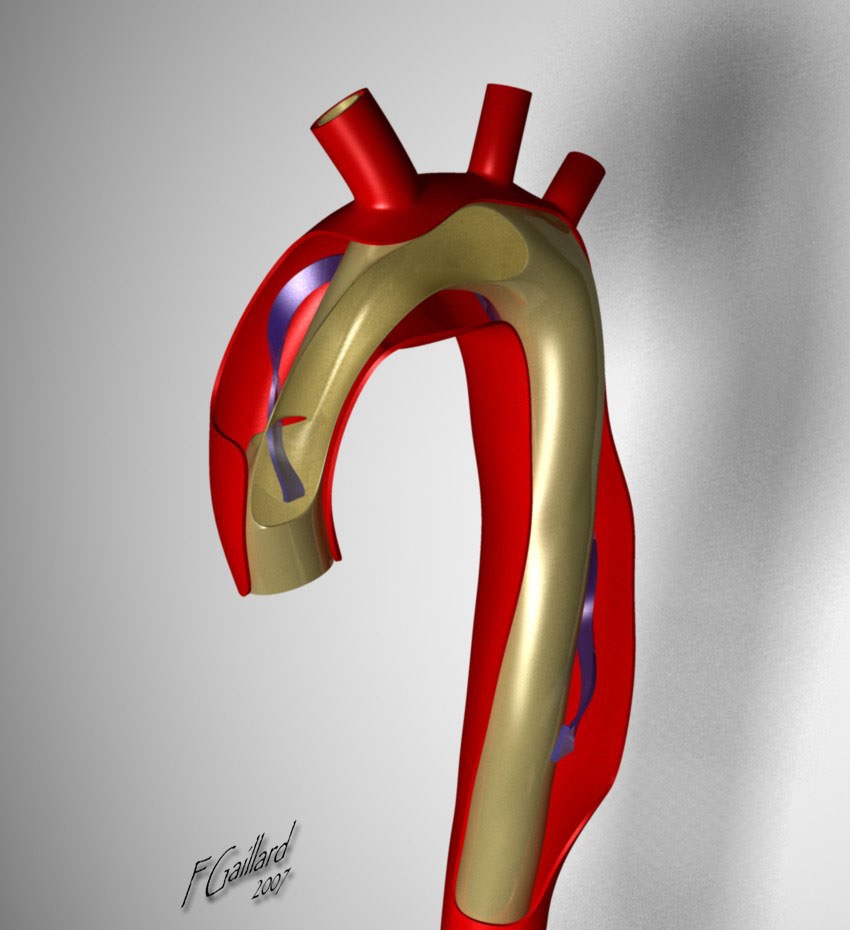
Stanford type A / DeBakey type I
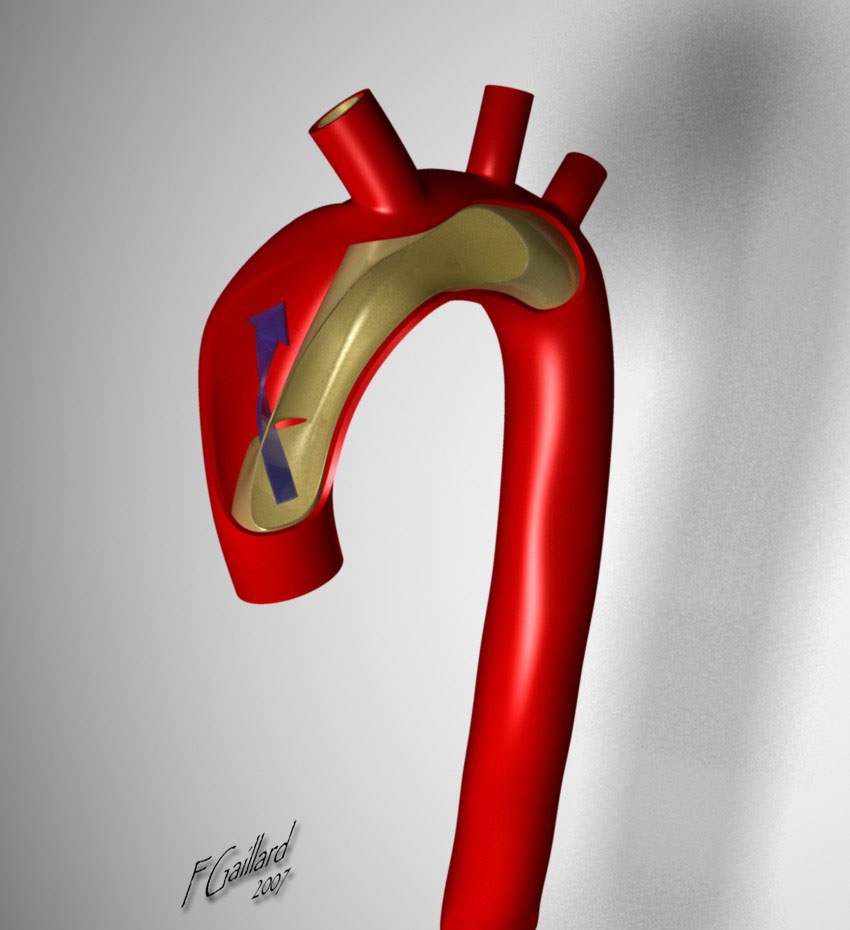
Stanford type A / DeBakey type II
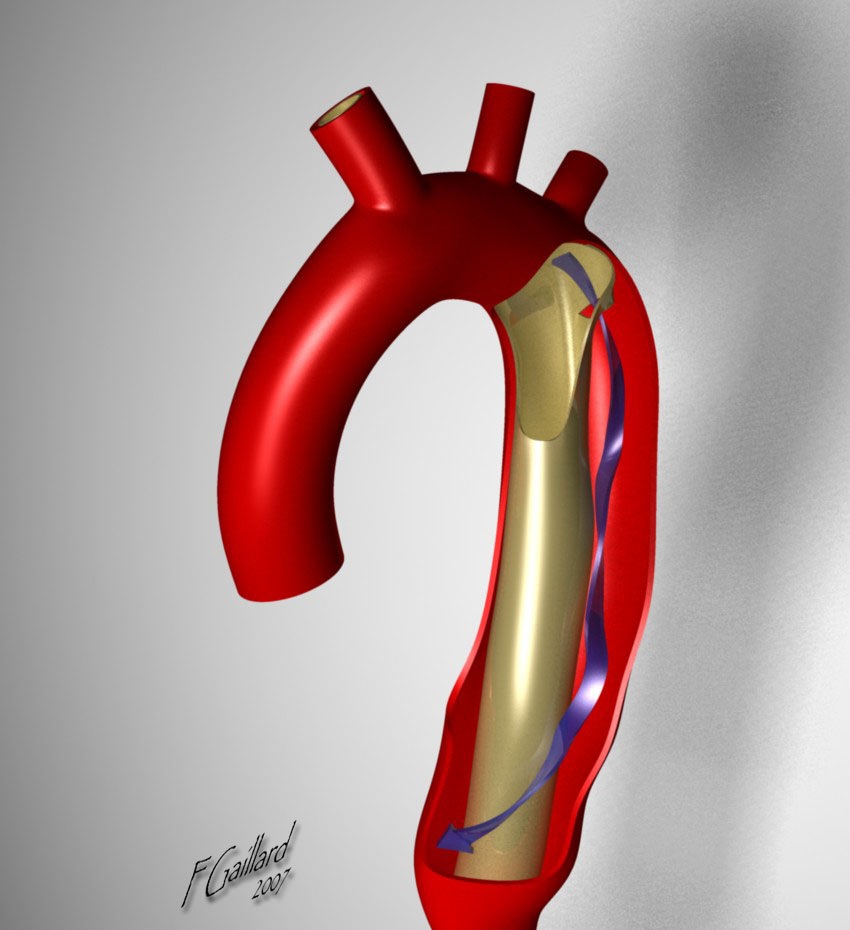
Stanford type B / DeBakey type III
+PassMedicine Notes
Aortic dissection is a rare but serious cause of chest pain.
Pathophysiology- tear in the tunica intima of the wall of the aorta
- hypertension: the most important risk factor
- trauma
- bicuspid aortic valve
- collagens: Marfan's syndrome, Ehlers-Danlos syndrome
- Turner's and Noonan's syndrome
- pregnancy
- syphilis
- chest/back pain
- typically severe and 'sharp', 'tearing' in nature
- pain is typically maximal at onset
- classically chest pain is more common in type A dissection and upper back pain is more common in type B dissection. However, there is considerable overlap and both chest and back pain are present in many patients
- pulse deficit
- weak or absent carotid, brachial, or femoral pulse
- variation (>20 mmHg) in systolic blood pressure between the arms
- aortic regurgitation
- hypertension
- other features may result from the involvement of specific arteries. For example:
- coronary arteries --> angina
- spinal arteries --> paraplegia
- distal aorta --> limb ischaemia
- the majority of patients have no or non-specific ECG changes. In a minority of patients, ST-segment elevation may be seen in the inferior leads
Classification
Stanford classification- type A - ascending aorta, 2/3 of cases
- type B - descending aorta, distal to left subclavian origin, 1/3 of cases
- type I - originates in ascending aorta, propagates to at least the aortic arch and possibly beyond it distally
- type II - originates in and is confined to the ascending aorta
- type III - originates in descending aorta, rarely extends proximally but will extend distally