Highlighter is on. Drag to highlight text. Click a highlight to remove it.
ALL / Respiratory Medicine
Pneumothorax: management
Pneumothorax: management
The British Thoracic Society (BTS) published updated guidelines for the management of spontaneous pneumothorax in 2023.The updated guidelines put less emphasis on the size of the pneumothorax and more emphasis on whether the patient is symptomatic and the presence of high-risk characteristics.
Decision algorithm
The first step is assessing whether the patient is symptomatic
- the BTS define minimal symptoms as 'no significant pain or breathlessness and no physiological compromise'
- no or minimal symptoms → conservative care, regardless of pneumothorax size
- symptomatic → assess for high-risk characteristics
If a pneumothorax is symptomatic, the next step is assessment for high-risk characteristics
- high-risk characteristics are defined as follows:
- haemodynamic compromise (suggesting a tension pneumothorax)
- significant hypoxia
- bilateral pneumothorax
- underlying lung disease
- ≥ 50 years of age with significant smoking history
- haemothorax
- if no high-risk characteristics are present, and it is safe to intervene, then there is a choice of intervention:
- conservative care
- ambulatory device
- needle aspiration
- if high-risk characteristics are present, and it is safe to intervene → chest drain
How is safety or intervention determined?
- before a needle aspiration/chest drain insertion, the safety of intervention should be assessed
- this depends on the clinical context, but is usually:
- 2cm laterally or apically on chest x-ray, or
- any size on CT scan which can be safely accessed with radiological support
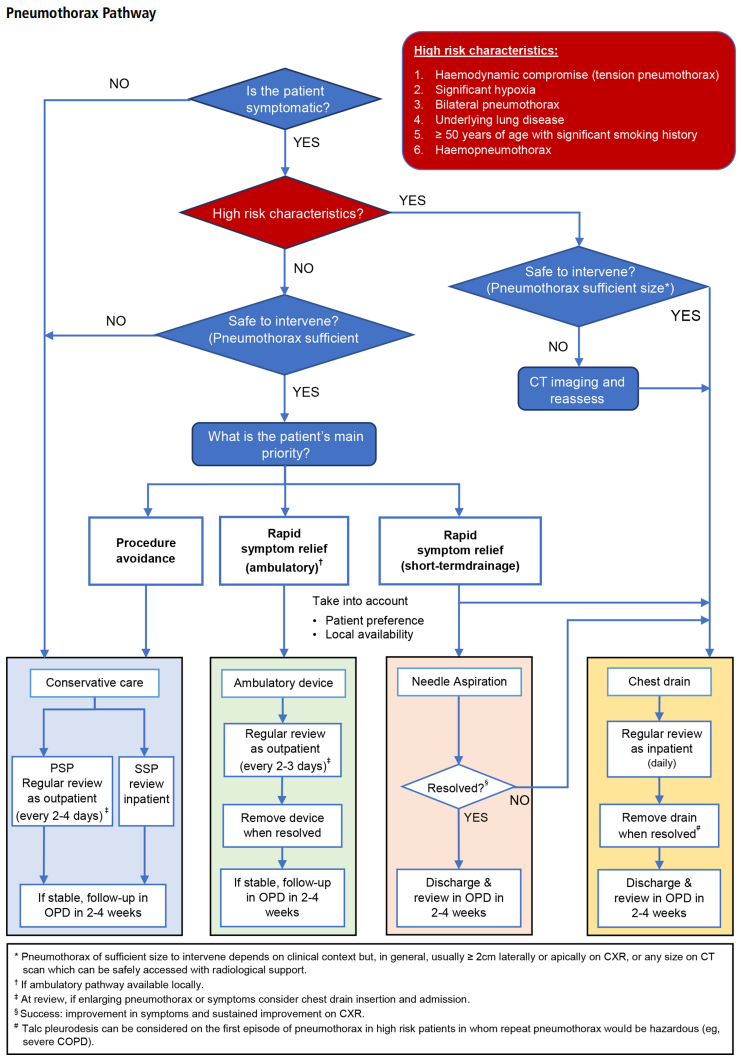
BTS algorithm on the management of spontaneous pneumothorax
Management options
Conservative care
- patients with a primary spontaneous pneumothorax that is managed conservatively should be reviewed every 2-4 days as an outpatient
- patients with a secondary spontaneous pneumothorax that is managed conservatively should be monitored as an inpatient
- if stable, follow-up in the outpatients department in 2-4 weeks
Ambulatory care
- an example of an ambulatory device is the Rocketµ Pleural Vent„
- it includes an 8FG catheter mounted on an 18G needle and a pigtail catheter to minimize the risk of occlusion
- ambulatory devices typically have a one-way valve and vent to prevent air and fluid return to the pleural space while allowing for controlled escape of air and drainage of fluid
- many devices also have an indication diaphragm that signals when the catheter tip enters the pleural space and continues to fluctuate with respiration, aiding in the assessment of pneumothorax resolution
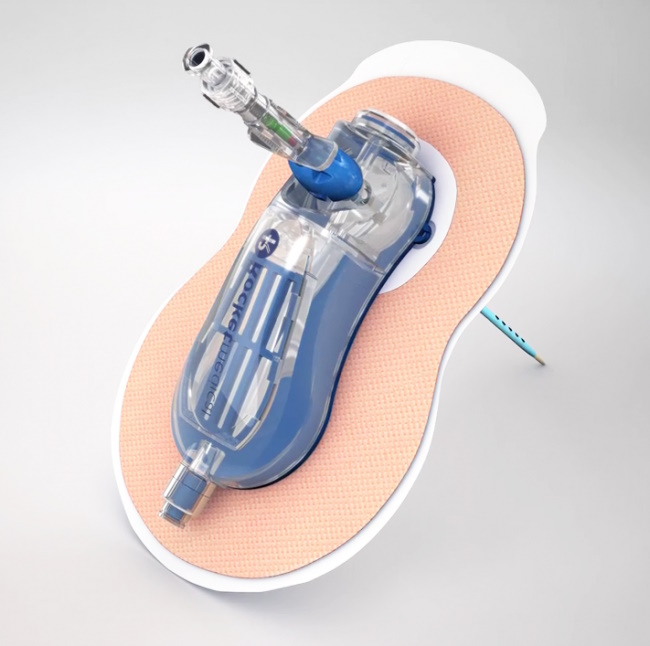
Example of an ambulatory care device to manage pneumothorax
Needle aspiration
- a chest drain should be inserted if needle aspiration of a pneumothorax is unsuccessful
- if resolved, discharge and follow-up in the outpatients department in 2-4 weeks
Chest drain insertion
- daily review as an inpatient
- remove drain when resolved
- discharge and follow-up in the outpatients department in 2-4 weeks
Persistentent / recurrent pneumothorax
If a patient has a persistent air leak or insufficient lung reexpansion despite chest drain insertion, or the patient has recurrent pneumothoraces, then video-assisted thoracoscopic surgery (VATS) should be considered to allow for mechanical/chemical pleurodesis +/- bullectomy.
Discharge advice
Smoking
- patients should be advised to avoid smoking to reduce the risk of further episodes - the lifetime risk of developing a pneumothorax in healthy smoking men is around 10% compared with around 0.1% in non-smoking men
Fitness to fly
- absolute contraindication, the CAA suggest patients may travel 2 weeks after successful drainage if there is no residual air. The British Thoracic Society used to recommend not travelling by air for a period of 6 weeks but this has now been changed to 1 week post check x-ray
Scuba diving
- the BTS guidelines state: 'Diving should be permanently avoided unless the patient has undergone bilateral surgical pleurectomy and has normal lung function and chest CT scan postoperatively.'
Image gallery
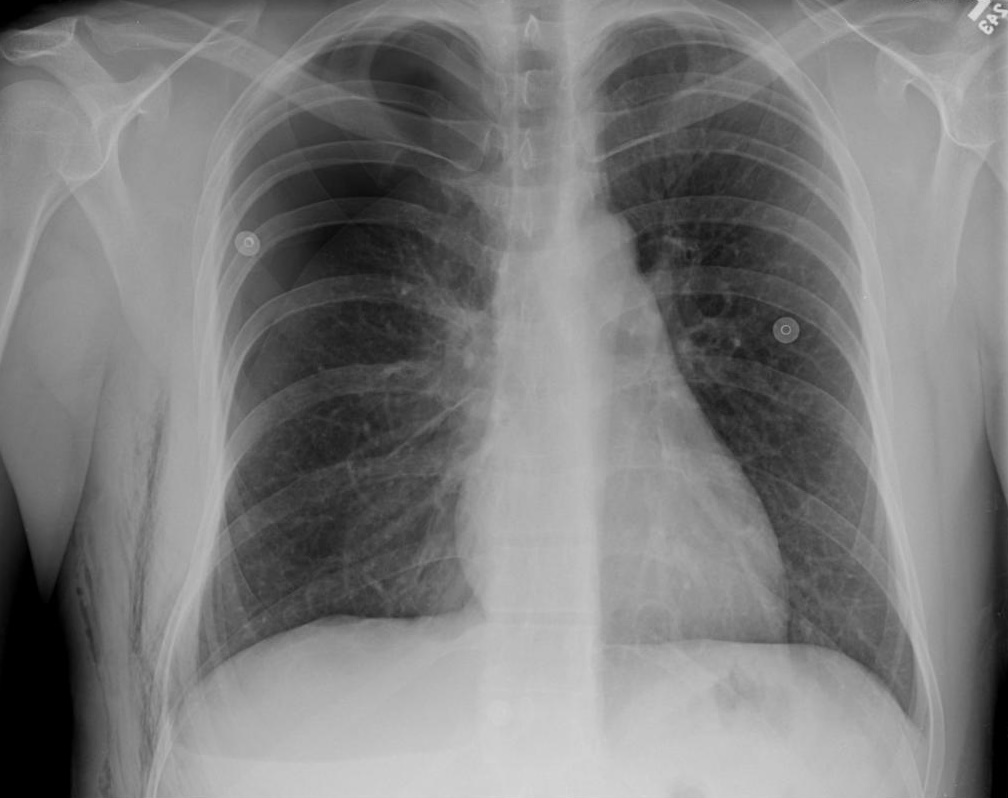
Right-sided pneumothorax. Note how the lung markers do not extend all the way to the periphery, with a pleural line seen.
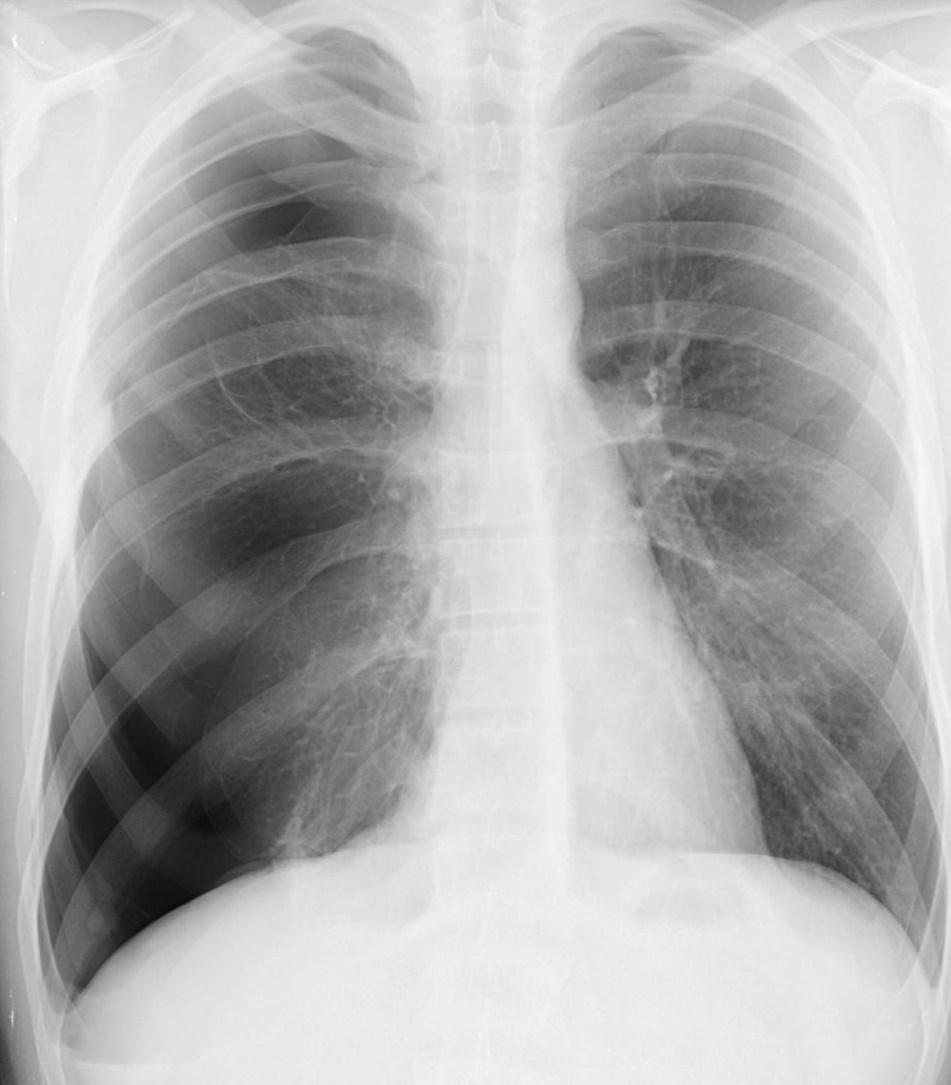
Right-sided pneumothorax. Lung markings not present in the periphery. There is no mediastinal shift in this film.
+PassMedicine Notes
The British Thoracic Society (BTS) published updated guidelines for the management of spontaneous pneumothorax in 2023.
The updated guidelines put less emphasis on the size of the pneumothorax and more emphasis on whether the patient is symptomatic and the presence of high-risk characteristics.
Decision algorithm
The first step is assessing whether the patient is symptomatic- the BTS define minimal symptoms as 'no significant pain or breathlessness and no physiological compromise'
- no or minimal symptoms --> conservative care, regardless of pneumothorax size
- symptomatic --> assess for high-risk characteristics
- high-risk characteristics are defined as follows:
- haemodynamic compromise (suggesting a tension pneumothorax)
- significant hypoxia
- bilateral pneumothorax
- underlying lung disease
- ≥ 50 years of age with significant smoking history
- haemothorax
- if no high-risk characteristics are present, and it is safe to intervene, then there is a choice of intervention:
- conservative care
- ambulatory device
- needle aspiration
- if high-risk characteristics are present, and it is safe to intervene --> chest drain
- before a needle aspiration/chest drain insertion, the safety of intervention should be assessed
- this depends on the clinical context, but is usually:
- 2cm laterally or apically on chest x-ray, or
- any size on CT scan which can be safely accessed with radiological support
Management options
Conservative care- patients with a primary spontaneous pneumothorax that is managed conservatively should be reviewed every 2-4 days as an outpatient
- patients with a secondary spontaneous pneumothorax that is managed conservatively should be monitored as an inpatient
- if stable, follow-up in the outpatients department in 2-4 weeks
- an example of an ambulatory device is the Rocketµ Pleural Vent„
- it includes an 8FG catheter mounted on an 18G needle and a pigtail catheter to minimize the risk of occlusion
- ambulatory devices typically have a one-way valve and vent to prevent air and fluid return to the pleural space while allowing for controlled escape of air and drainage of fluid
- many devices also have an indication diaphragm that signals when the catheter tip enters the pleural space and continues to fluctuate with respiration, aiding in the assessment of pneumothorax resolution
- a chest drain should be inserted if needle aspiration of a pneumothorax is unsuccessful
- if resolved, discharge and follow-up in the outpatients department in 2-4 weeks
- daily review as an inpatient
- remove drain when resolved
- discharge and follow-up in the outpatients department in 2-4 weeks
Persistentent / recurrent pneumothorax
If a patient has a persistent air leak or insufficient lung reexpansion despite chest drain insertion, or the patient has recurrent pneumothoraces, then video-assisted thoracoscopic surgery (VATS) should be considered to allow for mechanical/chemical pleurodesis +/- bullectomy.
Discharge advice
Smoking- patients should be advised to avoid smoking to reduce the risk of further episodes - the lifetime risk of developing a pneumothorax in healthy smoking men is around 10% compared with around 0.1% in non-smoking men
- absolute contraindication, the CAA suggest patients may travel 2 weeks after successful drainage if there is no residual air. The British Thoracic Society used to recommend not travelling by air for a period of 6 weeks but this has now been changed to 1 week post check x-ray
- the BTS guidelines state: 'Diving should be permanently avoided unless the patient has undergone bilateral surgical pleurectomy and has normal lung function and chest CT scan postoperatively.'