Highlighter is on. Drag to highlight text. Click a highlight to remove it.
ALL / Cardiology
Ventricular tachycardia: management
Ventricular tachycardia: management
Whilst a broad complex tachycardia may result from a supraventricular rhythm with aberrant conduction, the European Resuscitation Council advise that in a peri-arrest situation it is assumed to be ventricular in originIf the patient has adverse signs (systolic BP < 90 mmHg, chest pain, heart failure, syncope) then immediate cardioversion is indicated. In the absence of such signs antiarrhythmics may be used. If these fail, then electrical cardioversion may be needed with synchronised DC shocks.
Drug therapy
- amiodarone: ideally administered through a central line
- lidocaine: use with caution in severe left ventricular impairment
- procainamide
Verapamil should NOT be used in VT.
If drug therapy fails
- electrophysiological study (EPS)
- implant able cardioverter-defibrillator (ICD) - this is particularly indicated in patients with significantly impaired LV function
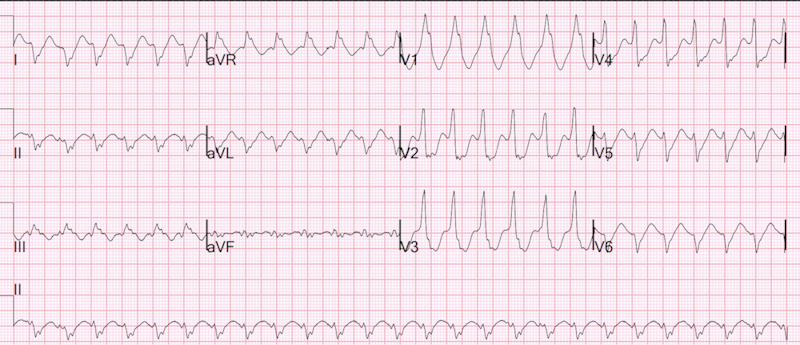
This ECG shows a broad-complex tachycardia at ~180 bpm with no visible P waves, regular rhythm, and QRS morphology not consistent with typical bundle branch block. This is ventricular tachycardia (VT) until proven otherwise. © Image used on license from Dr Smith, University of Minnesota
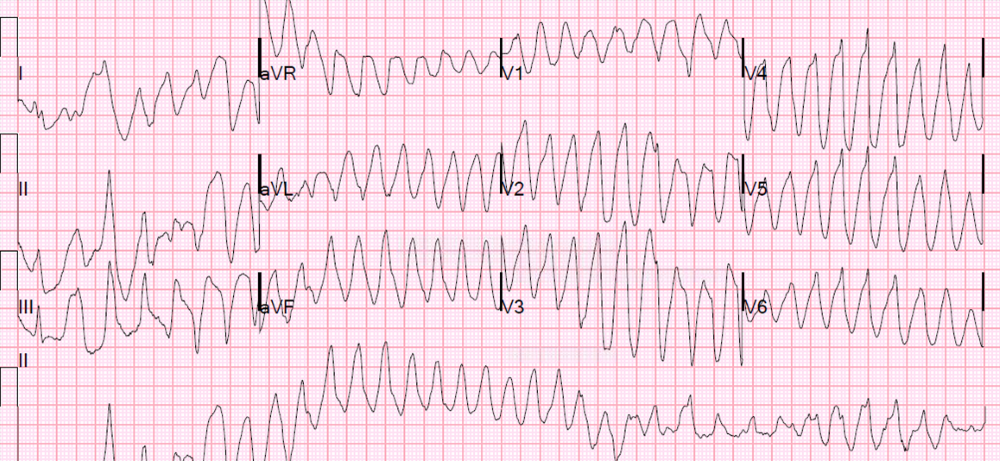
Polymorphic VT - © Image used on license from Dr Smith, University of Minnesota
+PassMedicine Notes
Whilst a broad complex tachycardia may result from a supraventricular rhythm with aberrant conduction, the European Resuscitation Council advise that in a peri-arrest situation it is assumed to be ventricular in origin
If the patient has adverse signs (systolic BP < 90 mmHg, chest pain, heart failure, syncope) then immediate cardioversion is indicated. In the absence of such signs antiarrhythmics may be used. If these fail, then electrical cardioversion may be needed with synchronised DC shocks.
Drug therapy- amiodarone: ideally administered through a central line
- lidocaine: use with caution in severe left ventricular impairment
- procainamide
Verapamil should NOT be used in VT.
If drug therapy fails- electrophysiological study (EPS)
- implant able cardioverter-defibrillator (ICD) - this is particularly indicated in patients with significantly impaired LV function