Highlighter is on. Drag to highlight text. Click a highlight to remove it.
ALL / Ophthalmology
Posterior vitreous detachment
Posterior vitreous detachment
Posterior vitreous detachment is the separation of the vitreous membrane from the retina. This occurs due to natural changes to the vitreous fluid of the eye with ageing. Posterior vitreous detachment is a common condition that does not cause any pain or loss of vision. However, rarely the separation of the vitreous membrane can lead to tears and detachment of the retina. It is important to rule out retinal tears or retinal detachment in anyone with suspected posterior vitreous detachment, as they may result in permanent loss of vision.Epidemiology:
- Occur in over 75% of people over the age of 65
- More common in females
Risk factors:
- As people age, the vitreous fluid in the eye becomes less viscous, and thus, does not hold its shape as well. Therefore, it pulls the vitreous membrane away from the retina towards the centre of the eye.
- Highly myopic (near-sighted) patients are also at increased risk of developing posterior vitreous detachment earlier in life. This is because the myopic eye has a longer axial length than an emmetropic eye.
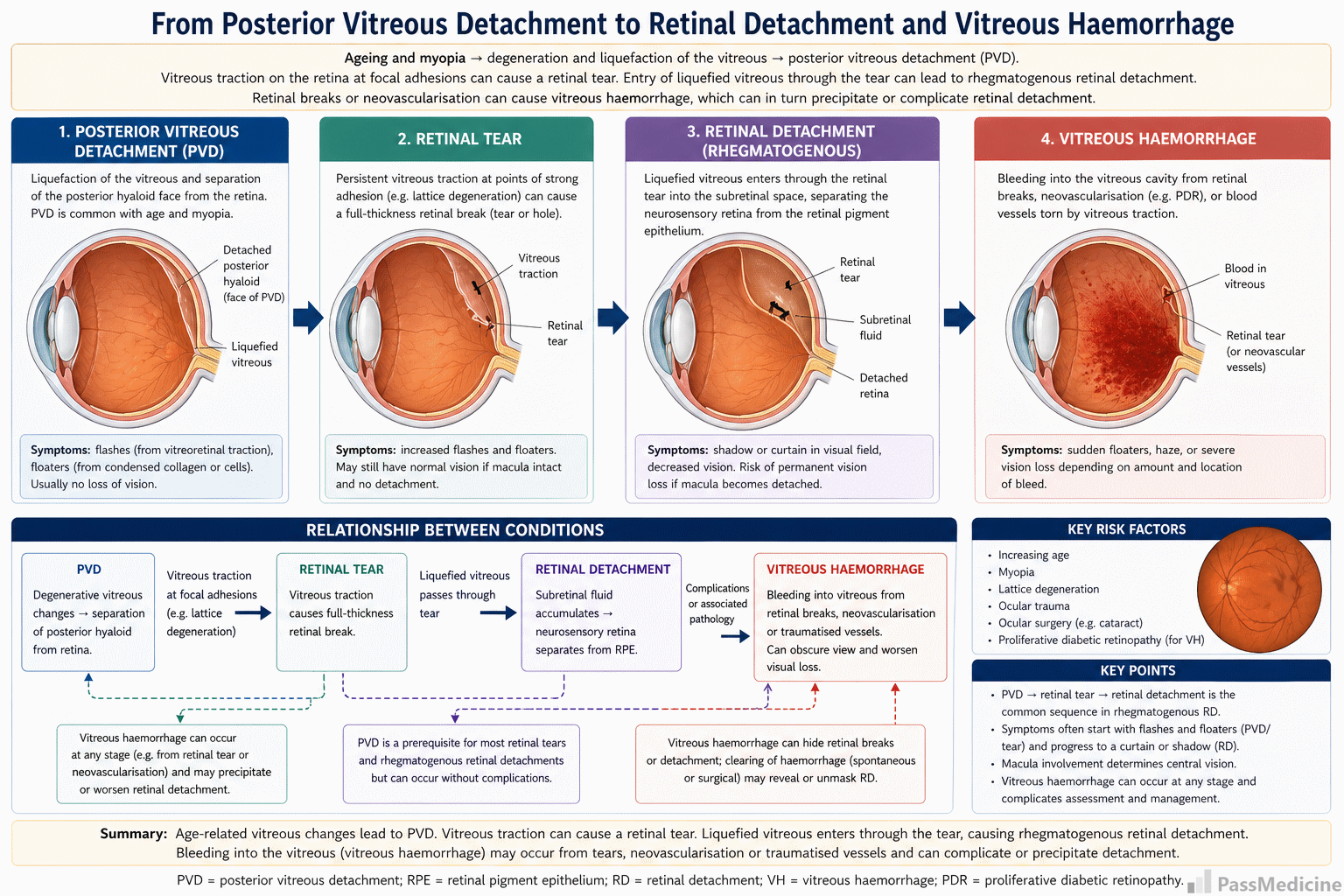
Relationship between posterior vitreous detachment, retinal detachment and vitreous haemorrhage
Symptoms:
- The sudden appearance of floaters (occasionally a ring of floaters temporal to central vision)
- Flashes of light in vision
- Blurred vision
- Cobweb across vision
- The appearance of a dark curtain descending down vision (means that there is also retinal detachment)
Signs:
- Weiss ring on ophthalmoscopy (the detachment of the vitreous membrane around the optic nerve to form a ring-shaped floater).
Investigations:
- All patients with suspected vitreous detachment should be examined by an ophthalmologist within 24hours to rule out retinal tears or detachment.
Management:
- Posterior vitreous detachment alone does not cause any permanent loss of vision. Symptoms gradually improve over a period of around 6 months and therefore no treatment is necessary.
- If there is an associated retinal tear or detachment the patient will require surgery to fix this.
+PassMedicine Notes
Posterior vitreous detachment is the separation of the vitreous membrane from the retina. This occurs due to natural changes to the vitreous fluid of the eye with ageing. Posterior vitreous detachment is a common condition that does not cause any pain or loss of vision. However, rarely the separation of the vitreous membrane can lead to tears and detachment of the retina. It is important to rule out retinal tears or retinal detachment in anyone with suspected posterior vitreous detachment, as they may result in permanent loss of vision.
Epidemiology:- Occur in over 75% of people over the age of 65
- More common in females
- As people age, the vitreous fluid in the eye becomes less viscous, and thus, does not hold its shape as well. Therefore, it pulls the vitreous membrane away from the retina towards the centre of the eye.
- Highly myopic (near-sighted) patients are also at increased risk of developing posterior vitreous detachment earlier in life. This is because the myopic eye has a longer axial length than an emmetropic eye.
- The sudden appearance of floaters (occasionally a ring of floaters temporal to central vision)
- Flashes of light in vision
- Blurred vision
- Cobweb across vision
- The appearance of a dark curtain descending down vision (means that there is also retinal detachment)
- Weiss ring on ophthalmoscopy (the detachment of the vitreous membrane around the optic nerve to form a ring-shaped floater).
- All patients with suspected vitreous detachment should be examined by an ophthalmologist within 24hours to rule out retinal tears or detachment.
- Posterior vitreous detachment alone does not cause any permanent loss of vision. Symptoms gradually improve over a period of around 6 months and therefore no treatment is necessary.
- If there is an associated retinal tear or detachment the patient will require surgery to fix this.