Highlighter is on. Drag to highlight text. Click a highlight to remove it.
ALL / Clinical Sciences
Cranial nerves
Cranial nerves
The table below lists the major characteristics of the 12 cranial nerves:| Nerve | Functions | Clinical | Pathway/foramen |
|---|---|---|---|
| I (Olfactory) | Smell | Cribriform plate | |
| II (Optic) | Sight | Optic canal | |
| III (Oculomotor) | Eye movement (MR, IO, SR, IR) Pupil constriction Accomodation Eyelid opening | Palsy results in
| Superior orbital fissure (SOF) |
| IV (Trochlear) | Eye movement (SO) | Palsy results in defective downward gaze → vertical diplopia | SOF |
| V (Trigeminal) | Facial sensation Mastication | Lesions may cause:
| V1: SOF, V2: Foramen rotundum, V3: Foramen ovale |
| VI (Abducens) | Eye movement (LR) | Palsy results in defective abduction → horizontal diplopia | SOF |
| VII (Facial) | Facial movement Taste (anterior 2/3rds of tongue) Lacrimation Salivation | Lesions may result in:
| Internal auditory meatus |
| VIII (Vestibulocochlear) | Hearing, balance | Hearing loss Vertigo, nystagmus Acoustic neuromas are Schwann cell tumours of the cochlear nerve | Internal auditory meatus |
| IX (Glossopharyngeal) | Taste (posterior 1/3rd of tongue) Salivation Swallowing Mediates input from carotid body & sinus | Lesions may result in;
| Jugular foramen |
| X (Vagus) | Phonation Swallowing Innervates viscera | Lesions may result in;
| Jugular foramen |
| XI (Accessory) | Head and shoulder movement | Lesions may result in;
| Jugular foramen |
| XII (Hypoglossal) | Tongue movement | Tongue deviates towards side of lesion | Hypoglossal canal |
Some cranial nerves are motor, some sensory and some are both. The most useful mnemonic is given below.
CN I ----------------------------------------------------------------------→XII
Some Say Marry Money But My Brother Says Big Brains Matter Most
S = Sensory, M = Motor, B = Both
Some Say Marry Money But My Brother Says Big Brains Matter Most
S = Sensory, M = Motor, B = Both

View from the inferior surface of the brain showing the emergence of the cranial nerves
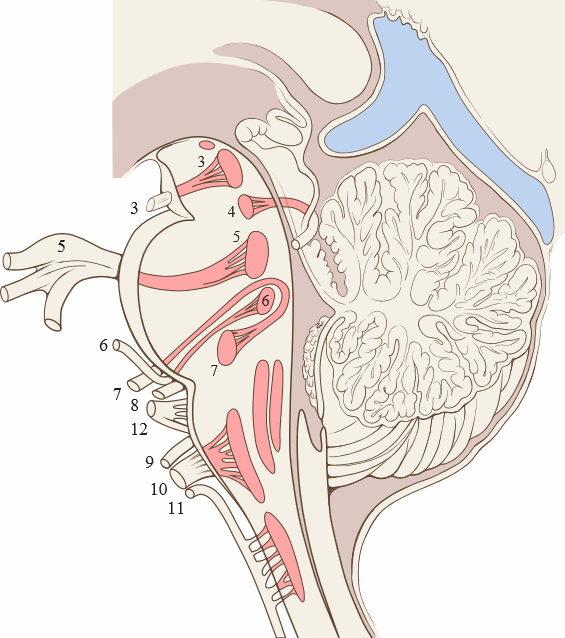

Diagram showing the nuclei of the cranial nerves in the brainstem
Cranial nerve reflexes
| Reflex | Afferent limb | Efferent limb |
|---|---|---|
| Corneal | Ophthalmic nerve (V1) | Facial nerve (VII) |
| Jaw jerk | Mandibular nerve (V3) | Mandibular nerve (V3) |
| Gag | Glossopharyngeal nerve (IX) | Vagal nerve (X) |
| Carotid sinus | Glossopharyngeal nerve (IX) | Vagal nerve (X) |
| Pupillary light | Optic nerve (II) | Oculomotor nerve (III) |
| Lacrimation | Ophthalmic nerve (V1) | Facial nerve (VII) |
+PassMedicine Notes
The table below lists the major characteristics of the 12 cranial nerves:
Nerve _ Functions _Clinical _ Pathway/foramen| I (Olfactory) _ Smell_ _ Cribriform plate| II (Optic) _ Sight_ _ Optic canal| III (Oculomotor) _ Eye movement (MR, IO, SR, IR) Pupil constriction Accomodation Eyelid opening_ Palsy results in- ptosis
- 'down and out' eye
- dilated, fixed pupil_Superior orbital fissure (SOF)|
- trigeminal neuralgia
- loss of corneal reflex (afferent)
- loss of facial sensation
- paralysis of mastication muscles
- deviation of jaw to weak side_ V1: SOF,
- flaccid paralysis of upper + lower face
- loss of corneal reflex (efferent)
- loss of taste
- hyperacusis_ Internal auditory meatus |
- hypersensitive carotid sinus reflex
- loss of gag reflex (afferent)_ Jugular foramen |
- uvula deviates away from site of lesion
- loss of gag reflex (efferent)_ Jugular foramen|
- weakness turning head to contralateral side_ Jugular foramen |
Some cranial nerves are motor, some sensory and some are both. The most useful mnemonic is given below.
CN I ------------------------------------------------------------------------>XII
Some Say Marry Money But My Brother Says Big Brains Matter Most
S = Sensory, M = Motor, B = Both
swb018.png View from the inferior surface of the brain showing the emergence of the cranial nerves swb019.png Diagram showing the nuclei of the cranial nerves in the brainstem