Highlighter is on. Drag to highlight text. Click a highlight to remove it.
ALL / Haematology
Hereditary spherocytosis
Hereditary spherocytosis
Hereditary spherocytosis is the most common hereditary haemolytic anaemia in people of northern European descent.Pathophysiology
- autosomal dominant mutations affecting proteins that anchor the cytoskeleton to the plasma membrane e.g. spectrin
- the normal biconcave disc shape is replaced by a sphere-shaped red blood cell
- red blood cell survival reduced as destroyed by the spleen
- spherocytes cannot deform adequately to traverse the splenic cords
- they become trapped and destroyed by splenic macrophages (extravascular haemolysis)
Presentation
- failure to thrive
- jaundice, gallstones
- splenomegaly
- aplastic crisis precipitated by parvovirus infection
- degree of haemolysis variable
- MCHC elevated
Diagnosis
- the osmotic fragility test was previously the recommend investigation of choice. However, it is now deemed unreliable and is no longer recommended
- the British Journal of Haematology (BJH) guidelines state that 'patients with a family history of HS, typical clinical features and laboratory investigations (spherocytes, raised mean corpuscular haemoglobin concentration [MCHC], increase in reticulocytes) do not require any additional tests
- if the diagnosis is equivocal the BJH recommend the EMA binding test and the cryohaemolysis test
- for atypical presentations electrophoresis analysis of erythrocyte membranes is the method of choice
Management
- acute haemolytic crisis:
- treatment is generally supportive
- transfusion if necessary
- longer term treatment:
- folate replacement
- splenectomy
Comparing G6PD deficiency to hereditary spherocytosis:
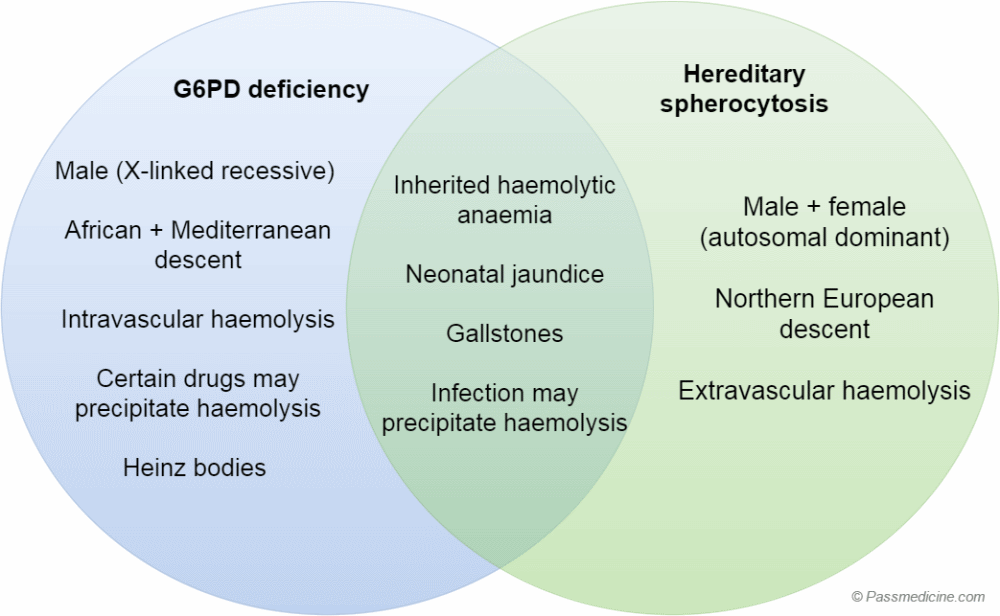
Comparison of G6PD deficiency to hereditary spherocytosis
| G6PD deficiency | Hereditary spherocytosis | |
|---|---|---|
| Gender | Male (X-linked recessive) | Male + female (autosomal dominant) |
| Ethnicity | African + Mediterranean descent | Northern European descent |
| Typical history | • Neonatal jaundice • Infection/drugs precipitate haemolysis • Gallstones | • Neonatal jaundice • Chronic symptoms although haemolytic crises may be precipitated by infection • Gallstones • Splenomegaly is common |
| Blood film | Heinz bodies | Spherocytes (round, lack of central pallor) |
| Diagnostic test | Measure enzyme activity of G6PD | EMA binding test |
+PassMedicine Notes
Hereditary spherocytosis is the most common hereditary haemolytic anaemia in people of northern European descent.
Pathophysiology- autosomal dominant mutations affecting proteins that anchor the cytoskeleton to the plasma membrane e.g. spectrin
- the normal biconcave disc shape is replaced by a sphere-shaped red blood cell
- red blood cell survival reduced as destroyed by the spleen
- spherocytes cannot deform adequately to traverse the splenic cords
- they become trapped and destroyed by splenic macrophages (extravascular haemolysis)
- failure to thrive
- jaundice, gallstones
- splenomegaly
- aplastic crisis precipitated by parvovirus infection
- degree of haemolysis variable
- MCHC elevated
- the osmotic fragility test was previously the recommend investigation of choice. However, it is now deemed unreliable and is no longer recommended
- the British Journal of Haematology (BJH) guidelines state that 'patients with a family history of HS, typical clinical features and laboratory investigations (spherocytes, raised mean corpuscular haemoglobin concentration [MCHC], increase in reticulocytes) do not require any additional tests
- if the diagnosis is equivocal the BJH recommend the EMA binding test and the cryohaemolysis test
- for atypical presentations electrophoresis analysis of erythrocyte membranes is the method of choice
- acute haemolytic crisis:
- treatment is generally supportive
- transfusion if necessary
- longer term treatment:
- folate replacement
- splenectomy
Comparing G6PD deficiency to hereditary spherocytosis:
pdd905.png Comparison of G6PD deficiency to hereditary spherocytosis _G6PD deficiency _ Hereditary spherocytosis| Gender _Male (X-linked recessive) _ Male + female (autosomal dominant)| Ethnicity _ African + Mediterranean descent_ Northern European descent| Typical history _ #-# Neonatal jaundice #-# Infection/drugs precipitate haemolysis #-# Gallstones _ #-# Neonatal jaundice #-# Chronic symptoms although haemolytic crises may be precipitated by infection #-# Gallstones #-# Splenomegaly is common| Blood film _Heinz bodies _ Spherocytes (round, lack of central pallor) | Diagnostic test _Measure enzyme activity of G6PD _ EMA binding test |