Highlighter is on. Drag to highlight text. Click a highlight to remove it.
ALL / Psychiatry
Tricyclic antidepressants
Tricyclic antidepressants
Tricyclic antidepressants (TCAs) are used less commonly now for depression due to their side-effects and toxicity in overdose. They are however used widely in the treatment of neuropathic pain, where smaller doses are typically required.The primary mechanism by which TCAs exert their antidepressant effects is through the inhibition of the reuptake of neurotransmitters
- Serotonin (5-HT): This neurotransmitter has a pivotal role in mood regulation. Inhibition of its reuptake leads to increased concentrations in the synaptic cleft, enhancing serotonergic neurotransmission.
- Noradrenaline (NA): Similar to 5-HT, blocking the reuptake of NA increases its synaptic cleft concentration, intensifying noradrenergic neurotransmission.
As well as 5-HT and NA, tricyclics interact with number of other receptors that contribute to their side-effect profile:
- antagonism of histamine receptors
- drowsiness
- antagonism of muscarinic receptors
- dry mouth
- blurred vision
- constipation
- urinary retention
- antagonism of adrenergic receptors
- postural hypotension
- lengthening of QT interval
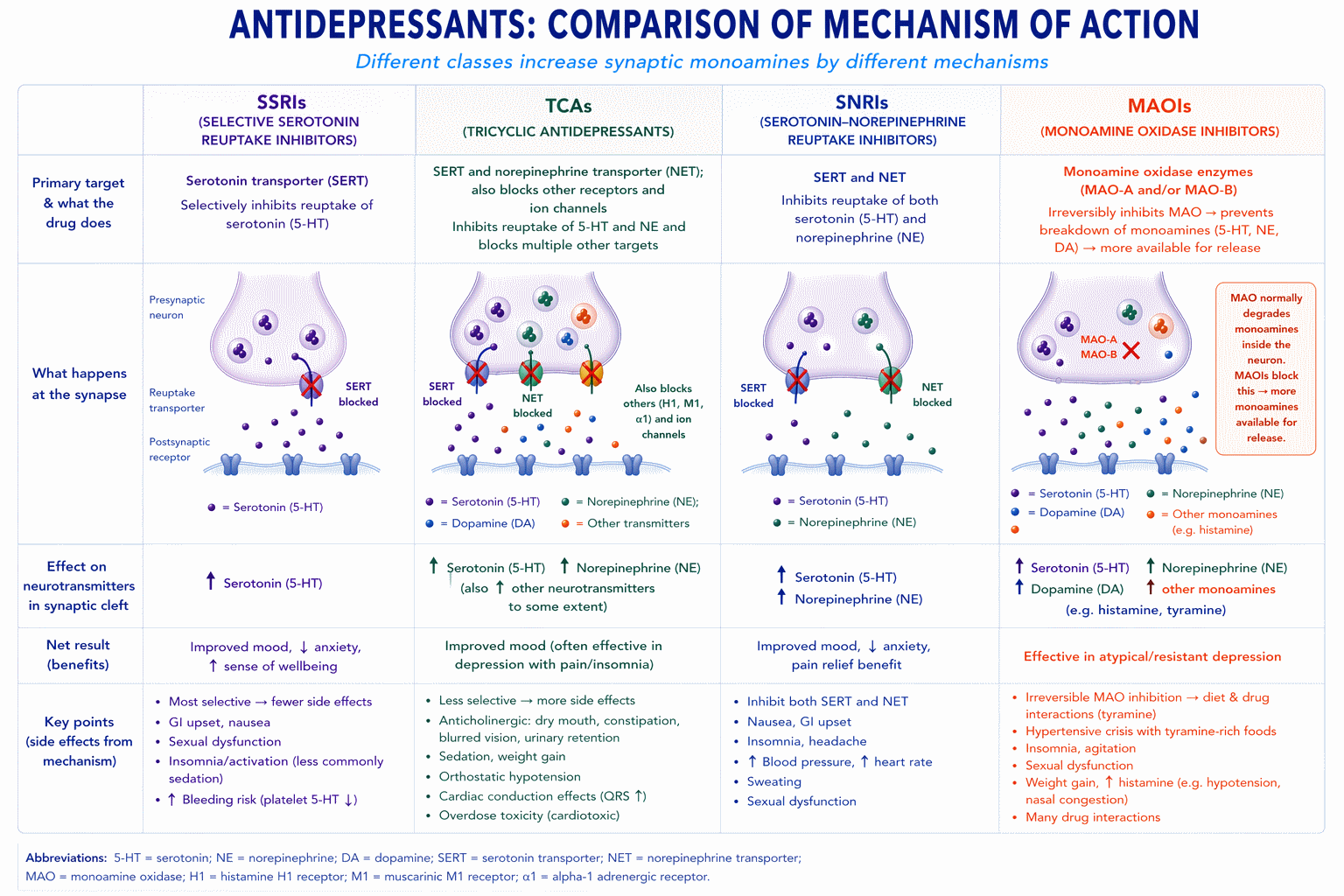
Mechanism of action of common antidepressants
Choice of tricyclic
- low-dose amitriptyline is commonly used in the management of neuropathic pain and the prophylaxis of headache (both tension and migraine)
- lofepramine has a lower incidence of toxicity in overdose
- amitriptyline and dosulepin (dothiepin) are considered the most dangerous in overdose
| More sedative | Less sedative |
|---|---|
| Amitriptyline Clomipramine Dosulepin Trazodone* | Imipramine Lofepramine Nortriptyline |
*trazodone is technically a 'tricyclic-related antidepressant'
+PassMedicine Notes
Tricyclic antidepressants (TCAs) are used less commonly now for depression due to their side-effects and toxicity in overdose. They are however used widely in the treatment of neuropathic pain, where smaller doses are typically required.
The primary mechanism by which TCAs exert their antidepressant effects is through the inhibition of the reuptake of neurotransmitters- Serotonin (5-HT): This neurotransmitter has a pivotal role in mood regulation. Inhibition of its reuptake leads to increased concentrations in the synaptic cleft, enhancing serotonergic neurotransmission.
- Noradrenaline (NA): Similar to 5-HT, blocking the reuptake of NA increases its synaptic cleft concentration, intensifying noradrenergic neurotransmission.
- antagonism of histamine receptors
- drowsiness
- antagonism of muscarinic receptors
- dry mouth
- blurred vision
- constipation
- urinary retention
- antagonism of adrenergic receptors
- postural hypotension
- lengthening of QT interval
- low-dose amitriptyline is commonly used in the management of neuropathic pain and the prophylaxis of headache (both tension and migraine)
- lofepramine has a lower incidence of toxicity in overdose
- amitriptyline and dosulepin (dothiepin) are considered the most dangerous in overdose
*trazodone is technically a 'tricyclic-related antidepressant'